Usually 120 to 150 years, though ancient magical suspension and sealed sanctuaries have allowed rare Mzekat to survive for centuries.
Darkvision
60 feet
Habitat
Underground sanctuaries, buried observatories, collapsed aqueducts, volcanic galleries, and hidden settlements beneath Elpine, the land the Mzekat called Mehet.
ancient civilization
underground
high magic
logic and scholarship
ruin survivor
Egyptian-inspired
Arabian-inspired
anti-necromantic
humanoid
SizeMedium
Speed25 feet
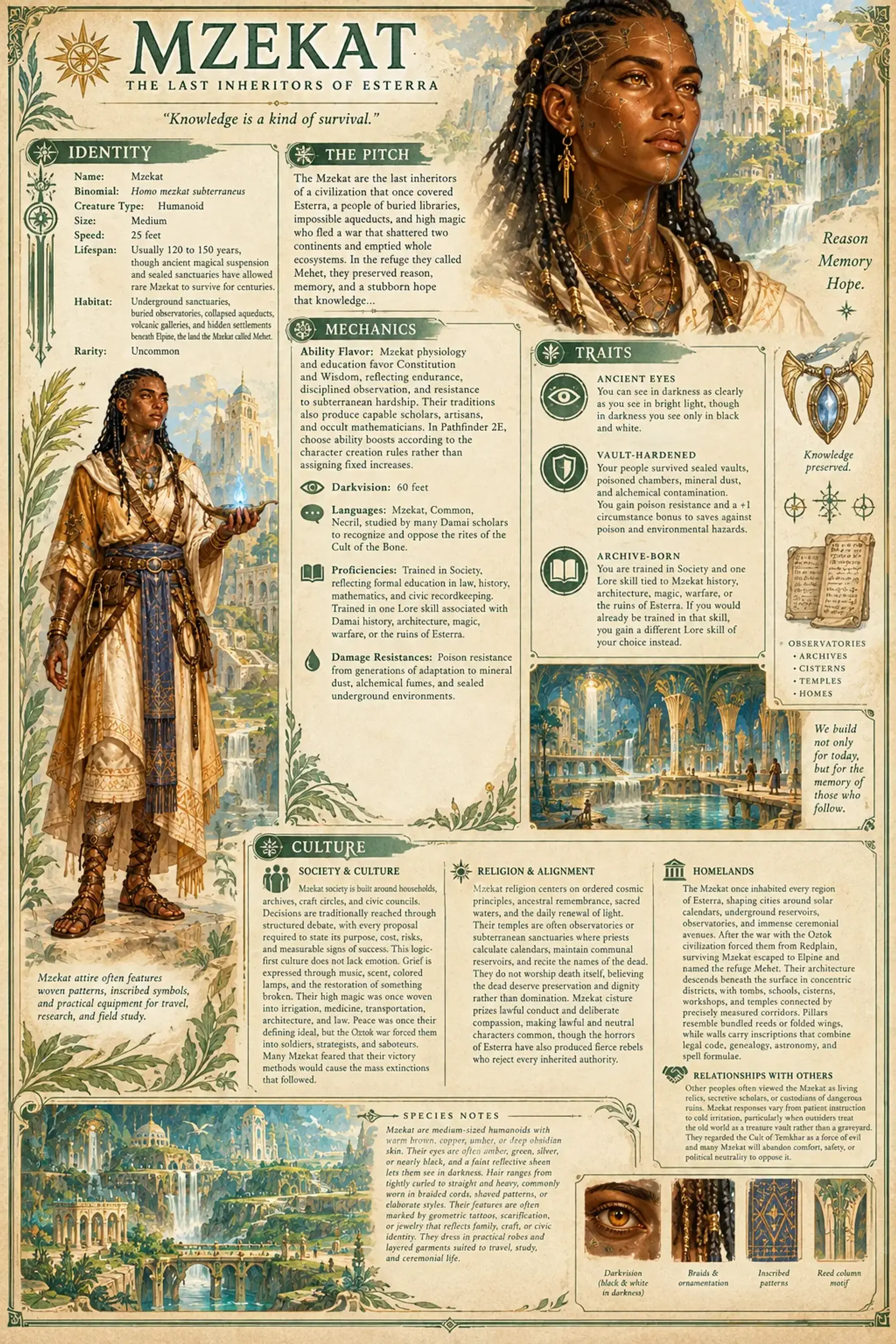
LifespanUsually 120 to 150 years, though ancient magical suspension and sealed sanctuaries have allowed rare Mzekat to survive for centuries.
Creature TypeHumanoid
Darkvision60 feet
The Mzekat are the last inheritors of a civilization that once covered Esterra, a people of buried libraries, impossible aqueducts, and high magic who fled a war that shattered two continents and emptied whole ecosystems. In the refuge they called Mehet, they preserved reason, memory, and a stubborn hope that knowledge might still repair what conquest destroyed.
Physical Description
Mzekat are medium-sized humanoids with warm brown, copper, umber, or deep obsidian skin. Their eyes are often amber, green, silver, or nearly black, and a faint reflective sheen lets them see in darkness. Hair ranges from tightly curled to straight and heavy, commonly worn in braided cords, shaved geometric patterns, or decorated coils. Many bear natural markings that resemble fine ink beneath the skin, especially along the hands, throat, and face. These patterns darken or shimmer near active magic. Their clothing favors layered linen, soft leather, woven mineral fibers, and fitted wraps designed for climbing through ruins. Jewelry is practical as well as symbolic, with scarabs, stars, measuring rods, eyes, and coiled serpents representing protection, inquiry, and continuity.
Society & Culture
Mzekat society is built around households, archives, craft circles, and civic councils. Decisions are traditionally reached through structured debate, with every proposal required to state its purpose, cost, risks, and measurable signs of success. This logic-first culture does not lack emotion. Grief is expressed through music, scent, colored lamps, and the restoration of something broken. Their high magic was once woven into irrigation, medicine, transportation, architecture, and law. Peace was once their defining ideal, but the Oztok war forced them to become soldiers, strategists, and saboteurs. Many Mzekat feared that their victory methods would cause the mass extinctions that followed.
Religion & Alignment
Mzekat religion centers on ordered cosmic principles, ancestral remembrance, sacred waters, and the daily renewal of light. Their temples are often observatories or subterranean sanctuaries where priests calculate calendars, maintain communal reservoirs, and recite the names of the dead. They do not worship death itself, believing the dead deserve preservation and dignity rather than domination. Mzekat culture prizes lawful conduct and deliberate compassion, making lawful and neutral characters common, though the horrors of Esterra have also produced fierce rebels who reject every inherited authority.
Homelands & Architecture
The Mzekat once inhabited every region of Esterra, shaping cities around solar calendars, underground reservoirs, observatories, and immense ceremonial avenues. After the war with the Oztok civilization forced them from Redplain, surviving Mzekat escaped to Elpine and named the refuge Mehet. Their architecture descends beneath the surface in concentric districts, with tombs, schools, cisterns, workshops, and temples connected by precisely measured corridors. Pillars resemble bundled reeds or folded wings, while walls carry inscriptions that combine legal code, genealogy, astronomy, and spell formulae.
Relationships With Other Peoples
Other peoples often viewed the Mzekat as living relics, secretive scholars, or custodians of dangerous ruins. Mzekat responses vary from patient instruction to cold irritation, particularly when outsiders treat the old world as a treasure vault rather than a graveyard. They regarded the Cult of Temkhar as a force of evil and many Mzekat will abandon comfort, safety, or political neutrality to oppose it.
Ready
Turn Mzekat into a sheet
A high-res, share-ready sheet you can post or print.