
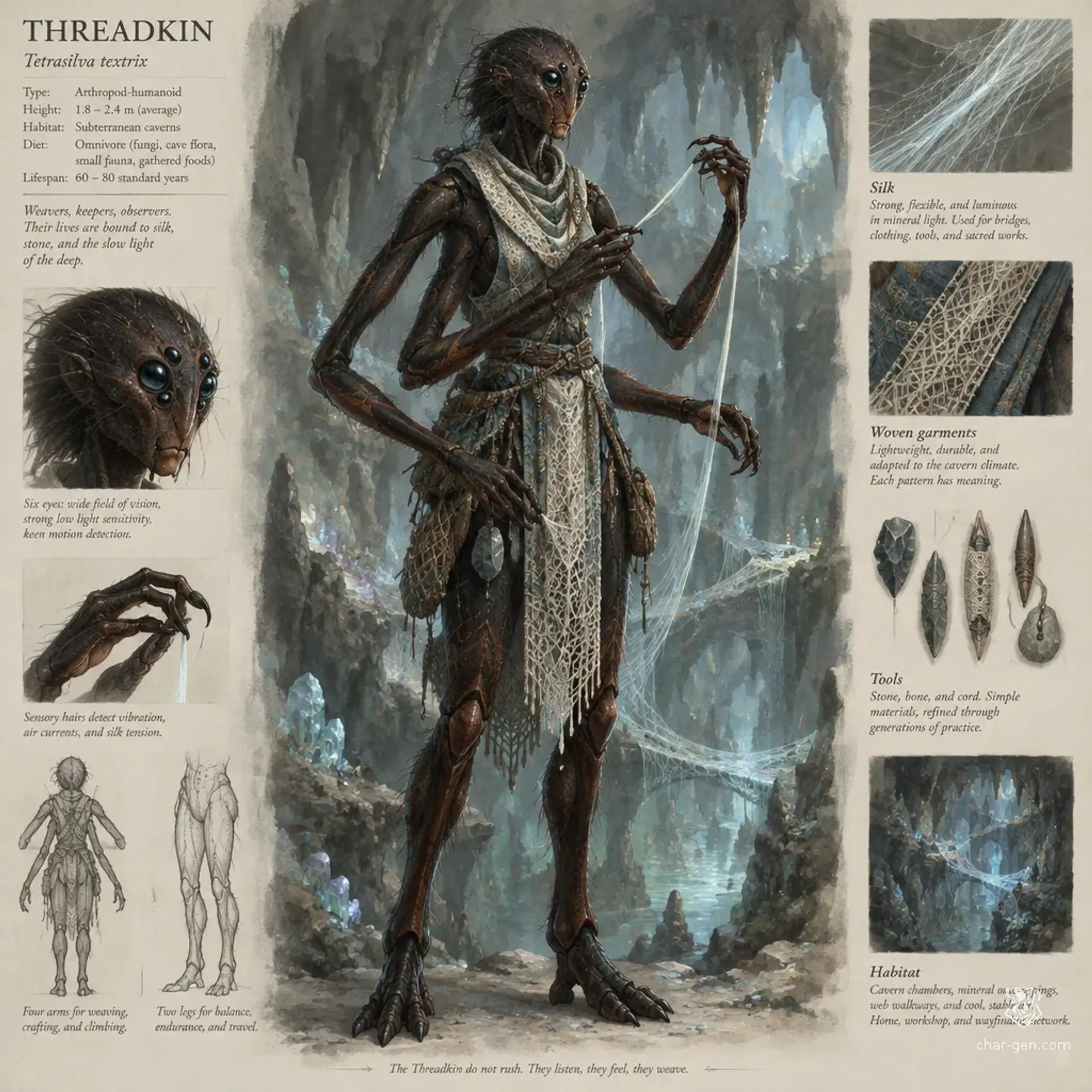
Araneanthropus subterraneus
Beneath the roads and roots, the Threadkin build living maps from silk, stone, and thought.
At a glance
Darkvision 120 ft.
Languages Common, Deep Speech
Height 5 ft. 6 in. to 6 ft. 6 in.
Weight 130 to 220 lb.
Lifespan 140 to 180 years, adult at 18
At the table
Your walking speed is 30 feet, and you have a climbing speed of 30 feet. You can climb difficult surfaces, including ceilings, without needing to make an ability check.
You have darkvision out to 120 feet. In that range, you see in dim light as if it were bright light and in darkness as if it were dim light, but you discern colors only as shades of gray.
You can communicate telepathically with one creature you can see within 30 feet of yourself, provided the creature understands at least one language. The creature can respond telepathically while the connection lasts. The connection ends if you or the creature moves beyond range. You can maintain this connection with only one creature at a time.
You can cast the Web spell once without a spell slot, requiring no material components. Intelligence, Wisdom, or Charisma is your spellcasting ability for this spell, chosen when you select this species. You regain the ability to cast it in this way when you finish a Long Rest. When you reach character level 5, you can also cast it using any spell slots you have of the appropriate level.
As a Magic action, you can burrow through nonmagical, loose earth or sand at a speed of 10 feet. You do not disturb the surface while moving, and you cannot burrow through solid rock. You can remain beneath the surface for a number of minutes equal to your proficiency bonus; at the end of that time, you emerge in the nearest unoccupied space above ground. Once you use this trait, you cannot use it again until you finish a Long Rest.
Common, Deep Speech
Their patient, subterranean way of life tends toward Constitution and Wisdom, though players assign any ability score increases as they wish.
Their silk is especially responsive to subtle movement, and their sensory hairs are unusually dense.
Tremorweavers excel as sentries and routefinders. They are known for maintaining vast warning webs that can distinguish a familiar neighbor from a falling stone.
Beneath the roads and roots, the Threadkin build living maps from silk, stone, and thought. They sense footsteps through walls, trade messages along strands no surface-dweller can see, and can open a passage through soft earth where others find only a dead end. Their communities prize patience and mutual reliance, but the same gifts that make them excellent guides can make them unsettling neighbors: a Threadkin may know you are coming before you know you have made a sound.
Threadkin are upright, spider-like humanoids with four long, jointed arms and two sturdy legs.
Their bodies are covered in fine sensory hairs, and their dark, close-fitting chitin ranges from charcoal and russet to muted blue or pearl gray. Most have six or eight small eyes adapted to low light, though the arrangement varies between families. Spinnerets beneath the abdomen produce strong, fine silk, while sensitive pads on their feet and palms let them read movement through stone and thread. Their faces are expressive, with flexible mouthparts capable of clear speech.
Underground caverns, deep fissures, and ancient tunnel networks
Children learn to read vibrations through their feet and are closely supervised near unmarked tunnels.
Most reach physical maturity in their late teens and are expected to undertake a solitary passage-finding journey.
Elders may lose some speed but often develop remarkable sensitivity to distant movement and thought.
Threadkin organize in broods, which may be families, neighbors, or chosen communities rather than strict bloodlines.
Decisions are often made after each member has had time to speak, since haste is associated with cave-ins and needless loss. Skilled threadkeepers maintain warning webs and shared maps; routefinders explore new tunnels, while mind-listeners help settle disputes by attending to what people struggle to say. The people consider silk a practical resource, a means of communication, and a record of care.
Threadkin traditions honor ancestors, deep-earth spirits, and the patient forces that shape stone and living things.
Many maintain family webs bearing remembered names and stories, treating their upkeep as both memorial and duty. Their culture does not prescribe a single alignment: communal obligations can encourage cooperation, while the hazards of the deep also reward caution and self-reliance.
Threadkin communities tend to be cautious with strangers but are often generous to travelers who respect marked routes and local hazards.
They value reliable guides, careful listeners, and people who keep promises. Their habit of communicating through subtle gestures and vibrations can be mistaken for secrecy, while their ability to sense nearby movement may feel intrusive to visitors. Some trade silk, maps, and mineral knowledge with surface settlements; others prefer to keep their tunnels unrecorded.
Their settlements cling to cavern ceilings and walls, linked by silk walkways, taut warning lines, and carefully marked shafts.
Homes are woven around stone ribs and mineral outcroppings, with broad communal chambers reserved for conversation and quieter alcoves for rest. Because webs carry sound and vibration, residents use different weave patterns to mark public routes, private rooms, and dangerous ground.
No images yet.
A high-res, share-ready sheet you can post or print.