
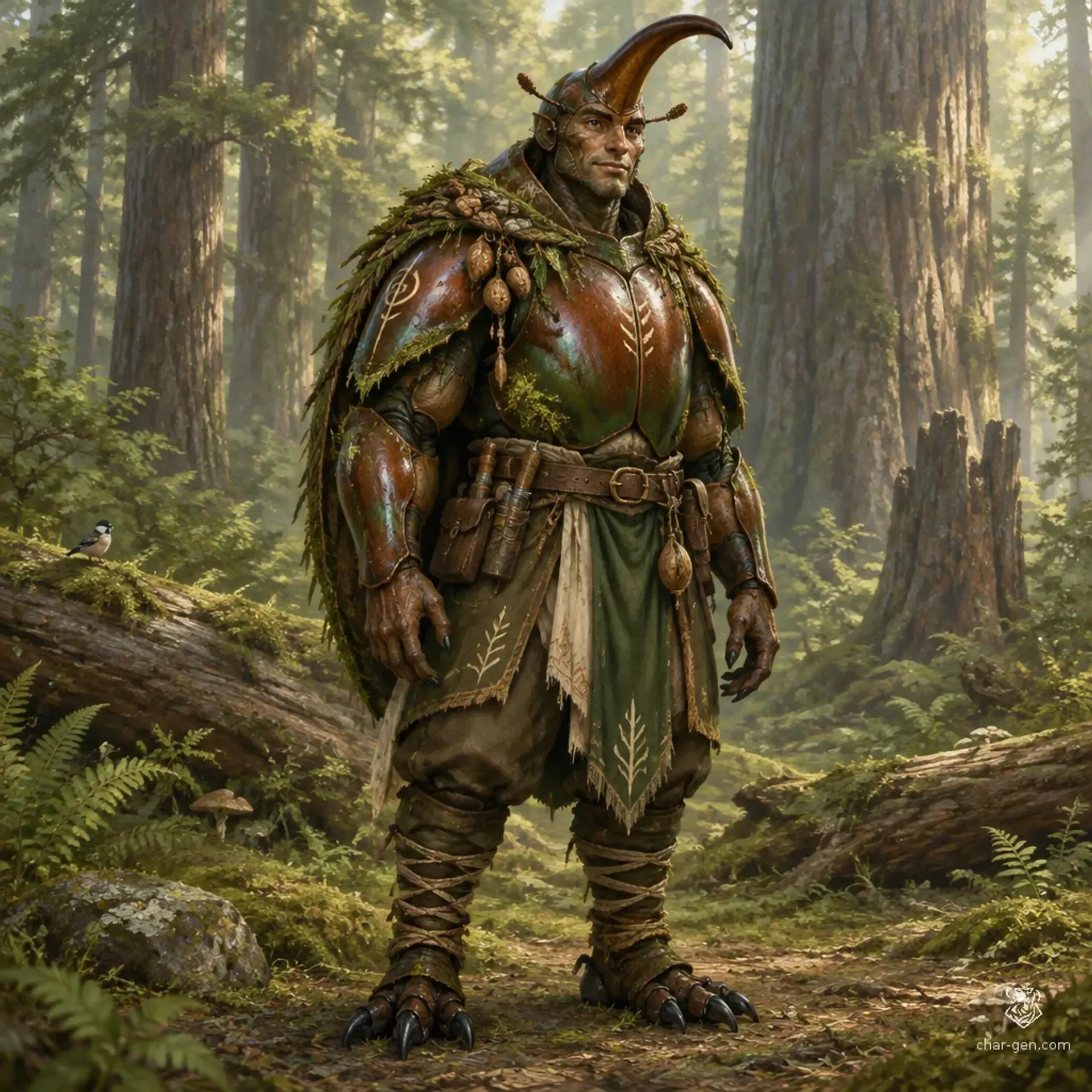
Lucanotherium silvaticum
A Grovehorn Beetlekin can brace a collapsing gate with one arm and patiently coax a frightened child from beneath it with the other.
At a glance
Darkvision None
Languages Common, Sylvan
Height 7 to 9 feet
Weight 400 to 700 pounds
Lifespan 150 to 200 years, adult at 20
At the table
You have a climbing speed of 20 feet. You can climb natural surfaces and sturdy structures without needing to make an ability check unless the surface is unusually slick or unstable.
Your horn is a natural weapon, which you can use to make unarmed strikes. On a hit, it deals plus your Strength modifier piercing damage, instead of the bludgeoning damage normal for an unarmed strike. You can choose to deal bludgeoning damage when the fiction calls for a shove or blunt impact.
When you move at least 20 feet straight toward a creature immediately before hitting it with your horn on the same turn, the target takes an extra piercing damage. You can deal this extra damage only once on each of your turns.
You count as one size larger when determining your carrying capacity and the weight you can push, drag, or lift. This trait does not change your space, reach, or ability to use equipment.
Common, Sylvan
Horn natural weapon
Their massive frames tend toward Strength and Constitution, while their patience often favors Wisdom. These are descriptive tendencies only; assign ability score increases as your character creation rules allow, such as +2/+1 as you wish.
Their horns sweep forward in a heavy, shovel-like curve, and their shells are often dark brown or charcoal.
Rootwards are practiced diggers and defenders of old groves. They are known for patient vigilance and for clearing blocked paths without damaging nearby roots.
A Grovehorn Beetlekin can brace a collapsing gate with one arm and patiently coax a frightened child from beneath it with the other. These enchanted forest folk are built for immense labor, yet their deepest pride lies in knowing when not to use their strength. Their great horns mark them as formidable guardians, but among their own people, a horn’s worth is measured by the promises it has helped keep.
Grovehorn beetlekin are towering, broad-shouldered humanoids whose bodies are protected by dark, glossy carapaces in shades of chestnut, obsidian, bronze, or deep green.
Their faces are expressive and broadly humanlike, framed by short antennae that tilt and twitch with attention. A prominent horn rises from the brow, usually curving forward or upward; its shape, ridges, and polish vary from individual to individual. Their hands are dexterous despite their great size, and their legs end in sturdy, clawed feet suited to uneven woodland ground. Fine hairs along the joints and antennae sense movement in the air. Many decorate their shells with harmless moss, painted patterns, or small tokens tied to personal vows.
Temperate and subtropical forests, especially old-growth woodlands with rich soil, fallen timber, and sheltered clearings.
The horn begins as a soft bud, and the young learn balance, restraint, and the forest paths under close communal care.
The shell darkens and hardens; adolescents take on useful work and make a first vow to a grove, craft, or mentor.
Adults are physically imposing and commonly serve as wardens, builders, escorts, or negotiators for their communities.
Elder beetlekin often bear ridged, weathered shells and horns marked with the history of their service. Their strength fades slowly, though old injuries can linger.
Grovehorn communities organize around shared duties rather than rank.
Each adult is expected to contribute a useful craft or service, and the strongest are often assigned the most delicate tasks, where restraint matters as much as power. Their traditions include horn-carving ceremonies, seasonal repair days, and quiet vigils for fallen trees. A beetlekin’s horn is never carved without consent; its marks are personal records of journeys, vows, and important acts. Hospitality is generous, but guests are expected to respect the grove’s living boundaries.
Many honor the forest as a web of obligations between living things, rather than worshiping a single patron.
Some keep shrines to seasonal spirits, ancestral guardians, or deities of nature and protection. Their customs prize dependable conduct and measured strength, but individual temperaments vary widely. Most are not especially drawn to rigid law or rebellion for its own sake; they tend to judge choices by their consequences for the community and the land.
Beetlekin often become dependable allies to forest communities, though their size and armored appearance can make first meetings tense.
They value those who ask before assuming what beetlekin can lift, carry, or endure. In mixed communities, they may work as wardens, builders, caravan guards, or patient craftspeople. They are wary of industries that strip forests quickly, but distinguish between careful harvesting and destruction rather than condemning every outsider who works with timber.
Their settlements nestle among ancient trees, ravines, and fern-choked slopes.
Beetlekin builders favor sturdy platforms, broad ramps, and halls cut into fallen trunks or built around living trees without girdling them. Doors and furniture are generous in scale, but guest spaces are deliberately adaptable, with low benches and removable fittings for visitors of every size.
No images yet.
A high-res, share-ready sheet you can post or print.