
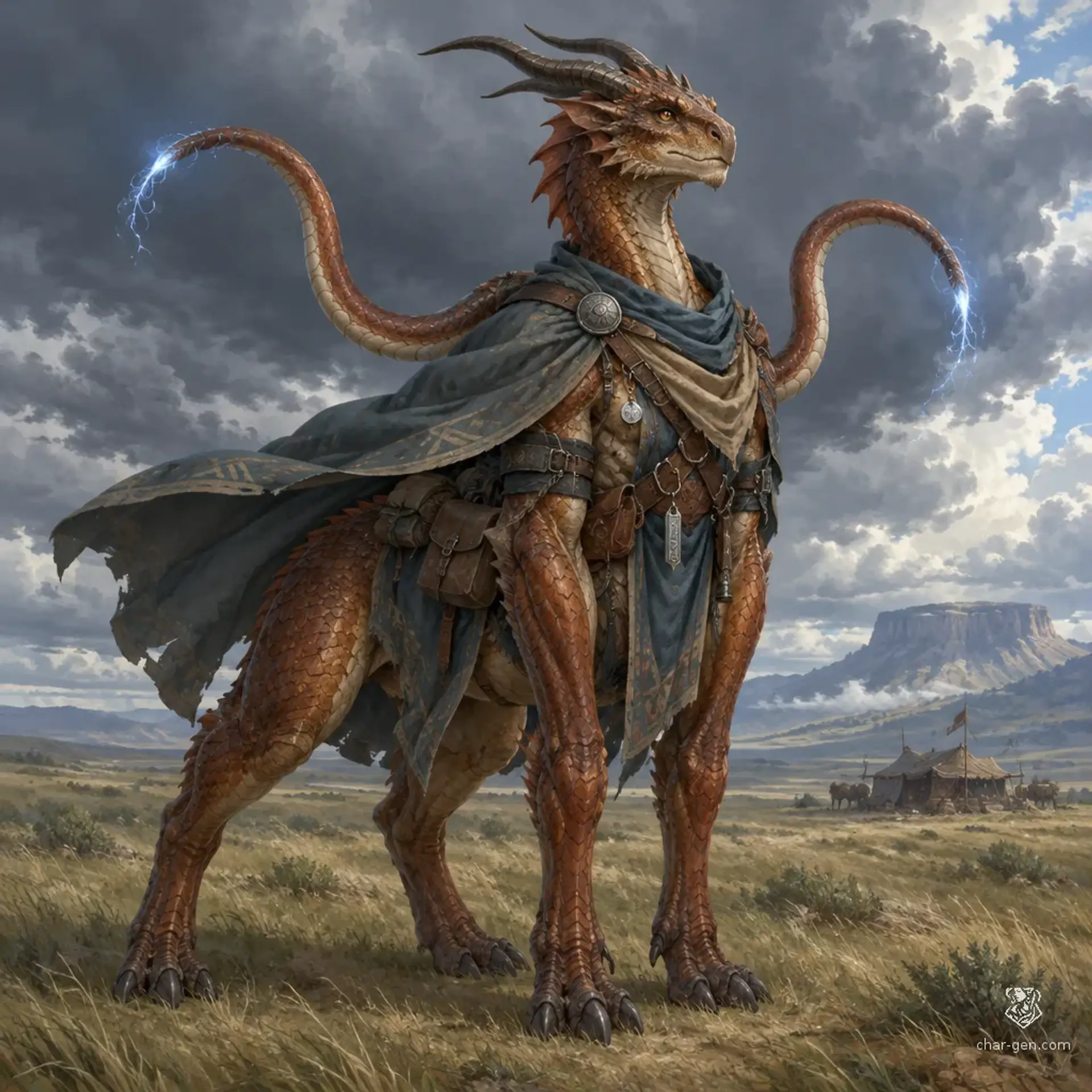
Dracovoltus campestris
A Veyrathi can cross a plain faster than most folk can saddle a horse, then arrive with a spell already shaping between crackling tentacles.
At a glance
Languages Common, Draconic
Height 5 ft. 6 in. to 6 ft. 6 in. at the shoulder
Weight 450 to 700 lb.
Lifespan 90 to 120 years, adult at 18
At the table
Your Speed is 40 feet. Your four-legged build is adapted to open ground and long travel, not to carrying a rider; you cannot serve as a mount for a creature of your size or smaller.
Your tentacles are natural weapons, which you can use to make unarmed strikes. When you hit with one, the strike deals lightning damage plus your Strength or Dexterity modifier, instead of the normal damage for an unarmed strike. You choose the ability for these strikes when you gain this species. The tentacles have a reach of 10 feet, but you can attack with them only on your turn.
You know one cantrip of your choice from the Wizard spell list. Intelligence, Wisdom, or Charisma is your spellcasting ability for it. When you reach character level 3, you can cast one 1st-level spell from the Wizard spell list without a spell slot. You regain the ability to cast it this way when you finish a Long Rest. You choose the spell and spellcasting ability when you select this species.
Common, Draconic
Their quick, sure-footed bodies and disciplined magical traditions often favor Dexterity and Intelligence, but players assign ability score increases as they wish.
Their tentacles flash with pale, branching arcs, and their magic often favors precision and sudden bursts of force.
Thunderstep lineages are renowned messengers and duelists. They train to direct their natural charge carefully, treating control as more impressive than raw power.
A Veyrathi can cross a plain faster than most folk can saddle a horse, then arrive with a spell already shaping between crackling tentacles. These draconic centaurs are nimble arcane adepts whose storm-bright limbs are both delicate tools and dangerous weapons. They come from a culture that prizes quick thought, useful skill, and the freedom to follow an open road.
Veyrathi have a powerful, four-legged lower body built for sustained speed across open country, joined to a humanoid, draconic torso.
Their hides range from warm bronze and russet to storm-gray, with small overlapping scales along the shoulders, flanks, and limbs. Two flexible tentacles grow from beneath the shoulder blades. Fine sensory pits line their undersides, and faint blue-white sparks sometimes dance between the tips when emotion or spellcraft stirs. Their eyes are often bright and reflective, while short horns, ridged brows, or swept-back crests vary by family.
Open plains, broad grasslands, and storm-swept plateaus
Young adults learn to control their stride, tentacles, and first sparks of magic under close family guidance.
Most reach physical and magical maturity in their late teens, then undertake a journey or apprenticeship beyond their home range.
With age, their scales dull and their magic grows subtle; elders often serve as navigators, judges, or keepers of oral histories.
Veyrathi families travel in extended caravans or form lasting settlements along dependable rivers and storm routes.
Children learn navigation, first aid, and controlled spellwork alongside ordinary crafts. Skill is respected when it serves others, but showmanship has its place: seasonal gatherings feature races, spell duels, and feats of precise tentacle work. Their quickness is cultural as well as physical, though elders remind the young that haste is not the same as judgment.
Their spiritual traditions commonly honor sky, storm, and the living grassland, though many follow the faiths of neighboring peoples.
Veyrathi tend toward practical, self-directed outlooks rather than any single alignment. They admire generosity freely given and distrust power that demands obedience without explanation.
Veyrathi often become couriers, guides, scouts, and magical tutors, and they value companions who respect both their independence and their need for room to move.
They are accustomed to being mistaken for mounts or hired purely for their speed, and many respond by making their personhood unmistakable. Their tentacles are expressive as well as dangerous, so asking before touching them is considered basic courtesy.
Their homes are built for movement and changing weather.
Seasonal camps use low, wind-resistant shelters arranged around communal halls, while settled communities favor broad doorways, open courtyards, and raised platforms for watching the horizon. Many settlements mark safe routes between water, shelter, and reliable sources of magical energy.
No images yet.
A high-res, share-ready sheet you can post or print.