
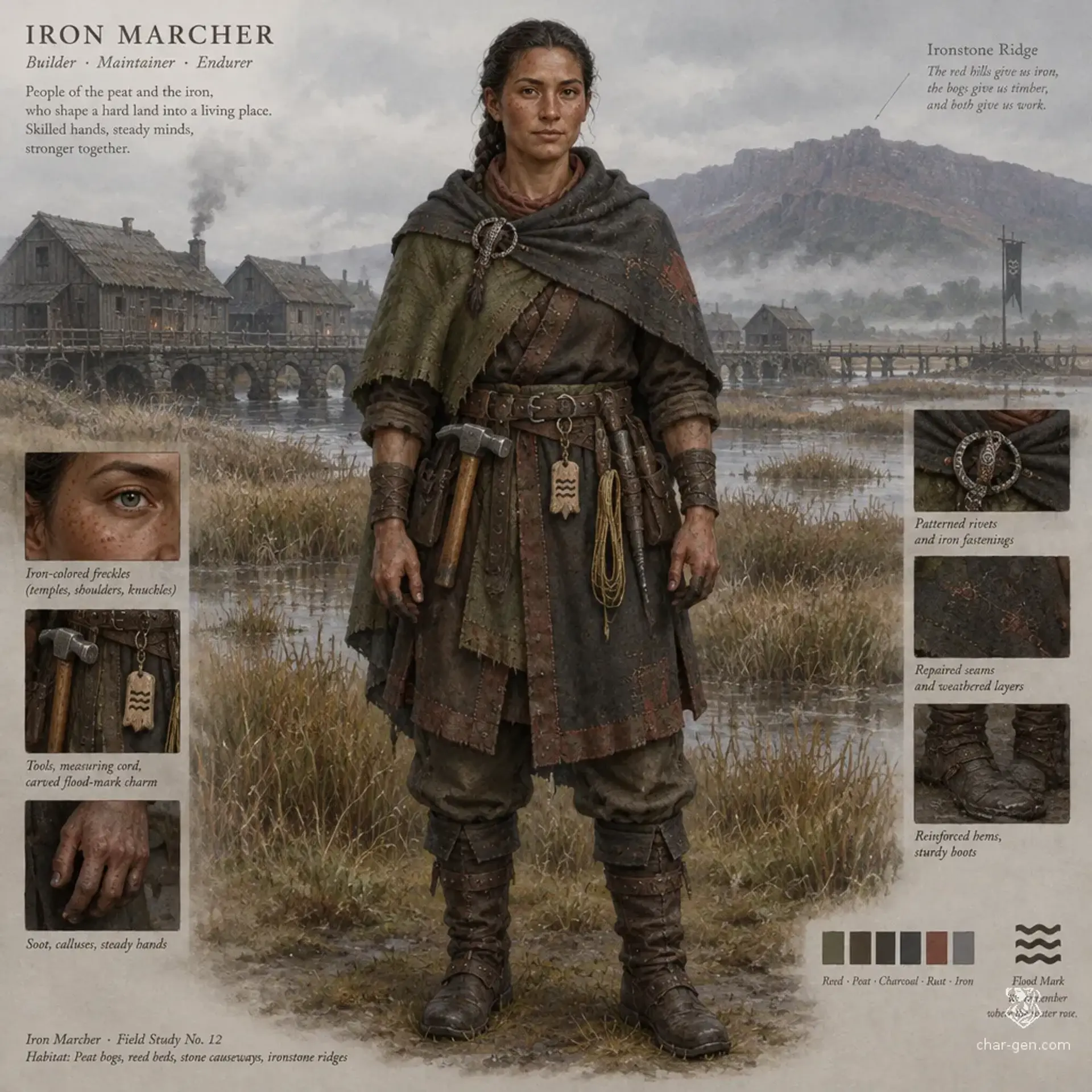
Ferrumarchia palustris
Born among the bog roads and ironworks of La Marche de Fer, Iron Marchers know that survival depends on both strong materials and stronger communities.
At a glance
Languages Common, March Cant
Height 4 ft. 10 in. to 6 ft. 2 in.
Weight 130 to 230 lb.
Lifespan 80 to 100 years, adult at 18
At the table
Your Speed is 30 feet.
You gain proficiency in one of the following, chosen when you select this species: smith's tools, mason's tools, or the Survival skill.
When you take damage from an attack, you can use your Reaction to reduce that damage by an amount equal to your Proficiency Bonus. You can use this trait a number of times equal to your Proficiency Bonus, and you regain all expended uses when you finish a Long Rest.
You can move through nonmagical difficult terrain made of mud, marsh growth, loose stone, or industrial debris without spending extra movement.
Common, March Cant
Iron Marchers tend toward Constitution and Wisdom, reflecting endurance and careful attention to weather, machinery, and dangerous ground. Players assign any ability score increases according to their character creation rules.
Typically have dark, mineral-flecked skin and a strong sense of balance on slick or shifting surfaces.
Bogwards come from the low wetlands and floodplain villages. They are skilled guides, ferrymen, and keepers of water rights, and often serve as mediators between settled communities and the marsh.
Born among the bog roads and ironworks of La Marche de Fer, Iron Marchers know that survival depends on both strong materials and stronger communities. They are patient builders, attentive scouts, and stubborn companions who would rather repair a failing bridge than abandon the people waiting on the other side. An Iron Marcher adventurer may travel to find a missing piece of local history, settle an old obligation, or learn whether the wider world can be trusted with what lies beneath the March.
Iron Marchers are sturdy humanoids with broad hands, compact frames, and a gait practiced on uneven ground.
Their skin ranges from warm brown and olive to slate-pale, often marked by faint freckles of iron-rich pigment along the shoulders, temples, or knuckles. Hair is commonly dark, rust-red, or ash-blond, and many wear it cropped or braided clear of machinery. Their eyes tend toward hazel, grey, or deep green. Work clothes are layered and patched, with reinforced hems, weatherproof wraps, and personal tools worn close at hand.
The peat bogs, ironstone ridges, rain-dark forests, quarry settlements, and fortified trade roads of La Marche de Fer.
Small, watchful children learn to recognize safe ground, rising water, and the different voices of a working forge.
Adolescents undertake a season of service with a household, guild, or patrol before choosing a trade and earning the right to speak in community councils.
Adults are considered full members of their community, though skill and reliability matter more than age in determining authority.
Elders often keep oral maps, family accounts, and the histories of repaired bridges and reclaimed land. Their advice is sought even when their hands have grown unsteady.
Iron Marcher society is organized around crews, households, and guild circles rather than hereditary rank.
Floodwardens, smiths, builders, and ferrymen hold influence when their work earns trust, but leadership is expected to be temporary and answerable. Apprenticeships are treated as reciprocal obligations: a learner gives labor, while a teacher gives instruction and a place in the community. Disputes are often settled at a shared workbench, where each party must explain not only what they want but what they are prepared to maintain.
Many Iron Marchers honor local spirits of water, stone, and hearth, or revere deities associated with craft, endurance, and protection.
Their customs favor practical offerings: a repaired tool left at a shrine, a channel cleared before the spring thaw, or a meal shared with a traveling stranger. They have no common alignment, though community traditions often encourage responsibility and mutual aid.
Iron Marchers trade readily with outsiders but are slow to grant them authority over shared works such as roads, canals, and forges.
They respect careful labor regardless of ancestry and distrust grand claims unsupported by evidence. Their direct manner can be mistaken for hostility, while their habit of remembering debts and favors can seem overly formal to people from more individualistic cultures.
Iron Marcher settlements rise on stone causeways and timber piles above wet ground.
Homes are built around shared hearths, with steep roofs, raised storage, and iron braces designed to be replaced rather than merely admired. Larger towns cluster around foundries, sluiceworks, or defensible crossings. Their builders favor practical beauty: patterned rivets, carved flood marks, and gates whose hinges are made to be repaired with local tools.
No images yet.
A high-res, share-ready sheet you can post or print.