
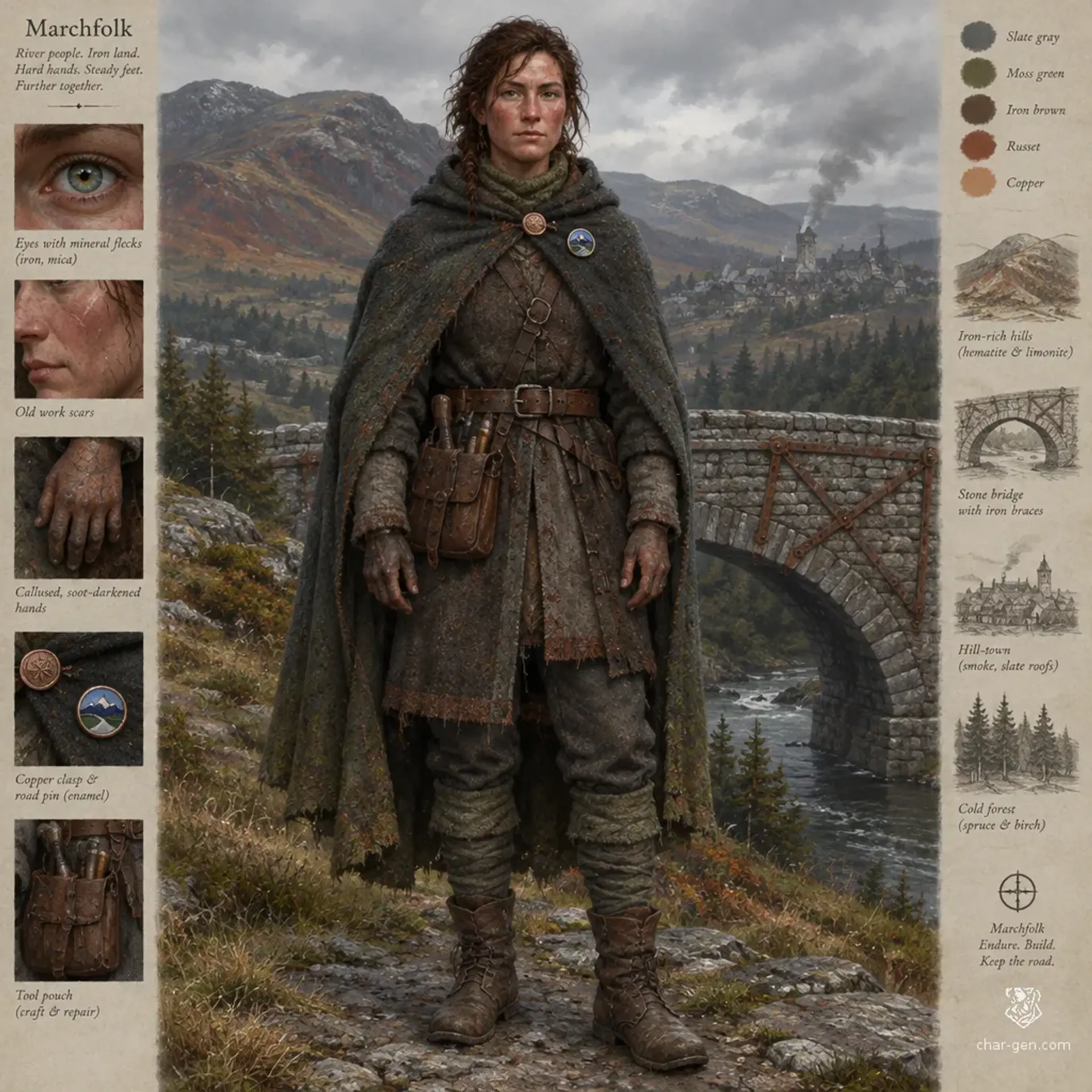
Ferrivagus marchensis
Born among the iron roads and stubborn hill towns of La Marche de Fer, Marchfolk learn early that survival is a craft shared with others.
At a glance
Darkvision 60 ft.
Languages Common, Marchcant
Height 4 ft. 10 in. to 6 ft. 2 in.
Weight 110 to 220 lb.
Lifespan 80 to 100 years
At the table
You can see in dim light within 60 feet of yourself as if it were bright light, and in darkness as if it were dim light. You discern colors in darkness only as shades of gray.
You have advantage on saving throws made to avoid or end the poisoned condition caused by inhaled smoke, dust, or similar airborne irritants. This trait does not protect you from poison delivered in other ways.
You gain proficiency with one of the following artisan's tools of your choice: smith's tools, mason's tools, or tinker's tools.
Common, Marchcant
Marchfolk often cultivate Constitution and Intelligence through hard labor, careful craft, and survival in a severe land. Assign any ability score increases permitted by your character rules as you wish; no scores are fixed by this ancestry.
Often have pale mineral flecks around the eyes and a reputation for measured speech.
Raised among exposed ridges and old watch roads, Highmarch families are renowned as surveyors, masons, and guides. Their communities maintain signal towers and take pride in knowing which paths remain passable after a storm.
Born among the iron roads and stubborn hill towns of La Marche de Fer, Marchfolk learn early that survival is a craft shared with others. Their keen eyes find shape in soot-darkness, their lungs tolerate the choking air of mines and forges, and their hands know how to coax a useful life from worn tools. A Marchfolk adventurer may be a caravan guard, wandering artisan, displaced villager, or simply someone who has decided that the world beyond the border deserves a closer inspection.
Marchfolk are sturdy, varied humanoids whose bodies bear the ordinary marks of a demanding climate: wind-reddened cheeks, callused palms, and the occasional old burn or scar.
Many have dark, iron-gray, or russet hair, though every common human coloring is found among them. Fine mineral flecks sometimes appear in the iris or beneath the skin at the temples, especially among families from ore-rich valleys. These traces are natural pigmentation, not metal beneath the flesh. Their voices are often roughened by smoke and cold air, and their clothing is layered for work, weather, and sudden travel.
The rugged borderlands of La Marche de Fer: iron-rich hills, cold forests, marshy lowlands, scattered mines, and the fortified roads between them.
A child is considered capable of learning a trade, though elders keep them away from dangerous furnaces and border work.
At roughly fifteen, a young Marchfolk undertakes a season of service, apprenticeship, or travel before choosing a household and vocation.
Most Marchfolk remain active well into old age, adapting their craft or taking on duties as teachers, judges, and keepers of local memory.
Marchfolk culture prizes useful knowledge, reliable neighbors, and work done well enough to outlast its maker.
Children commonly learn a trade alongside letters and local history. Apprenticeships are social bonds as much as instruction, and a craftsperson's reputation travels farther than their name. Towns settle disputes in public assemblies where witnesses, ledgers, and tangible evidence matter. Hospitality is customary, but guests are expected to respect tools, stores, and local warnings. Many Marchfolk take seasonal work on the iron roads, carrying news and skills between settlements.
Marchfolk honor a varied collection of hearth guardians, road saints, mountain powers, and ancestors remembered through family craft.
Many leave a small offering at a bridge or forge, asking for safe passage or steady hands. Their outlook is shaped less by doctrine than by mutual obligation, and they can be found across the full range of alignments, though communal responsibility is widely admired.
Marchfolk trade readily with travelers and neighboring communities, but trust is usually built through repeated dealings rather than grand declarations.
They respect anyone who keeps their word and can be impatient with those who mistake practical caution for cowardice. Old border feuds and competing claims to mines can divide neighboring towns, yet shared dangers often bring their people together quickly.
Marchfolk settlements cluster around dependable water, defensible crossings, and workable ore.
Their buildings favor thick stone foundations, steep roofs, narrow windows, and iron braces designed to endure hard weather and hard use. In isolated country, a forge, well, and watchtower may serve as the heart of an entire hamlet. Roads are marked with hammered iron posts, each bearing local signs for distance, danger, and the nearest place to find shelter.
No images yet.
A high-res, share-ready sheet you can post or print.