They mature at the same rate as humans and commonly live 90 to 120 years. Exceptional keepers may reach 150 years, though their memories often become crowded with inherited recollections.
Darkvision
60 ft.
Habitat
The Turnback Province, especially its river terraces, foggy orchards, upland roads, and settlements built around recurring natural phenomena.
Turnback Province
memory
seasonal magic
roadwardens
resilient
humanoid
ancestral tradition
SizeMedium
Speed30 ft.
LifespanThey mature at the same rate as humans and commonly live 90 to 120 years. Exceptional keepers may reach 150 years, though their memories often become crowded with inherited recollections.
Creature TypeHumanoid
Darkvision60 ft.
The people of the Turnback Province are patient, hardy travelers whose bodies remember the land's strange reversals. They build homes over old homes, preserve grudges as carefully as heirlooms, and treat every road as something that may one day lead backward. A Recurrent adventurer brings a gift for endurance, a wary reverence for history, and the unsettling certainty that some mistakes are not mistakes at all, but appointments kept by time.
Physical Description
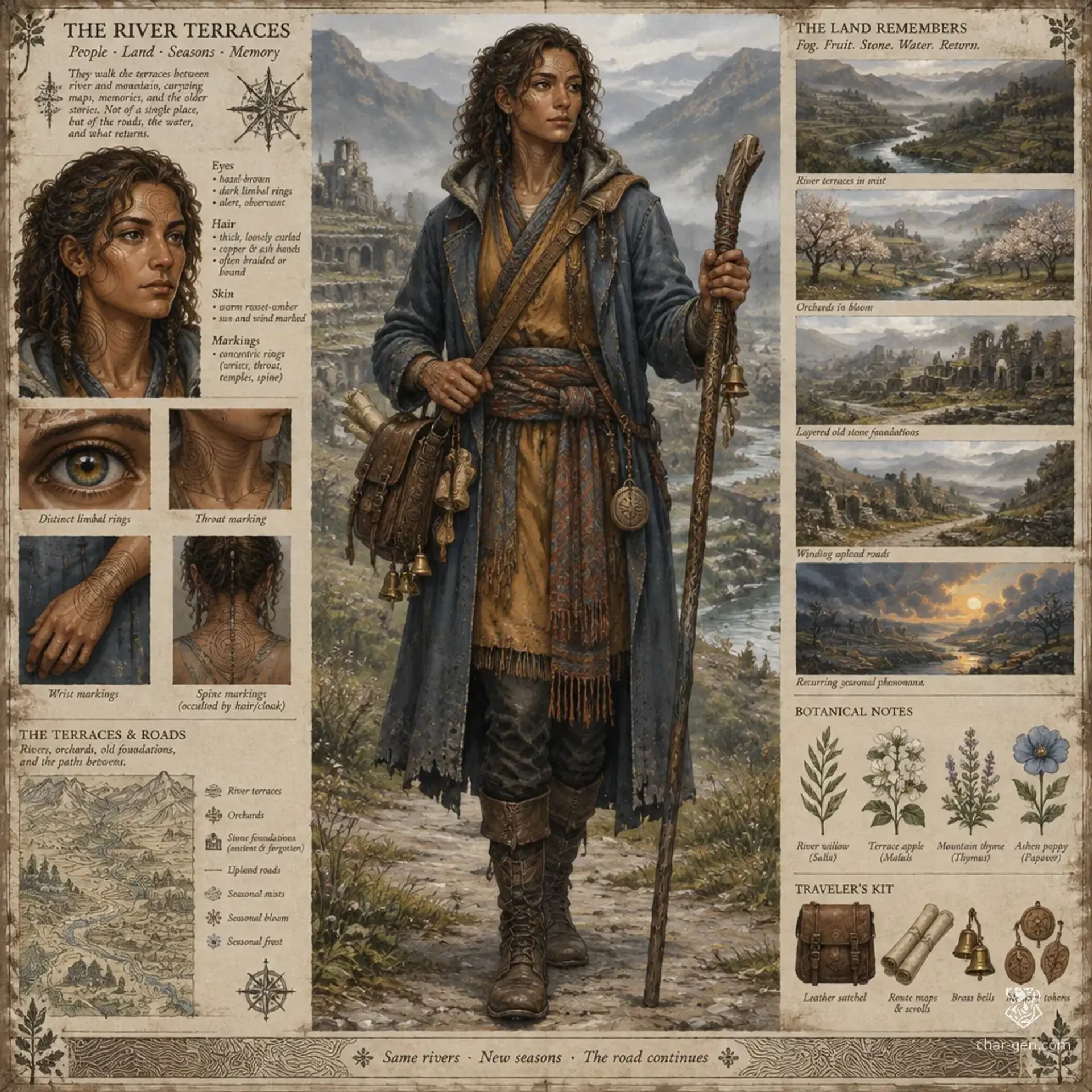
Recurrent folk are slender or broad-shouldered humanoids with durable bodies shaped by the province's shifting seasons. Their skin ranges from warm umber and russet to gray, moss green, and muted cream. Fine concentric markings appear along the wrists, throat, temples, or spine, becoming more pronounced with age. Their hair is usually thick and straight or loosely curled, often growing in bands of subtly different color. Their eyes have unusually distinct limbal rings, giving them a watchful, almost painted appearance. Most have strong hands, flexible joints, and a calm gait suited to uneven roads. Their voices often carry a faint double resonance, as though an older version of the speaker is quietly repeating each word.
Society & Culture
Recurrent society is organized around households called circles, each responsible for maintaining a specific place, craft, route, or body of knowledge. Children learn practical skills alongside memory disciplines, including oral recitation, knot codes, scent recognition, and the interpretation of old boundary marks. Major decisions are often made after a formal recounting of similar past disputes. This can make their councils slow, but it also gives them a strong resistance to panic and manipulation. Hospitality is reciprocal and recorded, while public shame is expressed through temporary removal from communal memory rites. Festivals mark not only harvests and births, but also the return of fogs, birds, roads, and ancestral names.
Religion & Alignment
Their faith centers on the Returning Current, an impersonal force believed to move through seasons, bloodlines, rivers, and stories. Some worship ancestral spirits, provincial saints, or minor landscape powers, while others reject religion and treat memory itself as sacred. Recurrent ethics favor patient responsibility over rigid law, though frontier settlements often prize strict custom. They are frequently neutral in alignment, with lawful and good communities common among archivists and wardens, and chaotic or darker traditions emerging among those who believe the past must be broken rather than preserved.
Homelands & Architecture
Turnback settlements are built in layers, with newer homes attached to older foundations rather than replacing them. Doors often face two directions, one toward the road and one toward a remembered road that no longer exists. Houses use slate, clay, dark timber, and living root supports. Public buildings commonly contain circular corridors, archive wells, and bells tuned to local weather patterns. A town may have several names, each reserved for a different historical condition.
Relationships With Other Peoples
Recurrent communities are hospitable but cautious with outsiders. Visitors are offered food, directions, and a chance to hear local history, yet trust is granted through repeated conduct rather than a single impressive act. They trade extensively with neighboring peoples, especially in preserved foods, medicinal plants, maps, bells, and durable textiles. Some outsiders find them morbid or stubborn because Recurrent folk speak openly about old disasters and maintain obligations to the dead. In turn, Recurrent people often view more impulsive cultures as exciting, generous, and dangerously forgetful.
Visual sheet
Turn Recurrent into a sheet
A high-res, share-ready sheet you can post or print.