
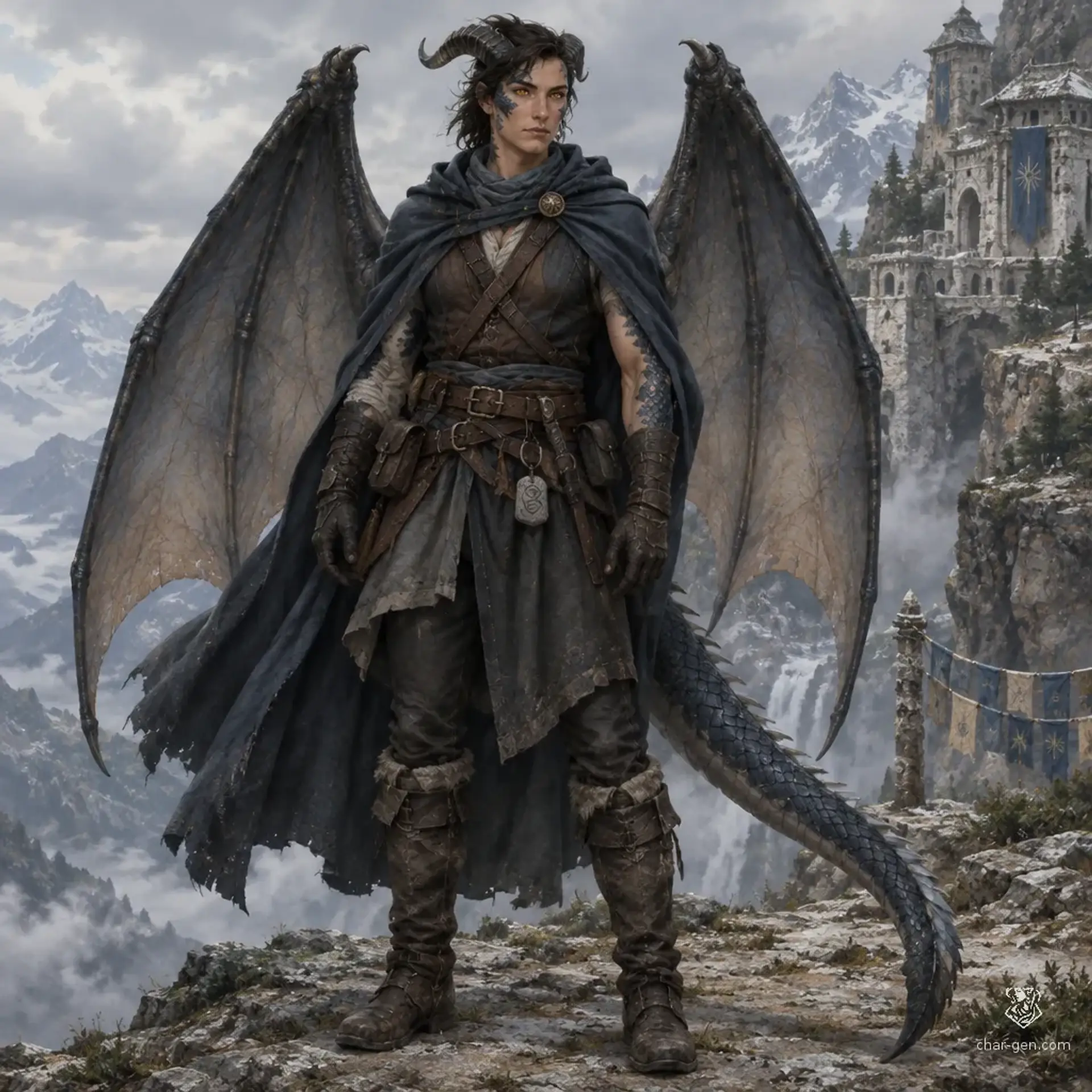
Homo draconis altivagus
At a glance
Darkvision 60 ft.
Languages Common, Draconic
Height 5 ft. 8 in. to 6 ft. 8 in.
Weight 150 to 270 lb.
Lifespan 120 to 160 years, adult at 18
At the table
Your walking speed is 30 feet. You also have a flying speed of 30 feet. You cannot use this flying speed while wearing medium or heavy armor. If you are airborne when you become unable to fly, you descend safely at up to 60 feet per round and take no falling damage if you land during that descent.
You can use your horns to make an unarmed strike. On a hit, the strike deals + your Strength modifier piercing damage instead of the bludgeoning damage normal for an unarmed strike.
You count as one size larger when determining your carrying capacity and the weight you can push, drag, or lift.
Your draconic eyes grant you darkvision out to 60 feet. In darkness, you see shades of gray rather than color.
Your scales can turn aside a blow when you brace yourself. As a reaction when a creature you can see hits you with an attack, you can reduce the damage by + your Constitution modifier. Once you use this trait, you cannot use it again until you finish a long rest.
Common, Draconic
Vowspires tend toward Strength and Constitution, with keen instincts often expressed through Wisdom. For D&D 5E (2014), assign ability score increases according to your table's preferred method rather than treating these tendencies as fixed bonuses.
Their scale patches and wing membranes tend toward gold, bronze, or pale ivory, and their eyes often shine like polished metal.
Dawncrests are often drawn to public service, diplomacy, and visible acts of protection. Their communities prize courage tempered by patience.
Created and blessed by the dragon god Bahamut, Vowspires are mountain-born guardians with human faces and the unmistakable gifts of dragons: horns, scales, powerful tails, and broad wings. Their bodies are built for strength and altitude, but their oldest traditions insist that might is a trust, not a right. A Vowspire adventurer may be a pilgrim seeking the purpose behind that inheritance, a protector whose home has fallen, or simply someone determined to choose their own path beneath an immense legacy.
Vowspires look human at a glance, with familiar faces, skin, hair, and builds, but their draconic inheritance is impossible to miss.
Patches of scales grow in asymmetrical arrangements, commonly along the collarbones, forearms, spine, thighs, or temples. Horns rise from the brow or sweep back from the crown, and a strong, balancing tail extends from the base of the spine. Their large wings are muscular and leathery, with colors that may echo their scales or contrast sharply. Their eyes have narrow pupils and irises in hues ranging from amber and green to silver, violet, and deep blue. The shape and color of their scales, horns, wings, and eyes vary widely, even among close kin.
High mountains, cliffside sanctuaries, wind-scoured plateaus, and secluded valleys.
Scales begin to show clearly, and young Vowspires learn balance, flight, and the duties their community expects of them.
A Vowspire is considered an adult after completing a chosen trial of service, often a dangerous journey or an act of guardianship.
Older Vowspires may become oath-keepers, scouts, or teachers. Their scales often pale at the edges, while their horns continue to grow slowly.
Vowspires are raised in close-knit circles that teach strength alongside restraint.
Children learn to manage their tails and wings before being trusted near steep ledges, then train in rescue, mediation, and defense as well as combat. Many communities organize around sworn duties rather than hereditary rank. An oath may bind a person to a place, a group of travelers, or a principle, but the meaning of that oath is expected to be discussed openly. Vowspires who leave home are not considered faithless; a journey can be a way to test inherited beliefs against the wider world.
Vowspire tradition honors Bahamut as creator and exemplar, but reverence is commonly expressed through deeds: sheltering travelers, keeping a sworn charge, and showing mercy when vengeance would be easy.
Some communities maintain formal shrines, while others treat an honest promise as a sacred act. Their cultures favor justice and protection, but individuals range across every alignment, and no Vowspire is born bound to a particular faith or code.
Vowspires are often welcomed as protectors and feared as potential conquerors, sometimes in the same village.
Their visible strength can invite expectations that they lead, fight, or serve as symbols of divine favor. Many respond by cultivating humility and careful listening, while others resent being treated as a public possession. They generally judge individuals by their actions, though communities shaped by long histories of persecution may be wary of outsiders until trust is earned.
Vowspire settlements cling to defensible ledges and sheltered basins.
Their buildings are low, thick-walled, and anchored against storms, with broad terraces for winged traffic and open courtyards for flight practice. Bridges are built with handholds and wind screens, while halls are carved to preserve warmth and carry the sound of spoken testimony. Aerie doors are often marked with records of the community's vows rather than heraldic claims.
No images yet.
A high-res, share-ready sheet you can post or print.