
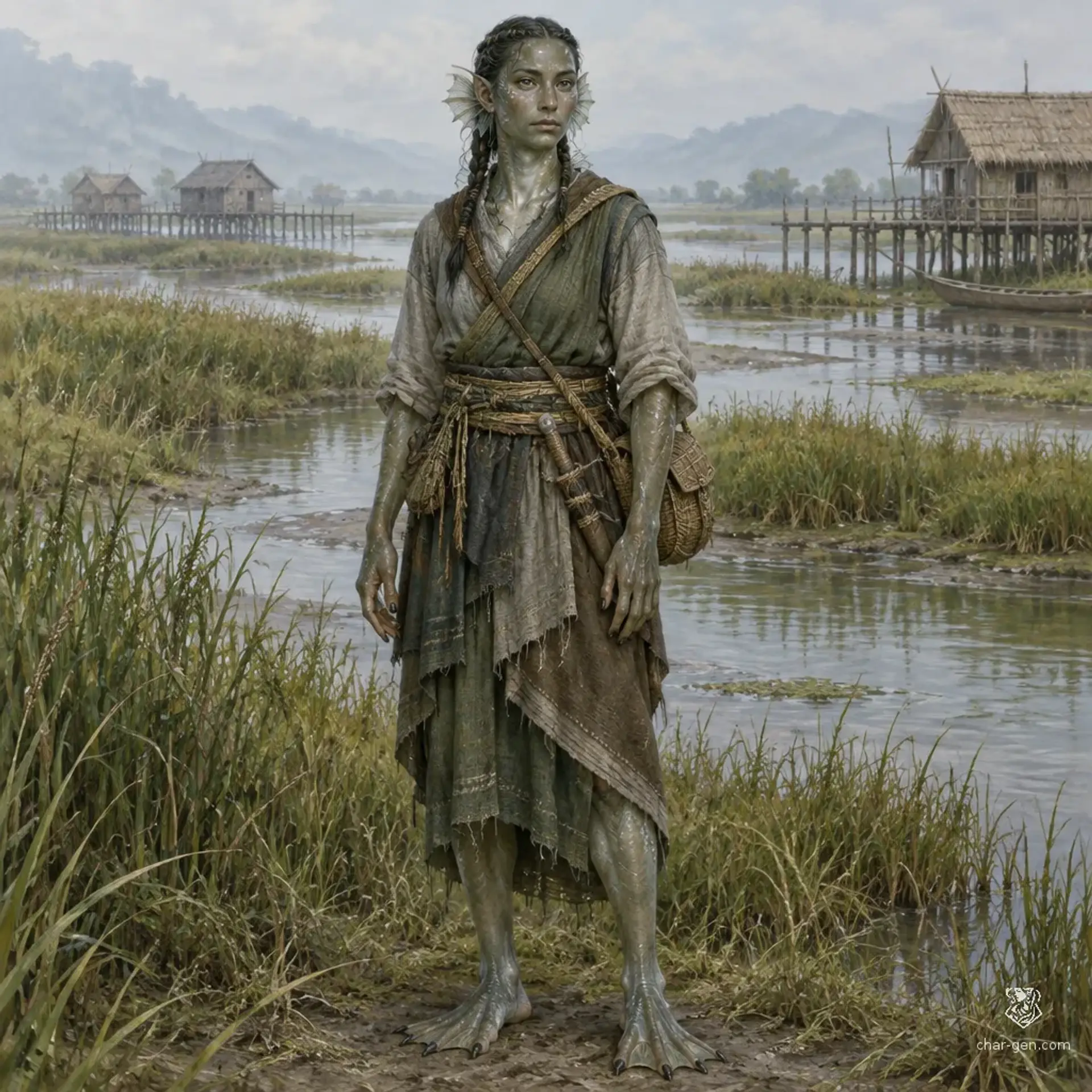
Homo palustris mantrialis
In Mantrial, the river is road, pantry, boundary, and unreliable neighbor.
At a glance
Darkvision 60 ft.
Languages Common, Mantrial
Height 4 ft. 10 in. to 6 ft. 2 in.
Weight 95 to 190 lb.
Lifespan 90 to 110 years, adult at 18
At the table
You have Darkvision with a range of 60 feet.
You have a swimming speed of 30 feet, and you can breathe both air and water.
You gain proficiency in either Investigation or Survival.
Common, Mantrial
Mantrial folk often cultivate patience, keen observation, and physical endurance. Their upbringing tends toward Constitution and Wisdom; assign ability score increases according to your character creation rules, with no scores fixed by ancestry.
A pale, reflective sheen along the face and neck, most visible in moonlight.
Glasswater Reedfolk come from clear lakes and spring-fed channels. Their communities are known for meticulous maps, skilled glassworkers, and careful recordkeeping.
In Mantrial, the river is road, pantry, boundary, and unreliable neighbor. The Reedfolk have learned to listen to its moods: the hush before a bank gives way, the bright change in a channel’s surface, the sudden silence of birds. They are skilled travelers through wet country, but not all are content to remain where every family knows the floodline by heart. Some leave as guides, envoys, or adventurers, carrying the practical wisdom of a people who know that survival is usually a shared undertaking.
Mantrial Reedfolk are humanoids with broad variation in build and complexion.
Their skin often carries a subtle sheen, especially along the cheekbones and throat, and may be patterned with fine, pale flecks reminiscent of light on shallow water. Thin, flexible frills at the neck and behind the ears help them sense nearby movement in water. Their hands and feet are slightly webbed, an adaptation for swimming and wading rather than a dramatic aquatic shape. Hair is commonly worn in close braids or tied back with reed fiber, keeping it clear of nets and work. Their eyes range from dark brown to gray-green, with a reflective glimmer in dim light.
The marshes, braided rivers, floodplains, and reed-fringed lakes of Mantrial, especially its seasonally inundated lowlands.
Children learn to read water, weather, and the small signs of a changing bank. They are considered under a household’s full protection.
Young adults undertake a passage between settlements, carrying a message or completing a practical service. Returning safely marks their entry into adult responsibilities.
Adults hold trades, maintain kinship ties, and contribute to communal works such as levees and flood archives.
Elders are valued as living records of former floods, vanished channels, and the promises made between settlements.
Kinship in Mantrial extends beyond blood.
Neighbors who share a landing, maintain a levee, or keep one another’s children safe may be treated as close family. Skills are taught through apprenticeship and practical demonstration, with children learning early to recognize safe footing and changing weather. A person’s reputation rests less on status than on whether they keep their word when conditions turn dangerous. Disputes are commonly settled at open councils, where each side is expected to state what it needs and what it is willing to contribute. Reedfolk are not universally cautious; many are bold explorers, but their boldness tends to be informed by preparation.
Mantrial faith is often expressed through seasonal observances rather than a single doctrine.
Families leave offerings of grain or polished stones at safe crossings and tell stories of the ancestors who first settled the higher ground. Many honor river spirits, local guardians, or a broad pantheon of nature and hearth powers. Their communal life encourages generosity and responsibility, though individuals range across every outlook.
Reedfolk are accustomed to trading with travelers and coordinating with neighboring settlements, but they value reliability over grand promises.
They often become trusted guides, mediators, and scouts. Some outsiders mistake their watchfulness for suspicion; Reedfolk, in turn, may find inland customs needlessly wasteful of water and indifferent to the land’s changing conditions.
Mantrial settlements are built to expect water rather than resist it outright.
Homes stand on pilings, earthen mounds, or floating foundations, linked by boardwalks and narrow canals. Shared storehouses sit above the highest remembered floodline, while public halls often double as shelters and meeting places. Buildings favor replaceable panels, woven reed insulation, and broad roofs that catch rain. A settlement’s oldest structure is commonly its flood archive, where maps, boundary agreements, and warnings are kept in sealed clay or glass containers.
No images yet.
A high-res, share-ready sheet you can post or print.