
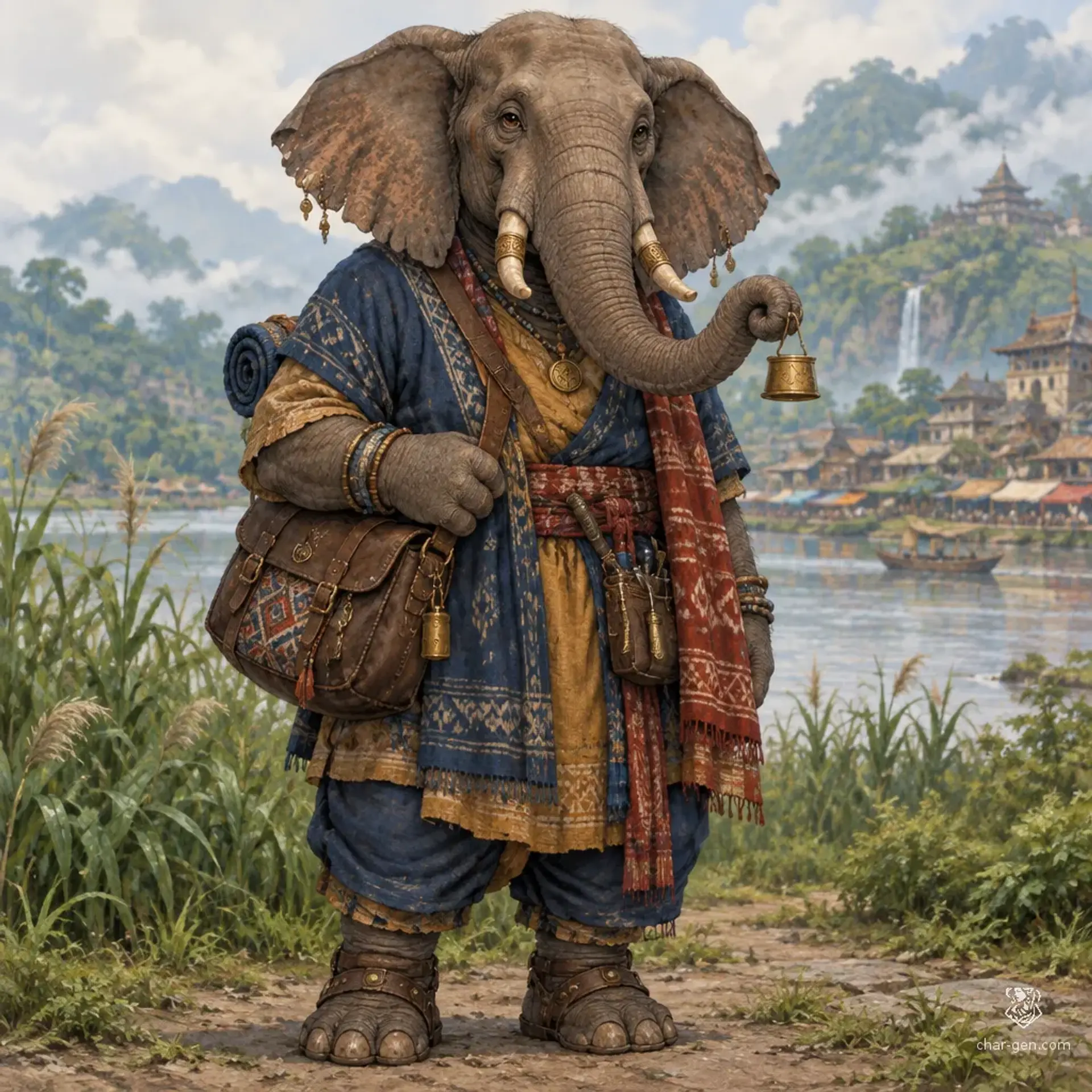
Elephas sapiens
Elephantfolk bring a steady presence to unsettled places.
At a glance
Languages Common, One other language of your choice
Height 5 ft. 8 in. to 7 ft. 2 in.
Weight 220 to 380 lb.
Lifespan 90 to 120 years
At the table
Your trunk can grasp, carry, or manipulate a small object weighing no more than 5 pounds. It can retrieve, stow, pour, or hold such an object, but it cannot wield a weapon or shield, perform somatic components, or make an attack. You can use it for the ordinary interactions involved in handling an object.
You have Advantage on ability checks and saving throws you make to avoid or end the Prone condition.
Choose one skill from History, Insight, or Survival. You gain proficiency in that skill.
Elephantfolk often cultivate patience, physical resilience, and careful judgment, tending toward Constitution and Wisdom. Players assign ability score increases as they wish.
Often have broad, fan-shaped ears and strong associations with river craft, irrigation, and wetland travel.
Riverbank elephantfolk make homes along fertile waterways and floodplains. Their communities often value practical knowledge of water, soil, and seasonal change.
Elephantfolk bring a steady presence to unsettled places. Their keen trunks, durable bodies, and habit of thinking a problem through make them valued as builders, mediators, travelers, and protectors. Yet no two are alike: one may be a quick-witted courier, another a quiet archivist, and a third a restless adventurer who has no interest in staying put.
Elephantfolk are broad-bodied humanoids with thick, flexible trunks, large ears, sturdy legs, and skin ranging from warm gray and brown to muted rose or slate.
Their tusks vary greatly: some have none, some have short tusks, and others wear carved caps or bands according to personal taste and local custom. Hair may grow in sparse curls or coarse manes, and body markings, jewelry, and dress reflect family, profession, faith, and individual style. Their trunks are sensitive and dexterous, suited to delicate work as well as heavy labor.
River valleys, monsoon forests, dry uplands, bustling market towns, and the roads that connect them.
Young and still learning the customs of their household or chosen community. Many take on apprenticeships and supervised journeys.
Considered an adult after demonstrating sound judgment and taking responsibility for a craft, service, or household duty. This often occurs in the late teens.
Most remain active and independent for roughly a century. Elders may serve as teachers, archivists, mediators, or keepers of local memory.
Elephantfolk cultures are as varied as their homelands.
Many place importance on hospitality, skilled work, education, and keeping promises, while disagreements about custom are common and openly debated. Households may include several generations, apprentices, or unrelated companions. Music, storytelling, textile work, metalwork, cooking, and water management are among the many respected crafts. Individuals are encouraged to learn from elders, but a good question or practical improvement can change even an old tradition.
Elephantfolk follow many faiths and philosophies, including household traditions, local devotional practices, and secular codes of service.
Some honor divine figures associated with wisdom, thresholds, or good beginnings, but practices differ greatly between communities and individuals. Their cultural emphasis on care and responsibility does not dictate alignment; elephantfolk may be kind, ambitious, mischievous, stern, or anything between.
Elephantfolk have long traded skills and stories with neighboring peoples, and many communities are deliberately mixed.
Their size or deliberate manner can lead others to mistake them for imposing or ponderous, an impression they may exploit or gently correct. They value trustworthy conduct more than ancestry, and often form lasting ties through shared work, travel, or hospitality.
Elephantfolk live in many kinds of settlements, from dense river cities to small farming villages and mobile caravan communities.
Homes are adapted to their size, with broad doorways, sturdy stairs, shaded courtyards, and water stores. Public buildings often make room for communal meals, craftwork, and meetings. Architecture varies by region and material, with local stone, timber, brick, woven panels, or earth used according to need.
No images yet.
A high-res, share-ready sheet you can post or print.