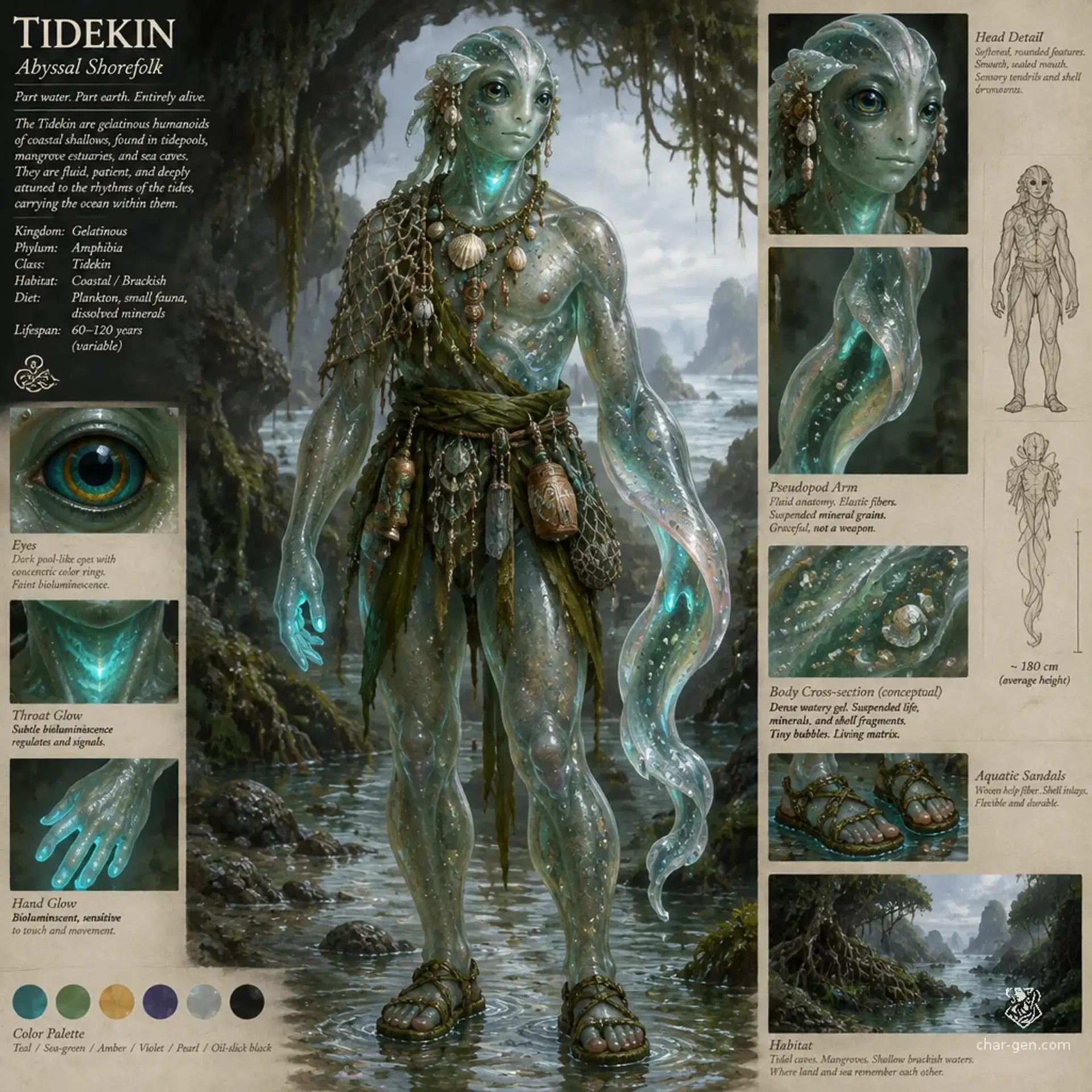
Globsters mature by about 18 years and commonly live 80 to 110 years. Rare elders can reach 140 years, though their bodies gradually become mineralized and less mobile.
Darkvision
60 ft.
Habitat
Coasts, tidal caves, mangrove swamps, river deltas, salt marshes, and subterranean waterways connected to the sea.
amphibious
aquatic
shapeshifter
memory-keeper
coastal
gelatinous
explorer
standard PC ancestry
SizeMedium
Speed30 ft., swim 30 ft.
LifespanGlobsters mature by about 18 years and commonly live 80 to 110 years. Rare elders can reach 140 years, though their bodies gradually become mineralized and less mobile.
Creature TypeHumanoid
Darkvision60 ft.
Globsters are wandering tide-born people whose translucent bodies remember every shore they touch. They can reshape themselves, sense the moods and residues left in water, and survive injuries that would kill more rigid folk. To meet a globster is to meet a living archive of shipwrecks, storms, lost names, and half-forgotten songs, carried inland by a traveler who may be seeking answers, kinship, or simply a place where the water feels right.
Physical Description
Globsters are soft-bodied, semi-translucent humanoids whose appearance varies according to diet, ancestry, mood, and environment. Their bodies resemble dense gel held together by an intricate network of elastic fibers and tiny mineral grains. Most globsters maintain two arms, two legs, and a rounded head when interacting with land-dwellers, but they can soften their edges, flatten themselves, or reshape minor features with practice. Their surfaces range from gray-blue and sea green to amber, pearl, violet, and oil-slick black. Light often glimmers faintly beneath their skin, especially around the eyes, throat, and hands. A globster's eyes are usually dark pools surrounded by sensitive color rings, while their mouths can seal completely when underwater. They have no hair, but many decorate themselves with shells, beads, painted markings, or strips of woven kelp.
Society & Culture
Globsters organize themselves into pools, shoals, and current-houses. A pool is a community connected by shared water, shared history, and mutual responsibility. Shoals are traveling groups that follow seasonal currents, trade routes, or migrating sea life. Current-houses are extended families and professional lineages devoted to navigation, healing, salvage, diplomacy, or memory keeping. Globsters do not always distinguish between biological relatives and people who have shared a birth pool, since communal care is more important to them than ancestry. They regard identity as both continuous and flexible. A person's body, name, memories, and relationships all change over time, yet the community helps preserve the thread connecting each stage.
Religion & Alignment
Globster spirituality centers on the Turning Tide, an impersonal cycle of change, dissolution, return, and renewal. Most communities honor local water spirits, ancestors, and natural forces rather than a single universal god. Globsters tend toward neutral alignments, valuing adaptation and communal survival, but individuals may be compassionate wanderers, stern custodians, playful tricksters, or ruthless opportunists. Their religious ceremonies involve shared water, rhythmic movement, and the exchange of harmless sensory memories.
Homelands & Architecture
Globster settlements form around protected pools, flooded caverns, and broad cisterns. Their buildings combine stone foundations with flexible frames of driftwood, shell, rope, and glazed ceramic. Doorways are often low and rounded, while communal chambers are partially flooded so residents can move between flowing, crawling, and upright shapes. Important buildings contain memory wells, where generations of globsters deposit harmless traces of scent and dissolved mineral that preserve communal impressions.
Relationships With Other Peoples
Globsters are welcomed in many fishing communities but feared in places where people distrust shapeless bodies or associate them with drowning. They trade in navigation, salvage, medicine, weather prediction, and underwater construction. Their ability to absorb traces of memory makes them valued as witnesses and archivists, though it also creates suspicion that they can steal thoughts. Globsters generally regard humanoid peoples as fascinatingly rigid, emotionally loud, and inventive. They form strong friendships with sailors, rangers, healers, and others who live close to changing environments.
Visual sheet
Turn Globster into a sheet
A high-res, share-ready sheet you can post or print.