
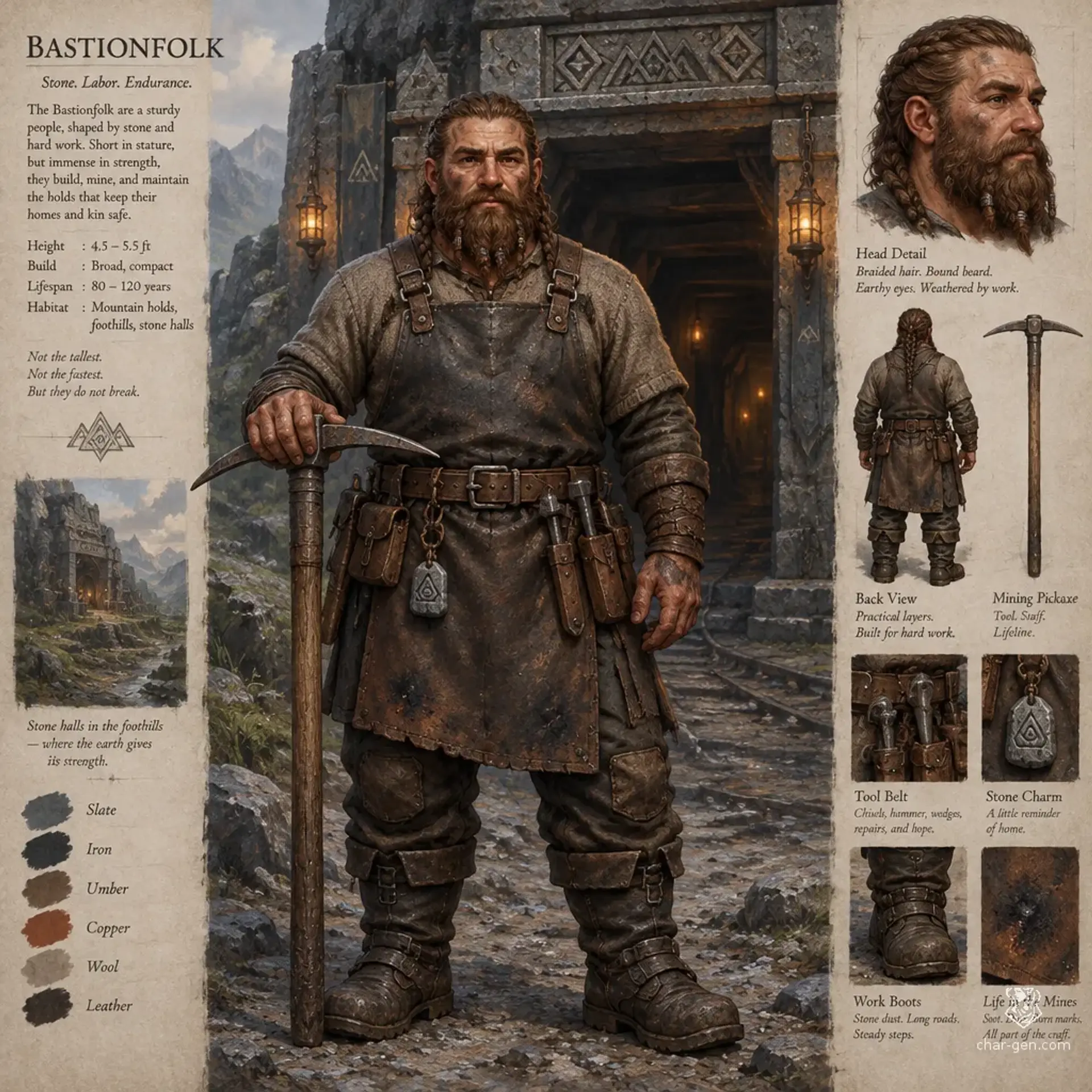
Petricola bastionis
Bastionfolk are the steadfast people of the Dwarf Bastion, a network of stone halls east of Frontier Fort.
At a glance
Darkvision Accustomed to the dark belowground, Bastionfolk can see shapes and movement in dim light and darkness out to 60 ft., though colors are muted in darkness.
Languages Common, Bastion Cant
Height 3 ft. 8 in. to 4 ft. 6 in.
Weight 140 to 220 lb.
Lifespan 250 to 320 years, adult at 40
At the table
Years spent beneath the earth grant Bastionfolk keen sight in darkness, though they perceive only muted color when no light is present.
Bastionfolk are naturally sure-footed on broken stone and accustomed to cramped passages. They are difficult to knock off balance while standing on solid ground.
Their training and cultural traditions make axes and pickaxes familiar weapons. A Bastionfolk adventurer can use these tools confidently in a fight.
Bastionfolk are used to long shifts in mines and forges. They are resilient against ordinary fatigue from strenuous physical labor, though this does not protect them from injury or exhaustion caused by exceptional hardship.
Common, Bastion Cant
Bastionfolk often prize endurance, practical judgment, and steady hands. These are cultural tendencies, not requirements for any individual.
Often have soot-darkened hands, keen attention to heat and airflow, and a strong tradition of apprenticeship.
Forgehall Bastionfolk are smiths, metalworkers, and toolmakers, raised among the ringing anvils and controlled fires of the inner halls.
Bastionfolk are the steadfast people of the Dwarf Bastion, a network of stone halls east of Frontier Fort. Miners, blacksmiths, masons, and defenders, they know the weight of rock and the value of a tool that will not fail. They carry axes and pickaxes as naturally as other folk carry walking sticks, and many consider a well-kept weapon simply another piece of reliable craft.
Bastionfolk are compact, broad-built humanoids with dense bones, powerful shoulders, and hands shaped by generations of hard labor.
Their hair ranges from black and brown to copper, ash, and iron gray, often worn braided or tied back around workshops and mines. Many grow thick beards, though styles vary by individual and family. Their skin commonly carries the faint marks of soot, stone dust, old burns, and calluses. Their eyes tend to be dark or earthy in color, adapted to the low glow of underground lamps.
Underground halls, mines, stone fortresses, and the foothills surrounding their subterranean homes.
Children learn household crafts, safe tunnel practices, and the histories of their kin.
Young adults take on full guild duties, make their own household vows, and may travel beyond the Bastion.
Elders are valued for their accumulated craft knowledge, hard-won judgment, and memory of the halls.
Bastionfolk organize much of daily life around households, craft halls, and mining crews.
Skills are passed through apprenticeship, and a person's reputation is often tied to the care and reliability of their work. Axes and pickaxes serve both as familiar implements and as weapons when the halls are threatened. Communal meals, repair days, and commemorations of lost crews reinforce the idea that survival underground depends on everyone doing their share.
Their faith often honors hearths, ancestors, mountains, and the patient forces that shape stone.
Many keep small shrines near forges or at the entrances to old tunnels. Bastionfolk can follow any moral outlook, though communal duty and keeping one's word are widely respected.
Bastionfolk often build trust through shared work and practical help rather than quick professions of friendship.
They trade tools, metalwork, and tunnel knowledge with neighboring settlements, especially Frontier Fort. Some outsiders mistake their reserve for hostility, while Bastionfolk may regard hurried promises and disposable goods with suspicion. Once trust is earned, their loyalties are usually durable.
The Dwarf Bastion stands east of Frontier Fort, its outer gates set into a rugged slope and its inner halls descending through worked stone.
Broad stairs, load-bearing pillars, drainage channels, and well-marked tunnels make the settlement durable and easy to defend. Carved records and family emblems decorate communal chambers, while forges and workshops cluster near vents that draw smoke toward the surface.
No images yet.
A high-res, share-ready sheet you can post or print.