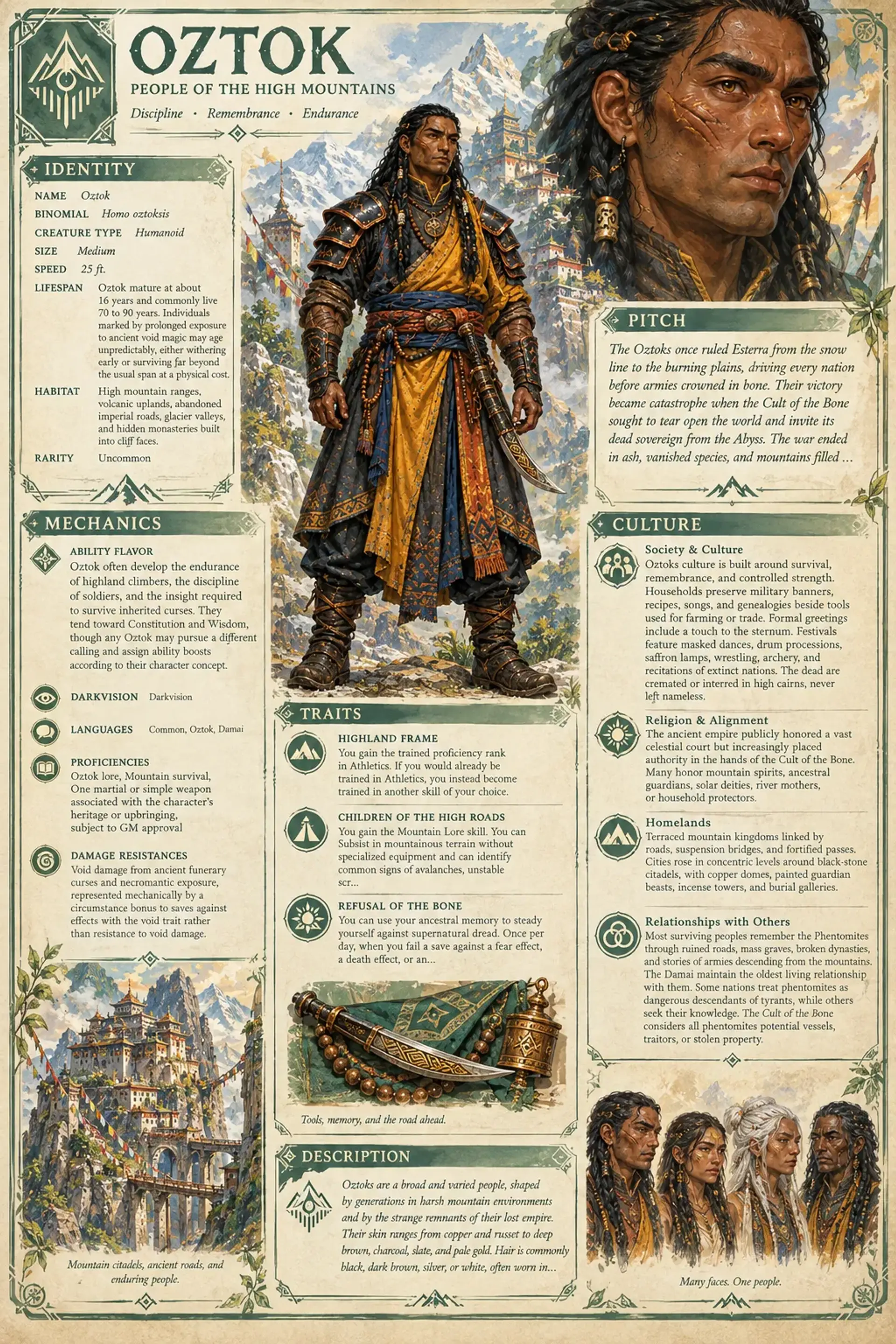
Oztok mature at about 16 years and commonly live 70 to 90 years. Individuals marked by prolonged exposure to ancient void magic may age unpredictably, either withering early or surviving far beyond the usual span at a physical cost.
Darkvision
Darkvision
Habitat
High mountain ranges, volcanic uplands, abandoned imperial roads, glacier valleys, and hidden monasteries built into cliff faces.
ancient civilization
mountain people
warrior culture
necromantic legacy
South Asian inspired
Hindi inspired
lost empire
anti-cult
humanoid
SizeMedium
Speed25 ft.
LifespanOztok mature at about 16 years and commonly live 70 to 90 years. Individuals marked by prolonged exposure to ancient void magic may age unpredictably, either withering early or surviving far beyond the usual span at a physical cost.
Creature TypeHumanoid
DarkvisionDarkvision
The Oztoks once ruled Esterra from the snow line to the burning plains, driving every nation before armies crowned in bone. Their victory became catastrophe when the Cult of the Bone sought to tear open the world and invite its dead sovereign from the Abyss. The war ended in ash, vanished species, and mountains filled with sealed tombs. Now the Oztoks survive as scattered descendants, haunted guardians, and reluctant heirs to an empire that conquered everything except the Damai. When one of them enters the room, history does not remember quietly. It reaches for a weapon.
Physical Description
Oztoks are a broad and varied people, shaped by generations in harsh mountain environments and by the strange remnants of their lost empire. Their skin ranges from copper and russet to deep brown, charcoal, slate, and pale gold. Hair is commonly black, dark brown, silver, or white, often worn in long braids threaded with colored cord, metal rings, or carved bone. Their eyes may be ordinary human shades, but many possess irises flecked with gray, violet, or ember red. Some families bear faint ridge patterns along the brow, cheekbones, shoulders, or spine. These marks are hereditary and harmless, though the Cult of the Bone once treated them as signs of divine favor. Oztoks clothing combines wrapped fabrics, layered wool, lacquered plates, high collars, and protective arm guards. Even peaceful travelers often carry a ceremonial blade.
Society & Culture
Oztoks culture is built around survival, remembrance, and controlled strength. Households preserve military banners, recipes, songs, and genealogies beside tools used for farming or trade. Formal greetings often include a touch to the sternum, acknowledging both the living heart and the bones that will remain. Public debate is valued, but uncontrolled anger is considered dangerous because the empire taught them how easily discipline can become obedience. Festivals feature masked dances, drum processions, saffron lamps, wrestling, archery, and recitations of extinct nations. The dead are cremated or interred in high cairns, never left nameless. A household that cannot identify its ancestors adopts names from the lost. Martial training remains common, yet the highest cultural praise is reserved for those who possess strength and choose not to dominate.
Religion & Alignment
The ancient empire publicly honored a vast celestial court but increasingly placed authority in the hands of the Cult of the Bone. That cult promised an age without decay by covering Esterra in darkness and bringing the Dark Lord of Bones from the Abyss into the Material Plane. Many honor mountain spirits, ancestral guardians, solar deities, river mothers, or household protectors.
Homelands & Architecture
The old Oztoks heartlands were terraced mountain kingdoms linked by roads, suspension bridges, and fortified passes. Their cities rose in concentric levels around black-stone citadels, with copper domes, painted guardian beasts, incense towers, and burial galleries descending deep into the earth. Old imperial ruins remain dangerous, because many were built to serve as gates for the underworld.
Relationships With Other Peoples
Most surviving peoples remember the Phentomites through ruined roads, mass graves, broken dynasties, and stories of armies descending from the mountains. The Damai maintain the oldest living relationship with them, shaped by centuries of conflict, trade, refuge, and uneasy respect. Some nations treat phentomites as dangerous descendants of tyrants, while others seek their knowledge of lost roads and sealed ruins. Phentomites respond in different ways. Some conceal their ancestry, some wear it openly as a warning, and others devote their lives to repairing the damage left by their forebears. The Cult of the Bone considers all phentomites potential vessels, traitors, or stolen property.
Ready
Turn Oztok into a sheet
A high-res, share-ready sheet you can post or print.