
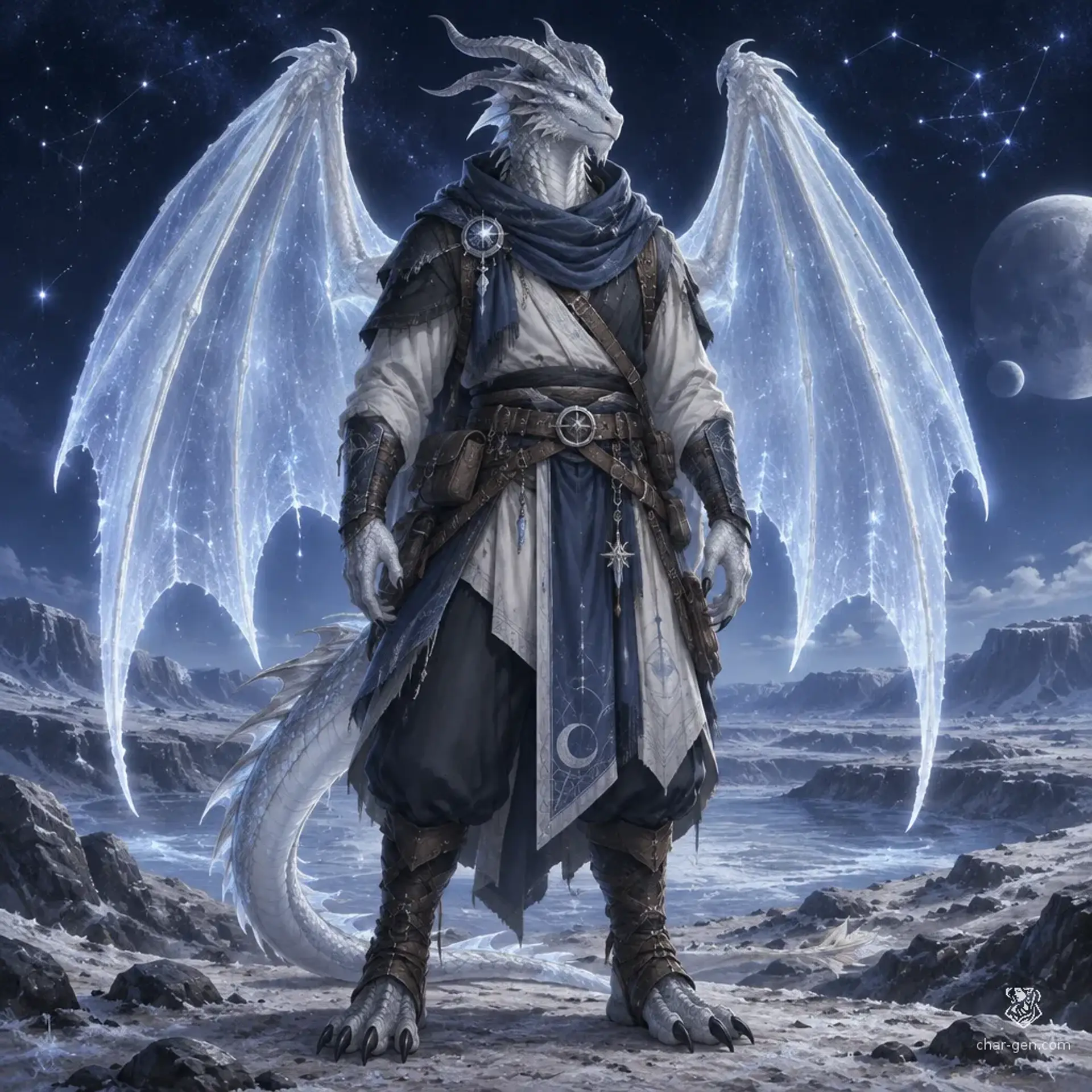
Dracoleuca lunaris
A lunar dragonborn descends from an otherworldly dragon lineage, arriving beneath a night sky that may not belong to this world.
At a glance
Darkvision 60 ft.
Languages Common, Draconic, Lunarspeech
Resistances Cold
Height 8 to 10 feet
Weight 450 to 800 pounds
Lifespan 250 to 400 years, adult at 18
At the table
You are Large rather than Medium or Small. You occupy a 10-foot-by-10-foot space. Your size affects what equipment fits you and how you interact with spaces or features that specify a creature's size.
Your spectral wings grant you a flying speed of 30 feet. You can fly continuously, including while wearing armor, though you cannot fly while incapacitated or restrained. The wings are visible but insubstantial and do not grant hands or an additional attack.
You have resistance to cold damage. You can also see in dim light within 60 feet of yourself as if it were bright light, and in darkness as if it were dim light.
When you take the Attack action, you can replace one attack with an exhalation of freezing breath in a 15-foot cone. Each creature in the area must make a Dexterity saving throw, with a DC equal to 8 plus your Constitution modifier and Proficiency Bonus. On a failed save, a creature takes cold damage; on a successful save, it takes half as much. The damage increases to at character level 5, at level 11, and at level 17. You can use this breath a number of times equal to your Proficiency Bonus, regaining all expended uses when you finish a Long Rest.
You know the Common and Draconic languages, and you can speak, read, and write Lunarspeech, a language of measured phrases and tonal inflections used by your people. If your setting does not use Lunarspeech, work with the DM to choose an appropriate additional language.
Common, Draconic, Lunarspeech
Cold
Lunar dragonborn often show endurance and perceptiveness shaped by life beneath unfamiliar skies. These are tendencies, not fixed bonuses: assign +2 and +1 to any ability scores, or +1 to three different scores, as appropriate for your table.
Their wing-glow forms sharp, crescent-shaped edges, and their breath leaves lacework frost on stone.
Crescent-blood families traditionally serve as pathfinders and boundary wardens. They favor direct speech and are often the first to volunteer for dangerous crossings.
A lunar dragonborn descends from an otherworldly dragon lineage, arriving beneath a night sky that may not belong to this world. Large and unmistakable, they cross the air on permanent wings of spectral moonlight and exhale a killing chill. Some seek a home among the stars; others have come to discover why the moon keeps calling them back.
Lunar dragonborn are imposing, broad-framed dragonfolk, usually standing between eight and ten feet tall.
Their scales range from frost-gray and blue-black to pale pearl, often catching light like polished stone. Horns, ridges, and tails vary by family, while their eyes commonly reflect a faint silver glow. Their wings are spectral: vast, featherless shapes of translucent moonlight that trail motes like drifting frost. They can pass through narrow gaps when folded close, but flare into a striking span in flight. The wings do not feel solid to the touch, though the dragonborn's body and carried equipment are wholly physical.
Otherworldly reaches, especially moonlit demiplanes, astral refuges, and high plateaus beneath unfamiliar constellations
Hatchlings are born with faint wing-shaped glimmers and learn to control their breath before they can fly.
Young adults undertake a solitary crossing of the open sky, returning with a chosen name and a promise to their community.
Mature individuals often become navigators, lorekeepers, envoys, or guardians of the paths between worlds.
Elders may grow translucent at the edges, their memories and silhouettes seeming to drift among the stars.
Lunar dragonborn communities organize around shared routes, observances, and mutual responsibility rather than a single throne.
They mark time by changes in light and keep detailed oral records of journeys, since the constellations of their birthplaces may not appear elsewhere. Hospitality is a serious custom: a guest is offered shelter and a safe place to land, while a host is expected to answer direct questions honestly. Their culture is not uniform, and isolated families often adopt local traditions.
Many honor the moon as a witness and keeper of cycles, without treating it as a single universal deity.
Others follow draconic ancestors, local gods, or the stars of their homeland. Their outlooks vary widely; communities tend to value deliberate action, but individual members may be merciful, ambitious, rebellious, or stern.
Their size and effortless flight can make them seem distant or imposing, but many are attentive hosts and careful listeners.
They often treat ground-bound companions with respect rather than pity, while expecting those companions to be candid about practical limits. Their otherworldly origins invite awe, suspicion, and unwanted claims of kinship from dragons and scholars alike.
Their settlements are built where horizons remain visible: crater rims, floating shelves of stone, and terraces suspended above cloud or void.
Broad landings, roofless gathering halls, and gently sloping ramps accommodate large bodies and frequent arrivals by air. In communities without stable ground, homes may be anchored to drifting islands by luminous cables.
No images yet.
A high-res, share-ready sheet you can post or print.