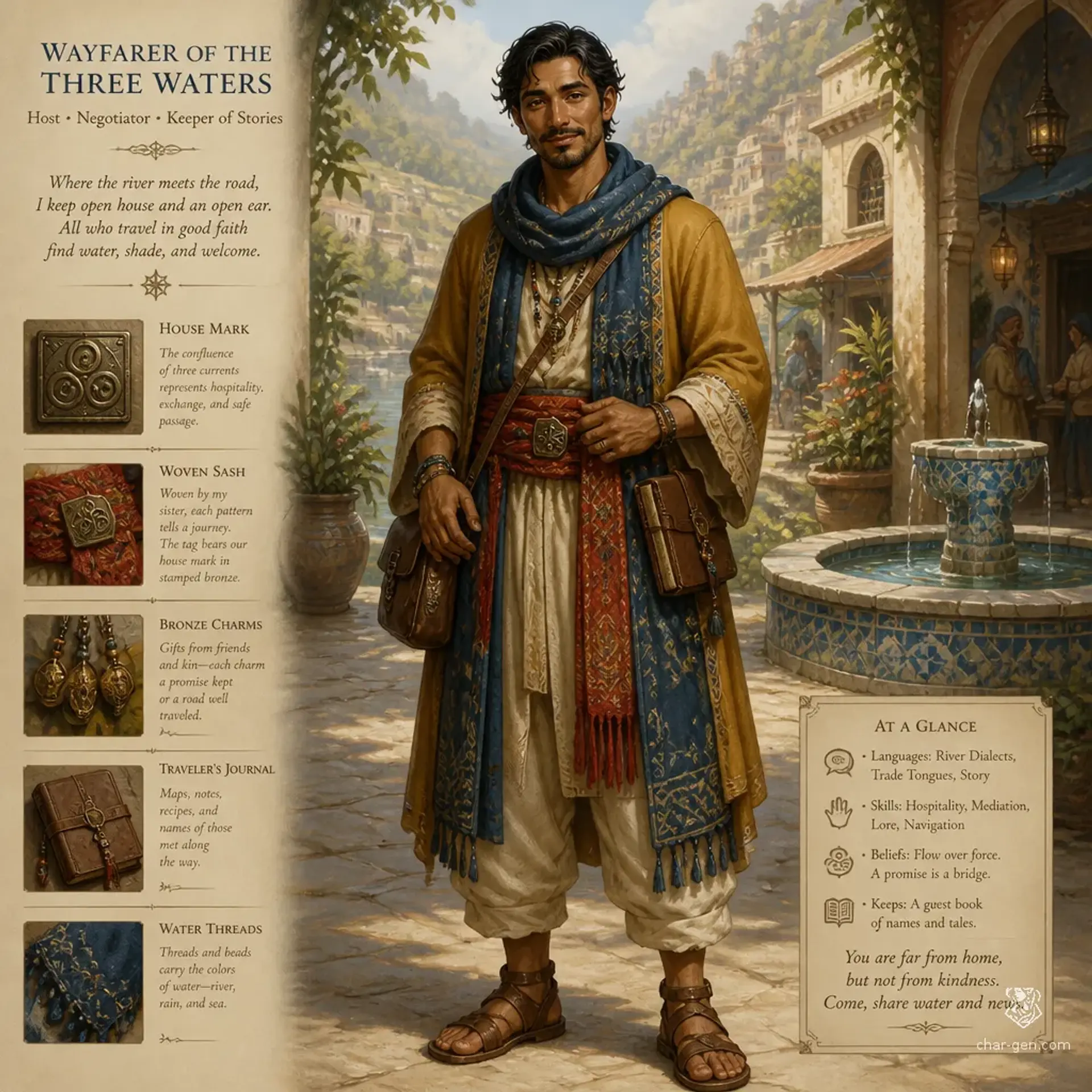
Veyari mature at much the same pace as other humans and commonly live 70 to 100 years. Exceptional elders may reach 110.
Habitat
Nearly anywhere people gather: river valleys, dry uplands, forest margins, crowded ports, highland terraces, and caravan roads. Veyari communities are especially common where several cultures meet.
human-based
adaptable
wanderer
community-minded
storyteller
common ancestry
SizeMedium
Speed30 ft.
LifespanVeyari mature at much the same pace as other humans and commonly live 70 to 100 years. Exceptional elders may reach 110.
Creature TypeHumanoid
The Veyari are wanderers, builders, healers, judges, artisans, and keepers of long memory. They do not share one bloodline so much as a way of meeting the world: with a welcoming hand, a well-told story, and the conviction that every person is shaped by the roads behind them. A Veyari adventurer may leave home to repay an old debt, test a family legend, master a craft, or discover which parts of tradition deserve to survive.
Physical Description
Veyari are human in their broad range of forms, with great variation in complexion, stature, hair texture, and facial features. Their appearance reflects the many climates and peoples among whom they have lived. Most favor clothing that is layered, breathable, and suited to movement, often accented by scarves, sashes, beads, stamped metal, or dyed thread. Personal adornment commonly records family, apprenticeship, pilgrimage, marriage, mourning, or a vow. Even among strangers, Veyari often recognize one another by the custom of wearing a visible household mark somewhere on the clothing or body.
Society & Culture
Veyari society is organized around households, guilds, neighborhood councils, and circles of obligation rather than a single empire or doctrine. Storytelling is a civic art, and a person's reputation often rests on how they treat guests, apprentices, dependents, and rivals. Meals are social contracts, names carry layered histories, and public festivals renew ties between communities. Veyari are ambitious without universally equating success with wealth. A respected life may be measured by the number of people taught, sheltered, healed, reconciled, or inspired.
Religion & Alignment
Veyari religion is diverse, but common practices emphasize ancestors, household guardians, sacred rivers, living mountains, seasonal festivals, and the moral importance of hospitality. Many Veyari maintain small home shrines or remembrance shelves rather than grand temples. Their cultures produce people of every alignment, though communal expectations often favor generosity, responsibility, and keeping one's word.
Homelands & Architecture
Veyari homelands are built around shade, water, and shared thresholds. Courtyard homes, stepped wells, pillared markets, hillside terraces, and roadside shelters are common. Architecture often combines practical climate design with intricate screens, painted doorways, roof gardens, and carved family symbols. A Veyari dwelling is understood to include not only its rooms but also its guest space, cooking fire, and the public path beyond its gate.
Relationships With Other Peoples
Veyari are accustomed to living beside other peoples and borrowing freely from neighboring customs. They are often valued as translators, mediators, merchants, teachers, and hosts, though their adaptability can be mistaken for a lack of conviction. Veyari families may be defined by blood, adoption, apprenticeship, shared faith, or sworn friendship. In many communities, the phrase 'of our house' is deliberately broader than 'of our kin.'
Visual sheet
Turn Veyari into a sheet
A high-res, share-ready sheet you can post or print.