
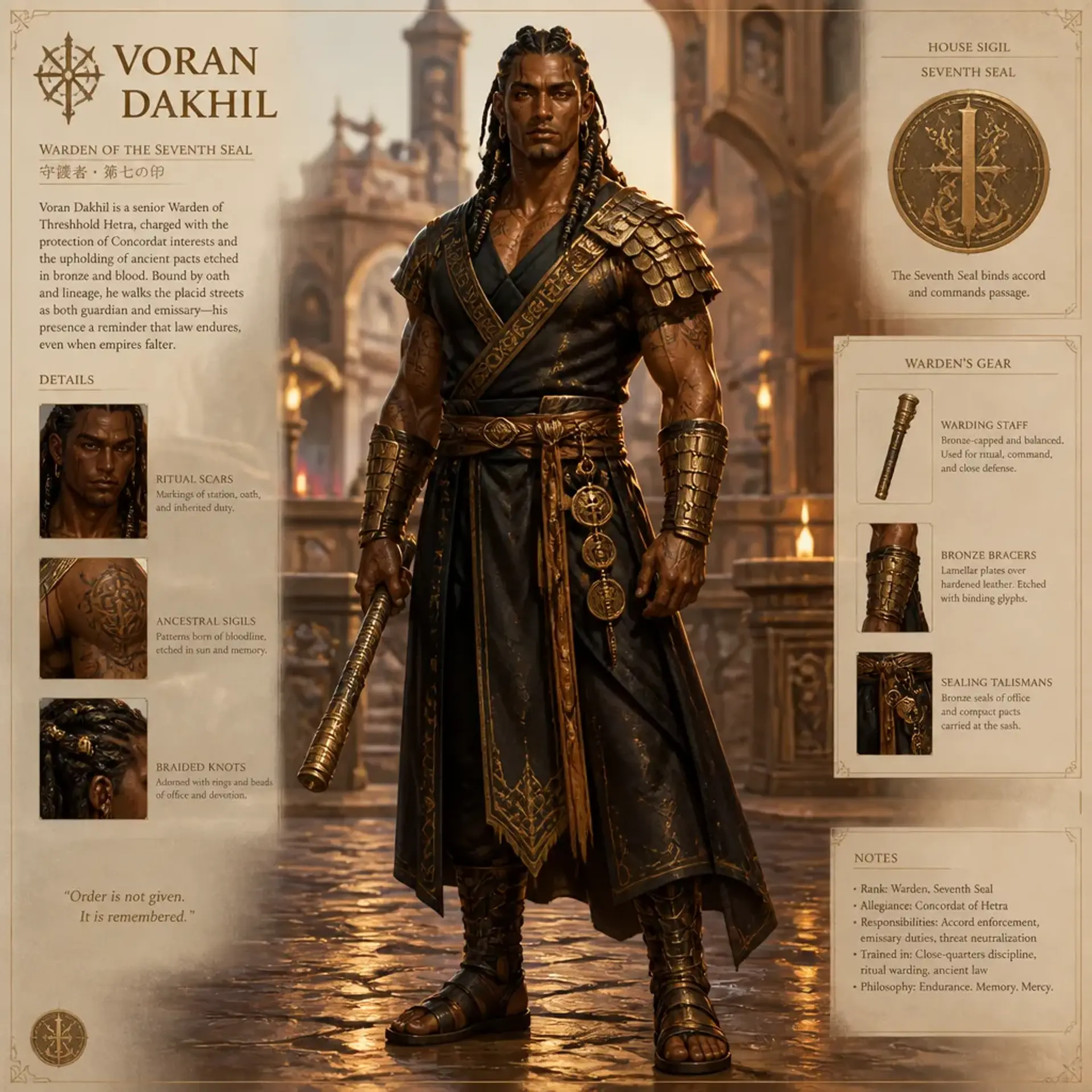
In the candlelit avenues of their bronze cities live towering warrior-scholars who see combat as an art of civic duty and lineage as a sacred trust. The Aureclan Wardens are famed for their thousand-year lives, formidable martial schools, and strict codes of honor, yet every house also raises poets, judges, healers, and builders. Adventurers among them carry the weight of a long memory and an even longer vow, and when they enter a campaign, it is usually to defend a city that remembers every debt ever owed.
Aureclan Wardens are tall, powerfully built humanoids with broad shoulders, dense muscle, and a regal bearing that makes even a still stance seem ready for battle. Most are female-presenting, though their biology is broadly dual-fertile rather than strictly divided by the categories other peoples expect, and they are known for bearing children regardless of the role they later choose in life. Their skin ranges from sunlit bronze to deep umber and pale gold, often marked with ritual scars, painted sigils, or inherited patterns that signify house, rank, and oath. Their eyes are usually bright and steady, and their hair is worn in braids, coils, knots, or cropped warrior cuts adorned with metal rings or glass beads.
Aureclan Wardens are raised in houses that function as both family and academy. From childhood they learn history, civic law, weapon craft, song, and the etiquette of public dispute. Their culture prizes self-mastery, visible preparedness, and the belief that every strength must answer to a responsibility. Because their lifespans are so long, memory is sacred, and names of the dead are recited at public meals, painted on walls, and archived in living genealogies maintained by trained keepers. Their long lives also make them patient planners, but they can become severe when a promise is broken, since to them betrayal is not a momentary failure but an injury that may echo for centuries.
Their faith is usually tied to oathkeeping, ancestors, city guardians, and the turning of seasons through public rites. They are not naturally inclined toward any one alignment, though their social traditions encourage law, duty, and measured force. Even those who rebel against their houses often keep the language of honor, because to them, morality is inseparable from accountability.
Their cities are built in terraces, court halls, training yards, bathhouses, and archive towers. Homes are arranged around communal courtyards so that no household stands alone, and every district includes places for exercise, debate, and public ritual. Their architecture favors thick stone, polished bronze, carved reliefs, and broad stairways made for ceremony and defense alike.
They respect competence, kept promises, and visible preparation. Many outsiders mistake them for aloof conquerors, but in truth they are deeply civic minded and often protective of allies who earn their trust. They tend to have complicated relations with patriarchal societies, mercenary cultures, and any realm that values impulse over duty. Once a bond is formed, however, they are famously steadfast and difficult to dislodge from an oath.
A high-res, share-ready sheet you can post or print.