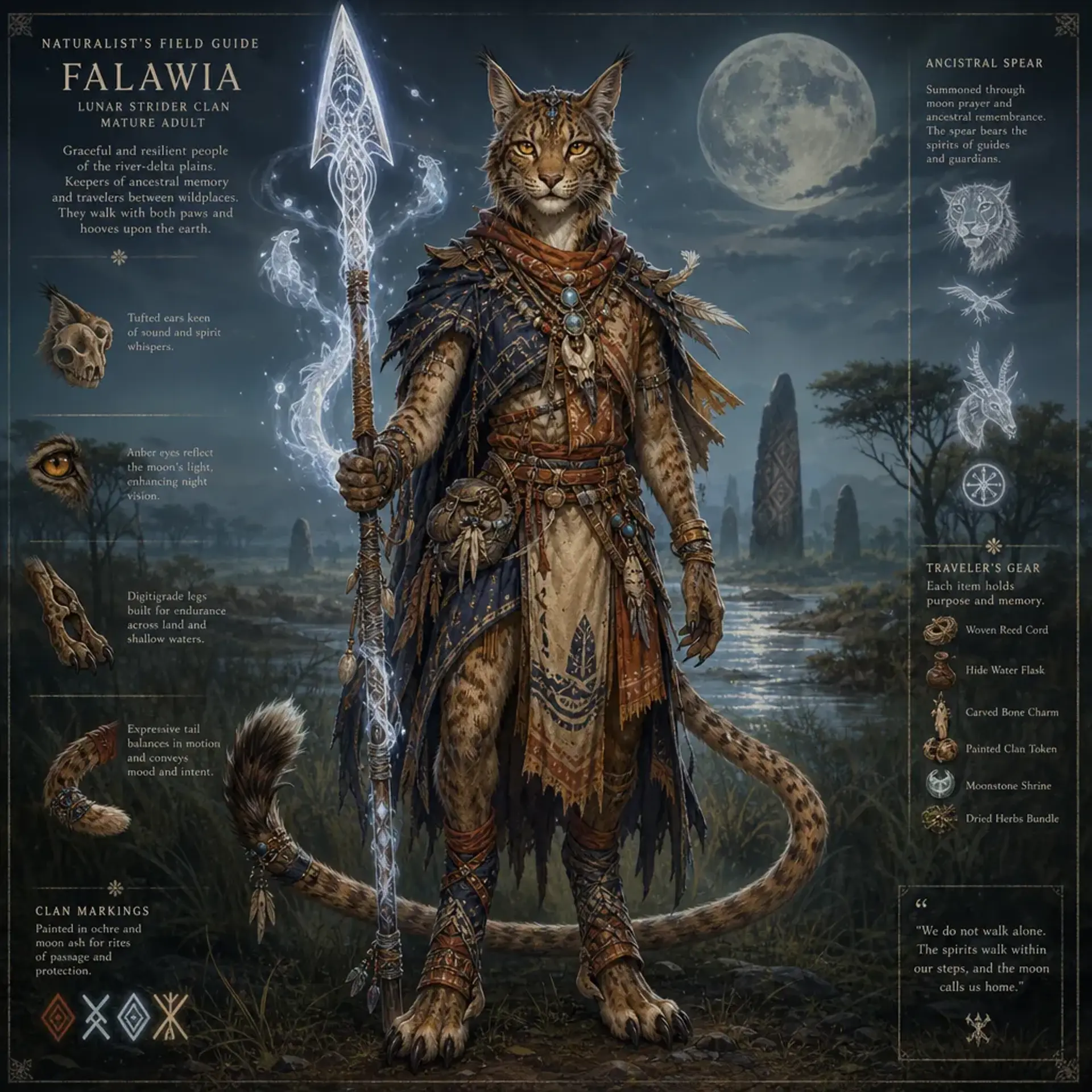
Falawia mature physically at about 16 years and commonly live 80 to 110 years. Elders who remain closely tied to ancestral rites sometimes survive longer, though their bodies may grow increasingly animalistic.
Darkvision
60 ft. in dim light as if it were bright light and in darkness as if it were dim light
Habitat
Open grasslands, moonlit forests, river deltas, thorn deserts, coastal marshes, and highland routes connected by seasonal migration
shape-shifter
spirit caller
moon-touched
nomadic
beast-traited
ancestral magic
explorer
SizeMedium
Speed30 ft.
LifespanFalawia mature physically at about 16 years and commonly live 80 to 110 years. Elders who remain closely tied to ancestral rites sometimes survive longer, though their bodies may grow increasingly animalistic.
Creature TypeHumanoid
Darkvision60 ft. in dim light as if it were bright light and in darkness as if it were dim light
The Falawia are moon-bound wanderers who walk between the living world and the country of spirits. They can become tiger, panther, gazelle, horse, crocodile, serpent, or other forms shaped by lineage and personal destiny, then call weapons made from ancestral memory to strike beings untouched by ordinary steel. A Falawia adventurer may be a scout following a vanished spirit trail, a disgraced ritualist seeking to restore a broken bond, or a young trail-walker determined to learn whether the voices of the dead are truly wise.
Physical Description
Falawia are humanoids whose bodies bear one or more unmistakable bestial traits. Some have feline eyes, retractable claws, whisker-spots, tails, or rounded ears. Others possess long ears, powerful legs, narrow faces, small horns, or split hooves reminiscent of swift plains animals. Reptilian Falawia may have armored hides, broad jaws, crests, tails, or flattened teeth. Many have patterned skin, fur, feathers, or scales that become more pronounced under moonlight. Their shape-shifting is not an illusion. Bone, muscle, hide, and hair flow into a chosen animal form with a sound like wind moving through dry grass. Even in humanoid guise, no Falawia is entirely without an animal sign.
Society & Culture
Falawia live in nomadic tribes organized around extended families, sworn companions, and circles of spiritual responsibility. Leadership is earned through service, judgment, and successful trials rather than inherited automatically. Every adult is expected to master at least one practical discipline and one spiritual discipline. Their trials may involve tracking a dangerous beast, surviving alone beneath a new moon, carrying a message through haunted country, or confronting a personal fear in the spirit realm. Stories are preserved through chants, painted hides, carved tokens, dance, and carefully repeated genealogies. A person's animal form is considered a conversation with their ancestors, not a costume or disguise.
Religion & Alignment
Falawia spirituality centers on the Moon Above, the Breath Between, and the countless ancestors who continue to advise the living. They do not always agree on whether these are separate powers or different faces of one sacred mystery. Rituals include moon dances, silent hunts, dream vigils, offerings of water, and journeys into the spirit world. Falawia are often neutral, good, or chaotic, valuing personal responsibility, communal balance, and freedom of movement over rigid law. Evil Falawia may twist spirit bargains, impersonate ancestors, or treat living beings as tools.
Homelands & Architecture
Falawia homelands are rarely fixed borders. Tribes travel between remembered places, following game, water, weather, and spiritual signs. Their camps are arranged around a central fire or moonstone shrine, with portable shelters made from hide, woven fiber, reed, and painted canvas. Semi-permanent settlements use curved earthworks, elevated platforms, river-stone foundations, and structures designed to welcome both living visitors and wandering spirits. Important sites are marked by standing stones, carved poles, bone chimes, and paths that only become visible beneath certain moons.
Relationships With Other Peoples
Falawia are often welcomed as guides, hunters, wardens, and interpreters of haunted places, but their ability to change shape can make settled communities uneasy. They value hospitality and judge outsiders by how they treat animals, graves, promises, and the vulnerable. Falawia generally respect other peoples who maintain strong ancestral traditions, while distrusting necromancers, spirit binders, and rulers who claim ownership over the dead. Their tribes may trade widely, yet they rarely surrender their sacred routes or permit strangers to disturb ancestral sites.
Visual sheet
Turn Falawia into a sheet
A high-res, share-ready sheet you can post or print.