Medium or Small, chosen when you select this species
Common
Humanoid
Humanoid·Medium or Small, chosen when you select this species
Clearwater Folk
Homo fluentis
Speed
30 ft.
Lifespan
Clearwater Folk mature at much the same pace as other humans and commonly live 75 to 95 years. Exceptional elders may reach 110 years, especially in communities with clean water, strong medical traditions, and low exposure to war.
Habitat
River valleys, lake shores, coastal marshes, fertile floodplains, wooded waterways, and any settled region shaped by reliable access to fresh water.
human-based
adaptable
community-minded
waterwise
traveler
common ancestry
SizeMedium or Small, chosen when you select this species
Speed30 ft.
LifespanClearwater Folk mature at much the same pace as other humans and commonly live 75 to 95 years. Exceptional elders may reach 110 years, especially in communities with clean water, strong medical traditions, and low exposure to war.
Creature TypeHumanoid
Clearwater Folk are human wanderers, settlers, ferriers, healers, and keepers of hard-won local knowledge. They understand that every road eventually meets a crossroads, every promise creates a current, and every community survives by sharing what cannot be replaced. A Clearwater adventurer may be gentle without being soft, practical without being unimaginative, and restless without ever forgetting where home lies.
Physical Description
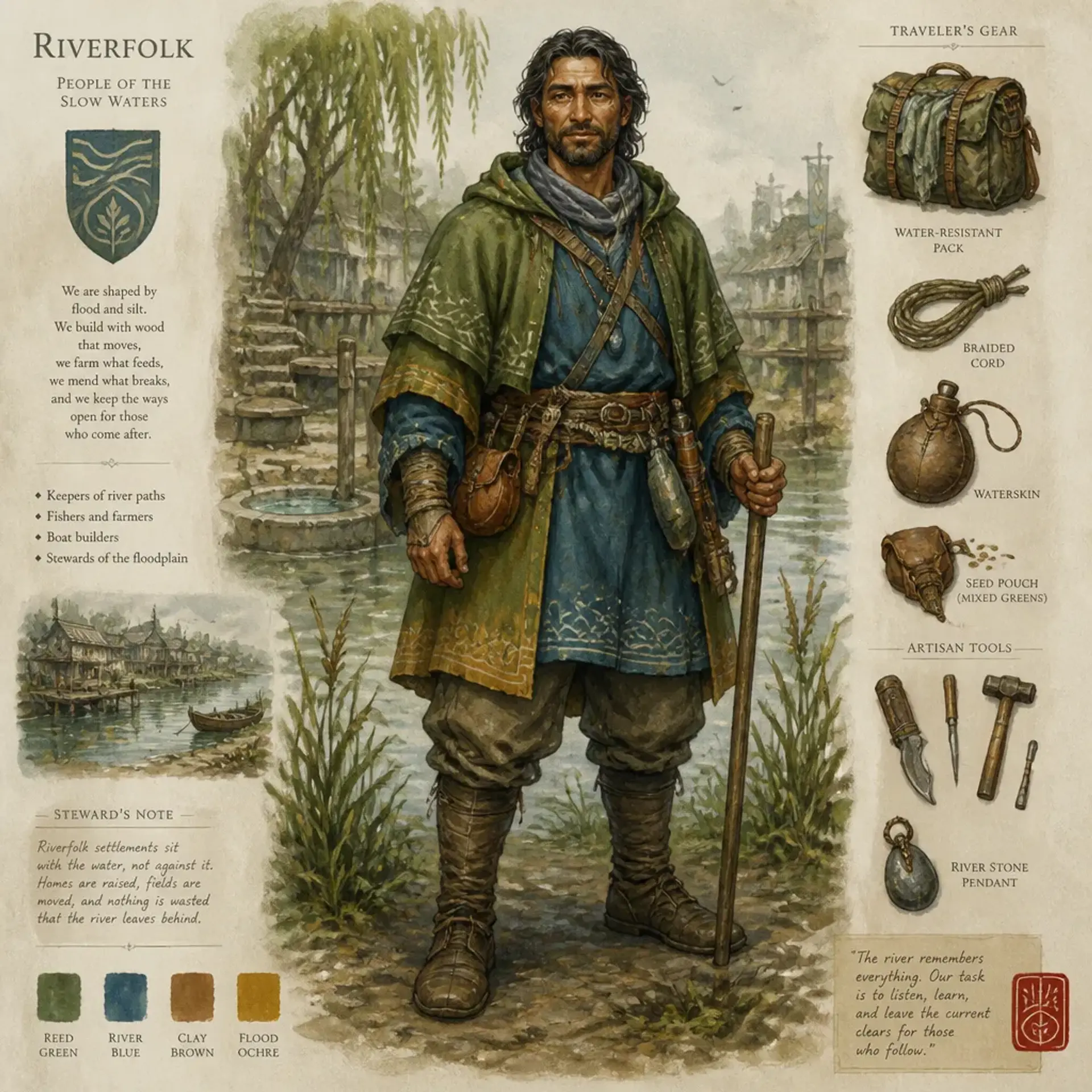
Clearwater Folk possess the broad range of appearances found among humans, with skin tones, hair textures, facial features, and body types shaped by countless generations of migration and intermarriage. Their communities often show subtle regional patterns: pale eyes are common in misty northern valleys, sun-browned skin in open floodplains, and dark hair in old coastal settlements. Many Clearwater people bear practical signs of their upbringing, including strong hands, weathered feet, compact travel packs, water-resistant clothing, or small scars from boats, tools, and rough terrain. Their most distinctive cultural feature is not biological but habitual: they assess a room the way others assess a river, noting entrances, currents of movement, and where danger might gather.
Society & Culture
Clearwater society is organized around households, work circles, and watersheds rather than strict bloodlines. A person may belong simultaneously to a family, a craft, a neighborhood, and a network of people who share responsibility for a particular spring, canal, ferry, or stretch of coast. Hospitality is treated as both kindness and infrastructure. Guests are fed, warned about local hazards, and told who can be trusted. Storytelling favors firsthand accounts, remembered routes, and tales of people who survived by cooperation. Disputes are often settled through witness testimony, practical restitution, or a public act that restores what was damaged.
Religion & Alignment
Clearwater Folk honor deities and spirits associated with travel, harvest, healing, weather, rivers, thresholds, and renewal. Some maintain household shrines containing a cup of clean water, a local stone, and a written name of the dead. Their outlooks range widely, though communal traditions often encourage benevolence, responsibility, and respect for natural cycles. A Clearwater person may be lawful because they value reliable agreements, chaotic because they distrust rigid channels, or anything between.
Homelands & Architecture
Clearwater homelands are built around access, shelter, and memory. Their villages favor raised walkways, broad porches, sluice gates, communal wells, and houses positioned to withstand seasonal flooding. River towns often grow in linked terraces, with public steps descending to docks and gathering places. Even inland communities preserve a symbolic watercourse, such as a tiled channel, rain garden, or stone basin, to remind residents that prosperity depends upon circulation rather than possession.
Relationships With Other Peoples
Clearwater Folk are found among nearly every people and often serve as intermediaries between cultures. They are valued as guides, healers, traders, pilots, and negotiators because they tend to remember practical details that others overlook. Their adaptability can also make them seem rootless to more insular societies. Clearwater communities generally judge outsiders by how they treat dependents, shared resources, and the vulnerable rather than by ancestry or status.
Visual sheet
Turn Clearwater Folk into a sheet
A high-res, share-ready sheet you can post or print.