
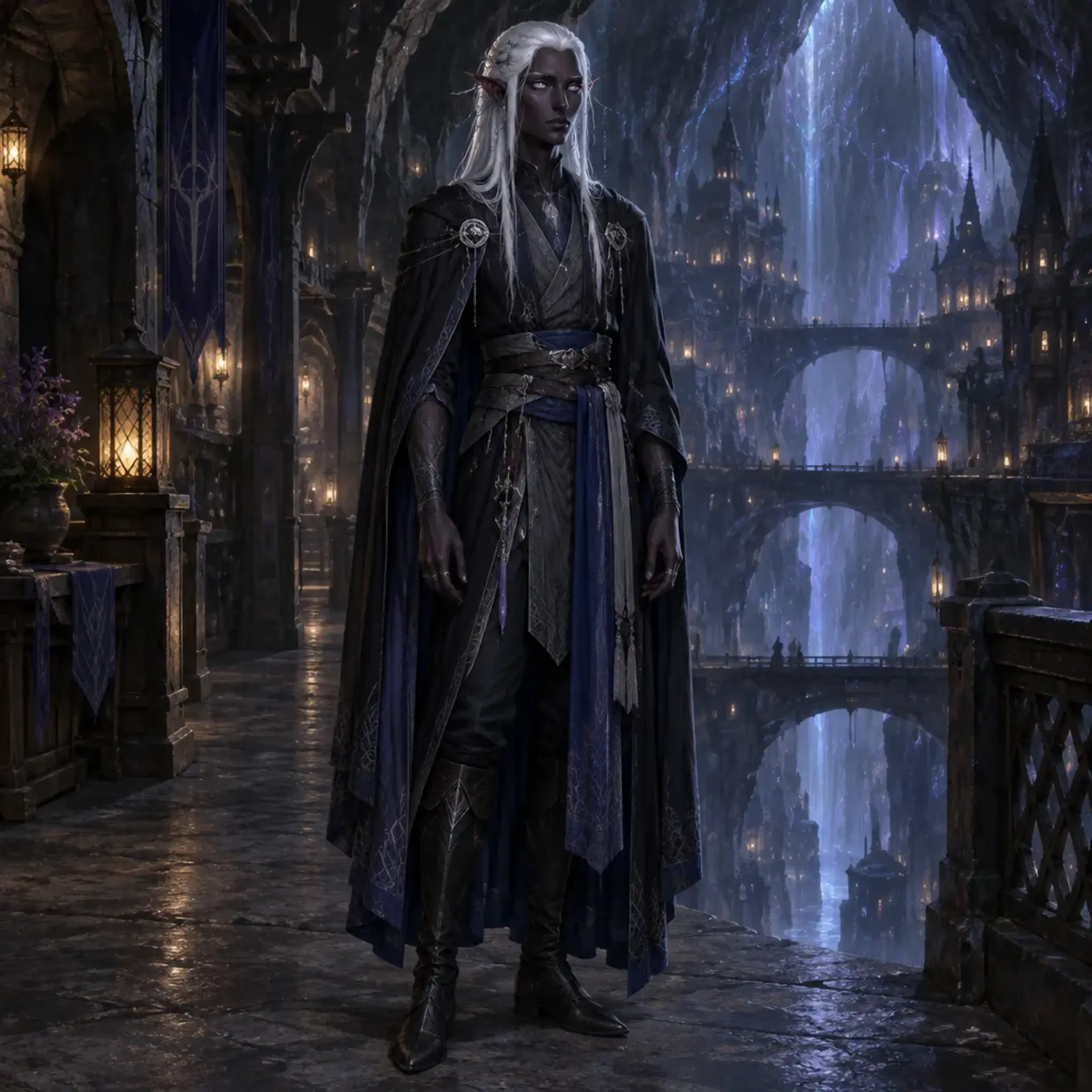
Noctielus tenebris
Beneath Ryma's cities and wilderness, the duskborn built a civilization of glittering halls, leyline vessels, and fiercely guarded family names.
At a glance
Darkvision Darkvision
Languages Common, Elven, Undercommon
Height 5 ft. 4 in. to 6 ft. 2 in.
Weight 105 to 175 lb.
Lifespan 600 to 750 years
At the table
As a Pathfinder 2E ancestry, duskborn characters use the standard ancestry rules and choose ancestry feats at the levels specified by the game. Their typical build favors quick movement and adaptability rather than exceptional bulk.
Accustomed to life in lightless caverns, duskborn can see in darkness and dim light. Darkvision is a standard ancestry sense; it does not grant sight through magical darkness.
Duskborn are at home in crowded settlements and layered underground cities. This cultural familiarity does not grant a universal skill proficiency; a character's background and feats determine their trained skills.
Common, Elven, Undercommon
Duskborn tend to prize intellect and force of personality, qualities cultivated by generations of fierce social competition. In Pathfinder 2E, choose ancestry boosts and flaws according to the system's normal character creation rules rather than treating these cultural tendencies as mandatory.
Their eyes frequently show pale silver, lilac, or pink hues, and their formal dress favors polished metal and intricate web patterns.
Raised within established noble lineages, houseborn duskborn are trained in etiquette, genealogy, and political maneuvering. Their refinement is often mistaken for effortless grace, though it is the product of demanding instruction.
Beneath Ryma's cities and wilderness, the duskborn built a civilization of glittering halls, leyline vessels, and fiercely guarded family names. They call their dark coloring a divine favor; their surface kin call it a mark of ancient treachery. A duskborn adventurer may be an envoy, exile, house agent, or simply someone who has decided that the world is larger than the rivalries that shaped them.
Duskborn resemble other elves in their long limbs and fine features, but their builds are typically wiry and athletic.
Their faces are sharply defined, and generations of deliberate selection among some noble houses have made conventional beauty a cultivated status marker. Skin ranges from deep gray to jet-black and obsidian, with dark blue and purple tones also occurring. Bright red eyes are common; pale blue, lilac, pink, and silver eyes are frequent, while green, brown, black, amber, and rose hues are less often seen. Hair is usually stark white or pale yellow, with silver and copper rarer. They favor long hair arranged with precious-metal pins and web-like ornaments. Duskborn do not grow full beards, though some grow fine facial down.
Urban
A child is raised within the household and its web of obligations. Their early education includes history, etiquette, and the names of allies and rivals.
A young duskborn is expected to demonstrate competence and loyalty. Many leave home as envoys, scouts, adventurers, or agents of a house.
Duskborn mature physically at a pace comparable to other elves, but are generally not considered fully established until they have secured a reputation and meaningful bonds.
Elders are repositories of precedent and grudges. Their counsel can preserve a house, though old rivalries may make them dangerous arbiters.
Duskborn society is strongly matriarchal, organized around noble houses led by matriarchs and supported by a powerful priesthood.
Intellect, persuasive presence, and political acuity have long been rewarded in the struggle between houses. Their ancestors opposed the peace sought by the elven leader Corellon Larethian during a civil war roughly two thousand years ago, clinging instead to expansionist ambitions. After their defeat, the priesthood of Lolth led them underground. Surface elves often describe their dark skin as a curse imposed for treachery; duskborn tradition regards it as a sign of divine favor. Hospitality is among the highest duties of honor. Feasts are sacred occasions and rare spaces where all participants are guaranteed safety. House leaders hold blót rites and feasts to strengthen legitimacy, seek divination, or sway legal proceedings. Some ceremonies include sacrificial offerings, a practice with a grim history and fierce dissent within duskborn communities.
Duskborn honor the wider elven pantheon but give special reverence to Lolth, goddess of fate, secrets, and revenge.
Her priesthood wields power comparable to that of the noble houses. Religious practice ranges from private divination to public ceremonies. At formal feasts, sacrifices may be offered to seek favor, legitimize a ruler, or influence a legal judgment. In older days these offerings were animals; some houses now sacrifice criminals, enslaved people, or captives, a custom opposed by many duskborn and condemned by much of the wider world. Duskborn have no single alignment: their cultures prize loyalty and hospitality, but can also reward ruthless ambition.
Duskborn often approach outsiders with reserve, and most assume their own traditions to be superior.
Yet hospitality is a binding obligation, and a guest formally welcomed into a home or feast is protected regardless of origin. Relations with other elven peoples remain strained by competing accounts of the ancient exile. Individual duskborn vary widely: some pursue trade and diplomacy, while others maintain the old expansionist ambitions or seek vengeance for perceived slights.
Most duskborn dwell in immense undercities built around mineral caverns, leyline junctions, and ancient halls.
Their structures combine carved stone, dark timber, metal screens, and high bridges over deep shafts. Noble residences are designed to display lineage and control: guests pass through guarded thresholds into carefully staged halls where feasts, negotiations, and divinations take place. In recent centuries, some duskborn have established enclaves across Ryma. Enchanted vessels follow ley currents between distant ports, carrying traders, envoys, and raiders alike.
No images yet.
A high-res, share-ready sheet you can post or print.