Half-elves mature at roughly the same pace as humans and commonly live 120 to 180 years. Rare individuals survive longer, but they remain shorter-lived than true elves.
Darkvision
60 ft.
Habitat
Urban
half-elf
human-elf ancestry
urban
border towns
adaptable
fey ancestry
standard PC ancestry
SizeMedium
Speed30 ft.
LifespanHalf-elves mature at roughly the same pace as humans and commonly live 120 to 180 years. Rare individuals survive longer, but they remain shorter-lived than true elves.
Creature TypeHumanoid
Darkvision60 ft.
Half-elves are the people of thresholds, born from human and elven families but claimed fully by neither. They know the warmth of crowded streets, the sting of being measured against an absent heritage, and the quiet strength of building a life from more than one inheritance. In every city, a half-elf may be a magistrate, dockworker, priest, thief, scholar, soldier, or neighbor, carrying old blood through very ordinary days.
Physical Description
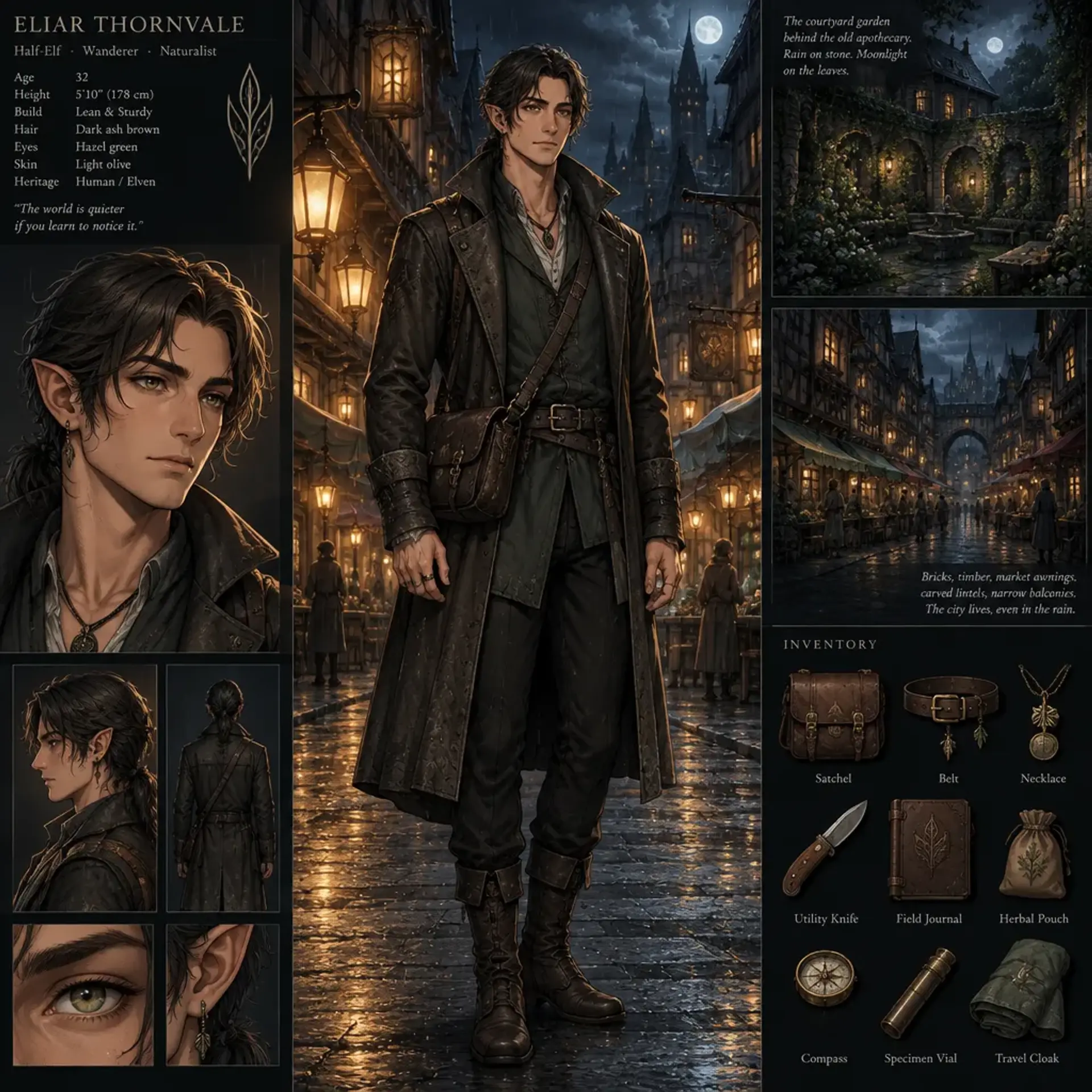
Half-elves combine human breadth and variation with a subtle elven cast. Their ears are usually only slightly pointed, their features may be fine-boned without appearing delicate, and their movements often carry a quiet economy learned from one or both sides of the family. Hair, skin, and eye colors follow the broad range found among humans and elves, though unusual combinations are common. They do not possess a universal glow, distinctive aura, or unmistakable sign of fey power. Most can pass easily among humans, while elves may recognize them by posture, voice, or the particular shape of a smile.
Society & Culture
There is no single half-elf society, nation, or political identity. Most grow up in human towns and learn the practical habits of urban life: reading contracts, navigating crowded markets, recognizing neighborhood loyalties, and knowing when a family name opens a door or closes it. They are accustomed to standing between people who expect them to choose a side. Some embrace this role as mediators and interpreters. Others reject it, insisting that their ancestry does not make them responsible for everyone else’s divisions. Half-elves often maintain layered identities, using one set of customs at home, another at work, and a third among relatives who speak Elvish.
Religion & Alignment
Half-elves follow the religions of their families, neighborhoods, professions, or personal convictions. Some honor elven traditions, human temples, local saints, household spirits, or no deity at all. Their divided heritage does not incline them toward any alignment. Many value freedom, fairness, loyalty, or adaptability, but no moral tendency belongs to the ancestry as a whole.
Homelands & Architecture
Half-elves have no homeland of their own. They are most common in human cities, border towns, river ports, and trade crossroads where different peoples meet often enough for mixed families to become familiar. Their homes follow local human construction, from narrow brick townhouses and timber cottages to crowded tenements above shops. In older neighborhoods, a half-elf family may preserve an elven feature such as a courtyard garden, an open stair, carved lintels, or a room built to catch moonlight, though these details are personal traditions rather than marks of a unified culture.
Relationships With Other Peoples
Half-elves are woven through human society rather than set apart from it. In cities, many are accepted without comment, while others face curiosity, prejudice, romantic idealization, or the assumption that they must serve as translators between cultures. Elves may treat them as kin, strangers, or reminders of human lives that move too quickly. Humans may regard them as familiar neighbors with an unusual family history. Half-elves themselves vary widely. Some seek elven communities, some avoid them, and many are content to remain among the people and streets that raised them.
Visual sheet
Turn Half-Elf into a sheet
A high-res, share-ready sheet you can post or print.