
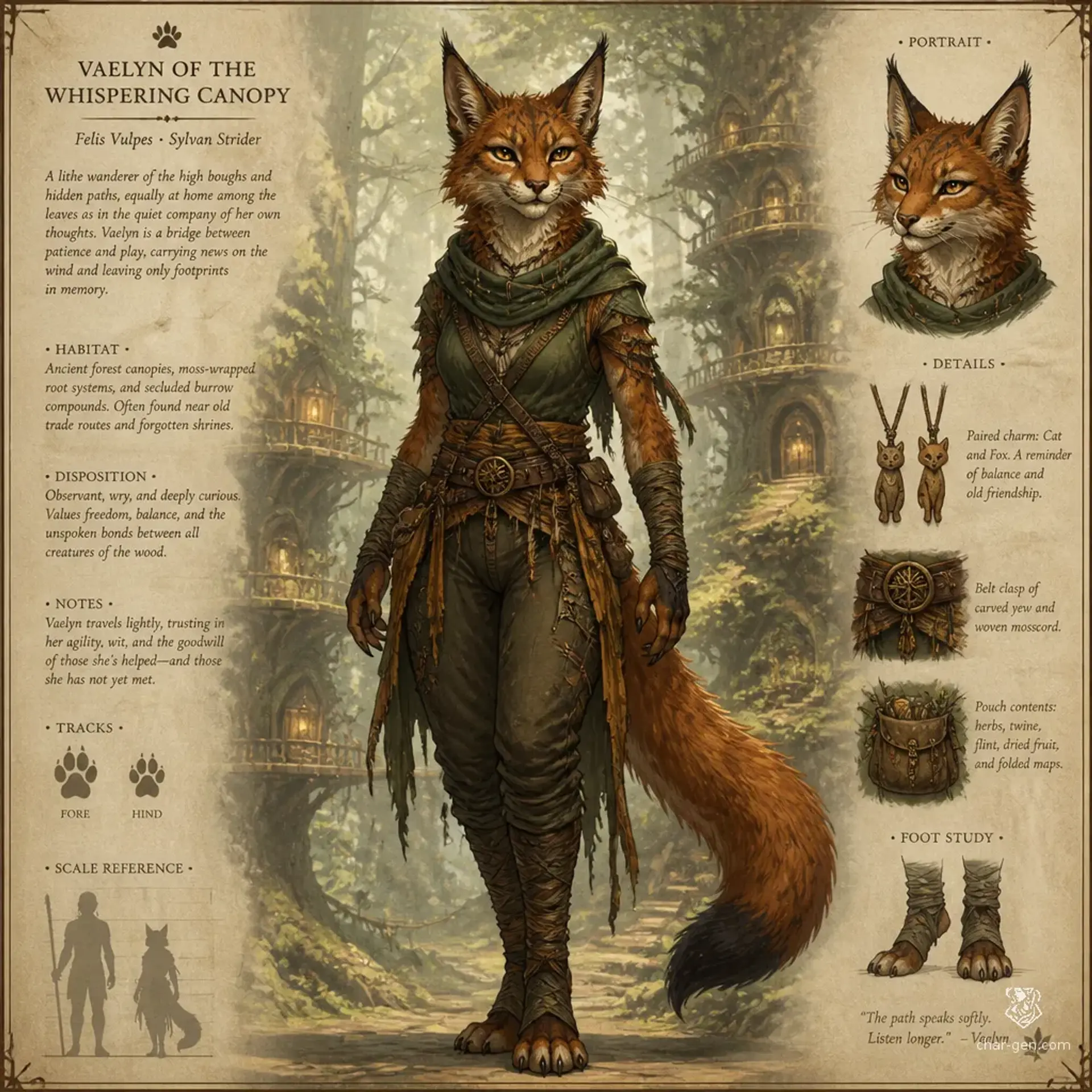
The Vulpesari are forest-born wanderers who honor two divine instincts at once: the cat god Nymara teaches them to wait, watch, and choose their moment, while the fox god Rasken urges them to question every boundary and slip through every opening. They are charming guides, sly negotiators, devoted hosts, and dangerous enemies when cornered. To meet one on the road is to encounter someone who may offer you tea, a riddle, a warning, or a perfectly timed theft, all with the same knowing smile.
Vulpesari are graceful, fox-featured humanoids with expressive ears, narrow muzzles, sharp incisors, and long, full tails. Their fur ranges from bright copper and autumn red to cream, charcoal, silver, sable, and mottled combinations. Their eyes may be amber, green, gold, or deep blue, and their pupils narrow in strong light. Many have darker markings along the ears, wrists, ankles, or tail tip. Their movements are quiet and economical, alternating between feline stillness and sudden vulpine speed. Clothing tends to favor layered wraps, fitted trousers, soft boots, and ornamented belts that leave the tail free.
Vulpesari society is organized around extended hearth-families, traveling circles, and shrine communities rather than permanent castes. Children are taught that every story has at least two useful versions, one that comforts and one that warns. Social status comes from trust, resourcefulness, and the ability to preserve a community during hardship. Public debates often take the form of riddling contests, while serious disputes are settled by a paired trial: one challenge tests patience, the other tests ingenuity. Festivals feature masked dances, night markets, silent contests of observation, and communal meals where guests are seated according to how far they have traveled. Deception is not automatically dishonorable, but betrayal of a guest, child, or sworn companion is considered among the gravest sins.
Vulpesari worship Nymara of the Velvet Paw and Rasken the Ember-Tailed as complementary powers. Nymara governs patience, solitude, beauty, alertness, and the dignity of choosing one's own company. Rasken governs cleverness, adaptation, humor, disguise, and the fortunate mistake. Their priests teach that wisdom lies in knowing when to remain still and when to run. Vulpesari are commonly neutral or chaotic in alignment, valuing personal freedom and practical compassion over rigid law, though many are deeply devoted to hospitality and sworn promises.
Vulpesari settlements are built where old trees, streams, and stone outcroppings meet. Their homes use elevated platforms, concealed burrows, rope bridges, hollowed trunks, and winding paths designed to reward careful attention. A typical settlement contains two central shrines: one open and sunlit, dedicated to Nymara of the Velvet Paw, the cat god of patience, beauty, and watchful independence; the other half-hidden among roots, dedicated to Rasken the Ember-Tailed, the fox god of cunning, transformation, and fortunate escape. Architecture reflects both patrons, pairing graceful arches and polished surfaces with secret doors, false walls, and deliberately misleading corridors.
Vulpesari are often welcomed as guides, scouts, storytellers, and negotiators, though their reputation for misdirection makes some communities wary. They respect forest-dwelling peoples who understand seasonal obligations and shared resources. They are fond of ordinary villages, where trade, gossip, and local secrets provide endless fascination, but they dislike institutions that demand unquestioning obedience. Their relationship with catlike and foxlike creatures varies by region. Some treat such animals as sacred companions, while others see them as reminders that divinity can inhabit instinct without requiring words.
A high-res, share-ready sheet you can post or print.