They mature physically around age 20 and commonly live 90 to 120 years. Their dense tissues resist many ordinary injuries, but overexertion and chronic strain can shorten their lives dramatically.
Darkvision
60 ft.
Habitat
Mountain valleys, highland forests, canyon settlements, fortified river crossings, and old imperial roads built to support their weight
human-derived
muscular
monstrous
powerful
highland
resilient
builder
guardian
SizeMedium
Speed30 ft.
LifespanThey mature physically around age 20 and commonly live 90 to 120 years. Their dense tissues resist many ordinary injuries, but overexertion and chronic strain can shorten their lives dramatically.
Creature TypeHumanoid
Darkvision60 ft.
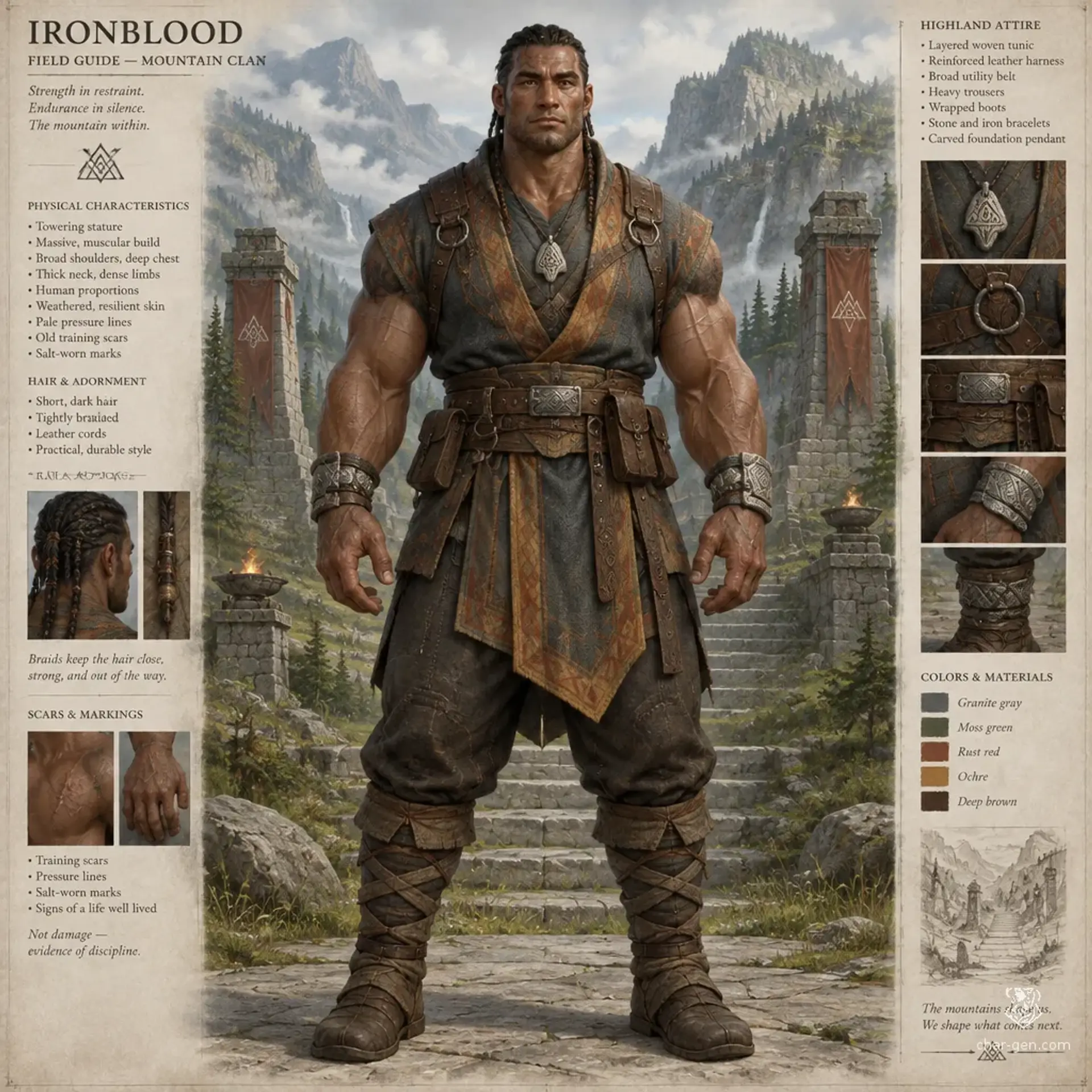
They look like humans sculpted from living masonry, every movement carrying the promise of impossible force. An Ironblood can haul a wagon from a ditch, hold a collapsing gate long enough for a village to escape, or clasp a teacup so delicately that no one realizes what those hands could do. Their greatest struggle is not becoming strong. It is learning when the world needs their strength and when it needs their gentleness.
Physical Description
Ironbloods are humans whose muscle fibers, connective tissues, and bones possess extraordinary density. Their frames are broad and heavily layered, with thick necks, powerful backs, deep chests, and hands capable of crushing thick timber. Their proportions remain recognizably human, though even a slender Ironblood appears built for hard labor. Skin commonly bears pressure marks, old training scars, and pale lines where muscle has grown against bone. Hair is often worn short, braided close, or bound with leather cords to prevent it becoming a hazard during work or combat. Their movement is not clumsy, but it carries a sense of contained weight. A trained Ironblood can handle fragile objects with astonishing care, while an untrained one may break furniture, tools, or bones by accident.
Society & Culture
Ironblood society measures adulthood through controlled achievement. A young person might be expected to repair a damaged bridge without harming anyone nearby, carry an injured stranger for a full day, or win a wrestling match while never allowing their opponent to touch the ground harshly. Physical training is universal, but brute force is considered an incomplete skill. Balance, precision, breathing, emotional discipline, and the ability to stop at the correct moment are treated as equal parts of strength. Communal meals are important social events, and elders often settle disputes by requiring each side to complete a difficult task together. Their stories praise builders, rescuers, healers, and protectors more often than conquerors.
Religion & Alignment
Ironblood spirituality centers on the ideas of weight, foundation, and consequence. Their oldest shrines are built around stones that no single person can move, symbolizing duties that must be shared. They honor deities and spirits associated with mountains, labor, healing, guardianship, craft, and oaths. Many lean toward lawful alignments because communal rules protect both the strong and everyone around them, though rebellious Ironbloods may reject any tradition that turns restraint into obedience. Evil Ironbloods are terrifyingly effective tyrants, enforcers, and raiders, but their own culture remembers such figures as warnings rather than heroes.
Homelands & Architecture
Their settlements favor broad stairways, reinforced floors, enormous doorways, and load-bearing pillars carved with family histories. Homes are often partly excavated into hillsides, combining cool stone chambers with open courtyards for wrestling, communal meals, and strength exercises. Bridges, mills, gates, and siegeworks are prestigious forms of art, and a master builder is expected to understand both structural mathematics and human anatomy.
Relationships With Other Peoples
Other peoples often admire Ironbloods as protectors while quietly fearing them as potential threats. Ironblood communities answer this suspicion with strict etiquette, public demonstrations of careful craft, and traditions that place service above dominance. They frequently become laborers, guards, sailors, rescuers, soldiers, and artisans whose work benefits from exceptional force. Some resent being treated as living machinery, especially by wealthy patrons who hire them for dangerous feats. Among themselves, Ironbloods are quick to recognize discipline and slow to forgive cruelty disguised as leadership.
Visual sheet
Turn Ironbloods into a sheet
A high-res, share-ready sheet you can post or print.