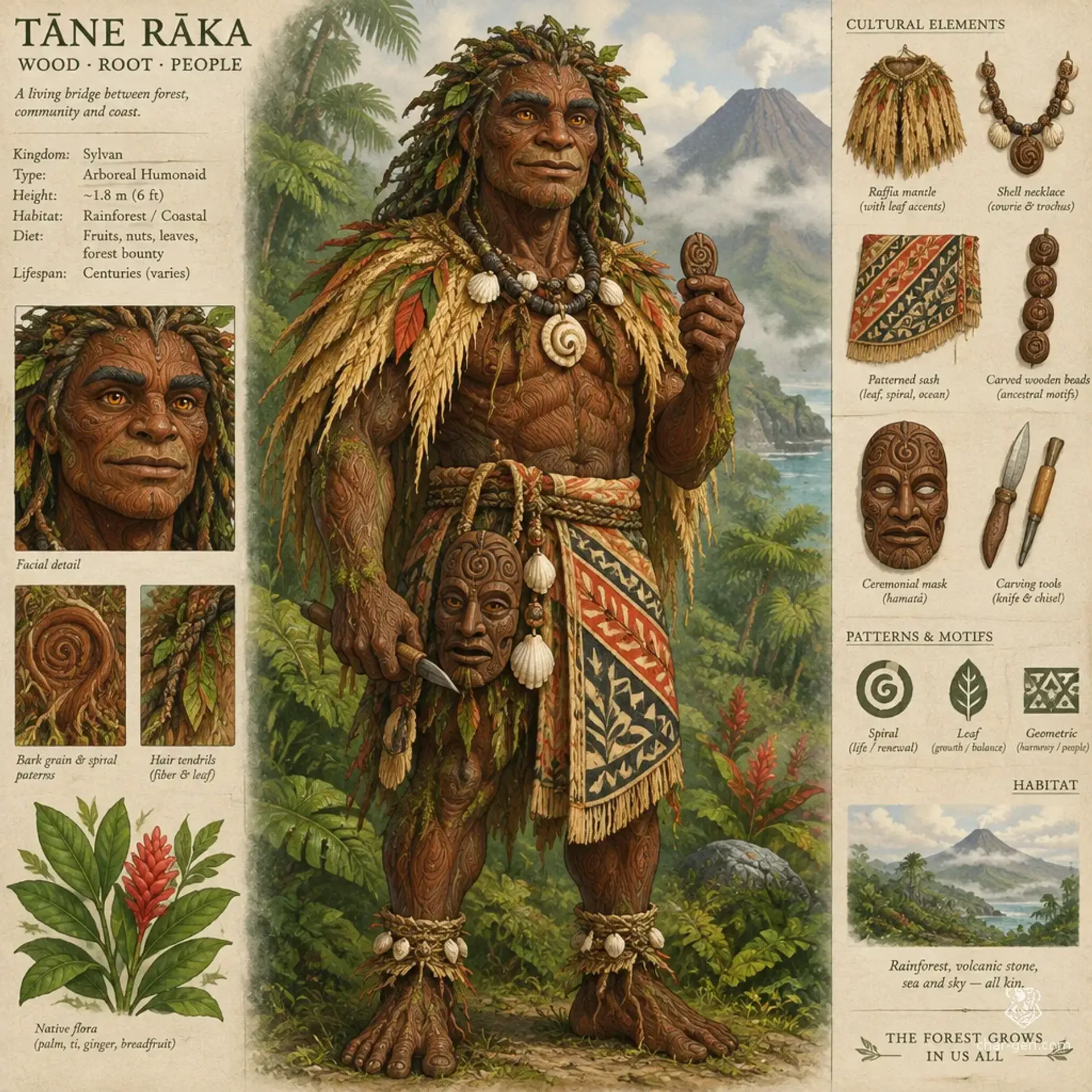
Tiki mature around age 18 and commonly live 90 to 120 years. A few elders survive for nearly two centuries before entering the Quiet Canopy.
Habitat
Tropical islands, rainforests, volcanic coasts, river deltas, and warm regions where old trees grow around abundant water.
ancestral
island
nature
mask-carver
resilient
tropical
wooden
SizeMedium
Speed30 ft.
LifespanTiki mature around age 18 and commonly live 90 to 120 years. A few elders survive for nearly two centuries before entering the Quiet Canopy.
Creature TypeHumanoid
Tiki are living vessels of memory, island-born wanderers whose wooden bodies carry the patterns of rain, flame, root, and reef. They carve masks to honor the dead, dance to keep old promises alive, and treat every forest as a relative rather than a resource. A Tiki adventurer may be a cheerful navigator, a solemn keeper of ancestral law, a mask-maker seeking the perfect face, or a young exile determined to learn whether the wider world has any wisdom worth bringing home.
Physical Description
Tiki resemble compact humanoids shaped from living wood, with warm brown, red, gold, charcoal, or greenish bark covering their bodies. Their features are broad and expressive, with heavy brows, flat or gently protruding noses, wide mouths, and large eyes that gleam amber, turquoise, or deep black. Most have hair made from flexible tendrils, coarse fibers, moss, feathers, or leaves. Their bodies bear natural grain patterns unique to each individual, often resembling spirals, waves, flames, or branching roots. Tiki do not possess fixed wooden faces, but many wear carved masks during ceremonies, negotiations, mourning, and battle.
Society & Culture
Tiki society is organized around extended households, craft circles, and clan groves rather than rigid social classes. Children belong to several overlapping communities, each with its own stories and obligations. Public life is shaped by music, masked dances, feasts, competitive storytelling, canoe races, carving contests, and ritual exchanges. Disputes are rarely settled through private argument alone. Instead, the opposing parties may perform their grievances before witnesses, allowing the community to judge not only the facts but the spirit in which each claim is made. Tiki value memory, but they also believe that forgotten things can return in new forms.
Religion & Alignment
Tiki spirituality is animistic and ancestral. They honor rain, reef, volcano, wind, great trees, remembered heroes, and the spirits believed to dwell within meaningful objects. Their priests are called Voice-Keepers, though many communities rely on gardeners, navigators, healers, and elders rather than a formal priesthood. Tiki traditions tend toward kindness, responsibility, and communal balance, but individual Tiki range across every alignment. A disciplined guardian may be lawful, while a wandering trickster may be chaotic without being cruel.
Homelands & Architecture
Tiki settlements cluster around ancestral groves, freshwater springs, and broad communal plazas. Homes are built from living roots, woven fronds, driftwood, coral, and volcanic stone, with roofs shaped to shed heavy rain. Every village maintains a house of masks where carved faces represent founders, guardians, natural forces, and unresolved grievances. Their architecture favors strong thresholds, open gathering spaces, and elevated walkways that allow roots, insects, and small animals to pass undisturbed.
Relationships With Other Peoples
Tiki are generous hosts but cautious partners. They judge outsiders less by ancestry than by how those outsiders treat the land, the vulnerable, and the promises they make. They often find stone-working peoples dependable, urban empires exhausting, and isolated mystics intriguing. Tiki may be mistaken for constructs or carved idols, an error they find alternately amusing and insulting. Long friendships are marked by exchanged masks, shared songs, or the planting of a tree in both companions' names.
Visual sheet
Turn Tiki into a sheet
A high-res, share-ready sheet you can post or print.