Lesser treants mature at about 20 years and commonly live 180 to 250 years. Exceptional elders may endure for more than 300 years if their roots remain healthy and their home soil is not poisoned.
Darkvision
60 ft.
Habitat
Old forests, river valleys, misty hills, orchardlands, mangrove shores, and any settled place where trees have been tended for generations.
plant folk
forest guardian
nature speaker
woodland traveler
living tree
stewardship
sapient plant
SizeMedium
Speed30 ft.
LifespanLesser treants mature at about 20 years and commonly live 180 to 250 years. Exceptional elders may endure for more than 300 years if their roots remain healthy and their home soil is not poisoned.
Creature TypePlant
Darkvision60 ft.
You are one of the groveborn, a lesser tree-folk whose roots can travel but whose memories remain planted in the soil of home. You carry living history in your rings, hear distress through the language of leaves, and measure a person's character by what they protect when no reward is offered. The wider world is full of roads, ruins, axes, iron, and astonishing possibilities. You have left the grove because something beyond its borders now needs your patience, your strength, or the particular wisdom of a being who knows that every great forest begins with a single seed.
Physical Description
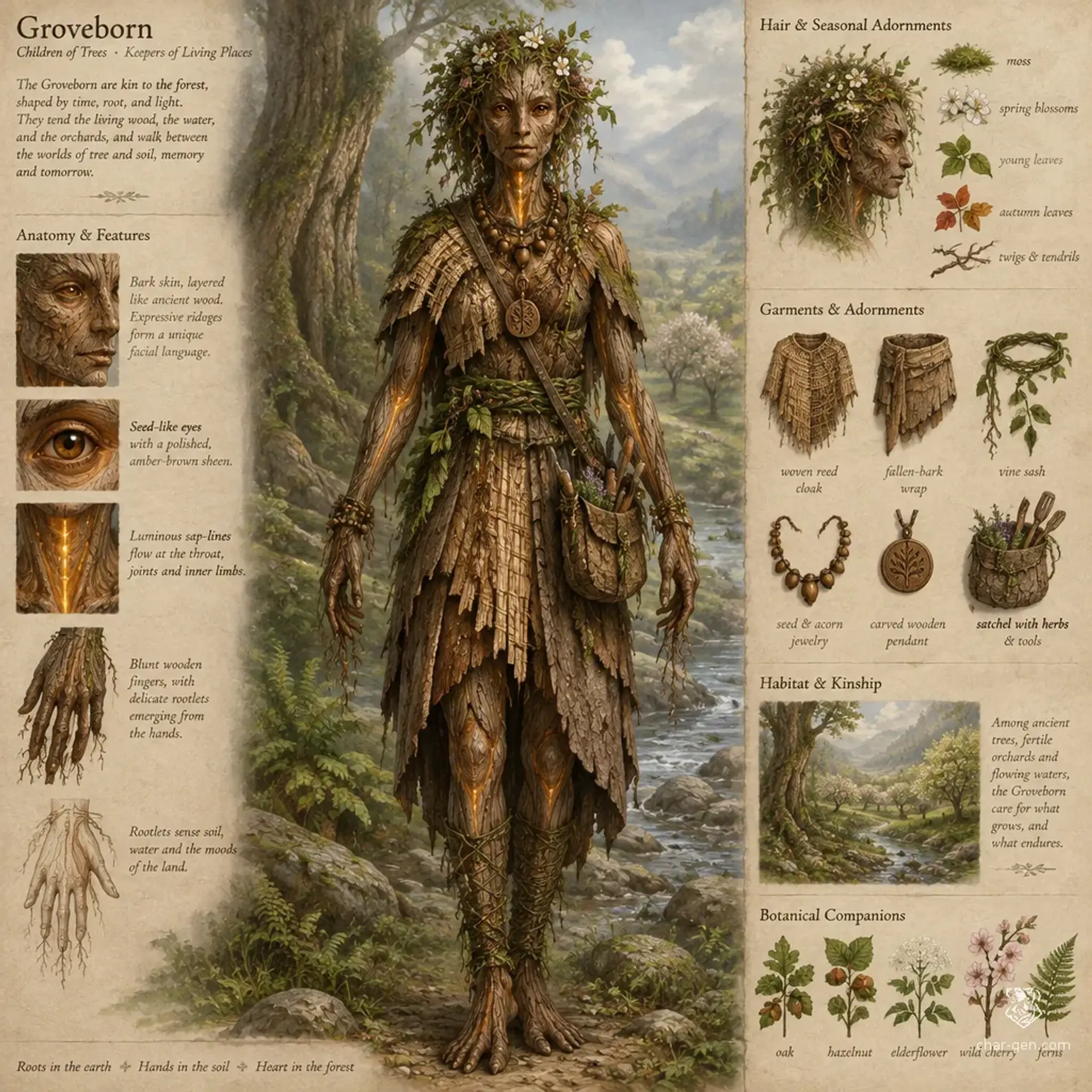
Groveborn resemble slender, upright trees shaped into humanoid form. Their bodies consist of layered bark over fibrous wood, with sap moving beneath translucent seams around the throat, wrists, and joints. Their faces are expressive arrangements of ridges, knots, and luminous sap-lines rather than flesh, and their eyes resemble polished seeds, amber beads, or pools of dark resin. Hair is replaced by foliage, moss, lichen, blossoms, or fine twigs, which may change with mood and season. Most groveborn have two arms and two legs, though their hands may end in blunt wooden fingers or flexible rootlets. They are sturdy but not massive, built for endurance, climbing, and careful movement through dense undergrowth.
Society & Culture
Groveborn communities are organized around stewardship rather than ownership. Each member is entrusted with a particular responsibility, such as tending seedlings, maintaining waterways, guarding borders, preserving stories, or welcoming travelers. Decisions are often reached through councils held over several days, allowing every voice time to be heard. Their art includes living topiary, scent gardens, seasonal songs, bark etching, and dances that imitate wind, rain, and animal movement. They celebrate germination, first fruit, autumn memory, and the return of migratory creatures. Death is treated as a transformation into soil, mulch, memory, and nourishment, never as an absolute end.
Religion & Alignment
Most groveborn revere the cycles of growth, decay, fire, flood, and renewal rather than a single universal deity. Many honor local nature spirits, ancestral trees, river powers, or gods associated with harvest and wilderness. Their ethics favor protection, reciprocity, and long memory, leading many toward good or neutral alignments. Groveborn who embrace personal ambition, vengeance, or radical freedom are not viewed as heretics, but they are expected to accept the consequences their choices plant.
Homelands & Architecture
Lesser treants dwell in groves arranged around ancient trees, spring pools, standing stones, and communal fire pits. Their shelters are grown rather than built, with woven branches forming arbors, bridges, platforms, and hollow chambers. They avoid harming living trees, preferring fallen timber, clay, woven reeds, and shed bark. A grove's paths change with the seasons, and visitors are expected to learn its landmarks through repeated journeys rather than maps.
Relationships With Other Peoples
Groveborn are cautious allies and formidable enemies. They respect farming communities that replenish the land, rangers who understand restraint, and artisans who work with fallen wood rather than needless slaughter. They distrust clear-cutters, reckless miners, and rulers who treat forests as disposable resources. Their relationships with other plant beings vary widely, from kinship with ancient woodland spirits to suspicion of aggressive fungal colonies or predatory vines. Among civilized peoples, groveborn are often welcomed as healers, gardeners, wardens, and scholars, though some communities fear their ability to move silently through the trees.
Visual sheet
Turn Groveborn into a sheet
A high-res, share-ready sheet you can post or print.