
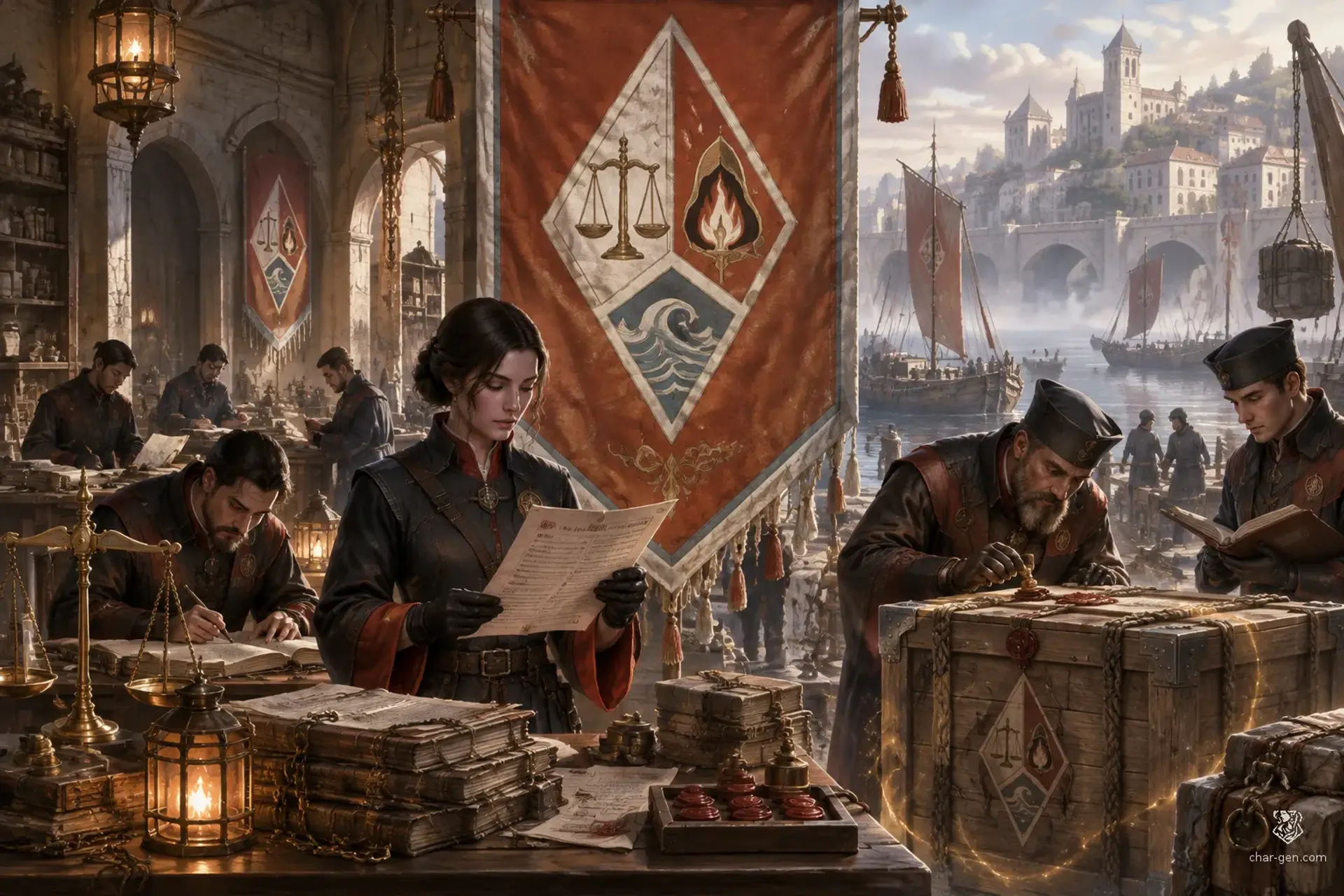
The Collegium of Three Seals
The first decades were spent turning a temporary crisis compact into a permanent civic office. The Collegium standardized weights, required written manifests, and made it possible for merchants to insure cargo without relying entirely on personal reputation. Its growth brought prosperity and resentment: small traders gained a way to challenge powerful buyers, while the new procedures gave officials fresh opportunities to delay competitors. About seventy years after its founding, the Collegium certified a shipment of imported lampstone as safe. The cargo later ignited in a crowded warehouse, killing workers and destroying several blocks of stores. This became the Ashen Quay Inquiry, a watershed moment. The Collegium accepted stricter inspection rules, published its first public accident register, and created a separate magical-safety mandate rather than letting customs officers make such judgments by instinct. In later generations, the buried city's ruins began yielding objects that entered trade disguised as commonplace wares. The Collegium has since become a gatekeeper not only of prices and duties, but of what the city is willing to acknowledge as dangerous. It is now powerful enough to frustrate a great house, but not powerful enough to ignore one.
The Collegium of Three Seals
- Type
- Chartered merchant-guild…
- Size
- Mid-sized
- Reach
- High in the docks
- Base
- The great river metropolis of the republic, whose local name remains open for the setting's canon.
Overview
The first decades were spent turning a temporary crisis compact into a permanent civic office. The Collegium standardized weights, required written manifests, and made it possible for merchants to insure cargo without relying entirely on personal reputation. Its growth brought prosperity and resentment: small traders gained a way to challenge powerful buyers, while the new procedures gave officials fresh opportunities to delay competitors. About seventy years after its founding, the Collegium certified a shipment of imported lampstone as safe. The cargo later ignited in a crowded warehouse, killing workers and destroying several blocks of stores. This became the Ashen Quay Inquiry, a watershed moment. The Collegium accepted stricter inspection rules, published its first public accident register, and created a separate magical-safety mandate rather than letting customs officers make such judgments by instinct. In later generations, the buried city's ruins began yielding objects that entered trade disguised as commonplace wares. The Collegium has since become a gatekeeper not only of prices and duties, but of what the city is willing to acknowledge as dangerous. It is now powerful enough to frustrate a great house, but not powerful enough to ignore one.
How it began
The Collegium's own account begins with the Spring of Split Ledgers, when a flood damaged warehouses along the river and merchants discovered that their insurance declarations, customs records, and cargo inventories all described different goods. A warehouse fire followed. Some owners blamed an illicit spell; others blamed wet lamp oil. The city lost a season of trade to lawsuits and retaliatory seizures. Three groups proposed separate remedies: underwriters wanted honest valuations, licensed practitioners wanted a standard for hazardous magic, and the river customs officers wanted a reliable manifest. Their compact created the Collegium of Three Seals. The story is probably tidier than the negotiations were. Old correspondence suggests that the first charter also settled a private debt between two banking houses.
How to know them
Dried-terracotta red, River-silt gray, Wax-seal ivory
- A three-field ivory lozenge stamped onto manifests.
- Three short taps of a wooden counter bell before a high-value inspection begins.
- A red thread tied through the corner of a bonded-cargo receipt to show that the cargo must not be opened without a witness.
Standing
What they say they want
What they are doing now
Where it leads
Remain an independent civic authority whose three separate seals make river commerce safer and more trustworthy, without allowing the council, banks, or temples to fold the Collegium into their own machinery. Its most ambitious members instead envision a citywide registry for all dangerous goods and licensed magical services.
How others see them
To merchants, it is a necessary nuisance: a dependable place to settle claims and an exasperating counter that can keep a ship tied up for days. Dockworkers respect the few officers who protect them from unsafe cargo, while fearing that a delay can cost a season's wages. The council presents the Collegium as proof that trade can be regulated without putting every decision in the hands of the banks or temples.
People
6 ranks
First Sealkeeper
Patient, exacting, and dryly humane. She gives people a chance to correct a declaration before she treats a discrepancy as fraud, but once she believes someone is exploiting that mercy she becomes immovable.
- First Sealkeeper1 member
The elected head of the institution, responsible for presenting its business to the council, assigning disputed cases, and signing orders that affect multiple mandates.
- Sealkeepers3 members
One leads valuation and insurance certification, one oversees magical safety, and one directs river customs. Each controls a separate budget and can appeal another Sealkeeper's ruling.
- Senior Examiners12 members
Experienced officers who hear appeals, inspect high-value cargo, train junior staff, and serve as witnesses when a disputed seal is challenged.
- Quay Examiners46 members
Inspect manifests, samples, cargo holds, and declared enchantments. Their authority is substantial at the docks but limited by charter and review.
- Counters and Ledger Clerks83 members
Record declarations, assess fees, preserve duplicate ledgers, issue receipts, and reconcile disputes between shipper, insurer, and customs officer.
- Bonded Hands28 members
A mixed staff of porters, warehouse wardens, messengers, and seal custodians. They are not all members, but their testimony can establish whether a cargo was altered in custody.
Other key members
- Ketek Varo Sealkeeper of Magical Safety
- Abeni Senior Examiner and likely successor to the First Sealkeeper
- Tamar Gori Sealkeeper of River Customs
- Ife Archive clerk
How they are organised
- Applicants must be vouched for by an established member or recognized commercial body.
- Applicants must demonstrate numeracy, careful recordkeeping, and familiarity with at least one branch of cargo practice.
- Quay examiners and magical safety staff must disclose relevant financial interests before taking cases.
- Members swear to preserve records accurately and to report attempts to buy or intimidate an examiner. Violations can lead to a hearing, loss of office, or a ban from handling seals.
Relations
8 factionsThe river pilots rely on the Collegium to authenticate manifests and settle disputes over damaged cargo. They support its safety mandate but resent inspections that delay departures during flood season.
Operations
What they do
How they do it
Services for hire
- Value and Insurance CertificateStandard fee set by declared cargo value, with reduced rates for small local consignmentsRecords declared value and issues a valuation certificate for insurers and commercial courts.
- Magical Cargo ReviewInspection fee, sometimes waived for public-safety referralsExamines declared magical cargo, records the methods and limits of the inspection, and advises on handling or storage. The procedures are custom institutional standards, not assumed game rules.
- River Manifest and DutyStatutory duty plus a small filing chargeRecords a river shipment, assesses applicable customs duty, and issues a receipt that can be presented at recognized quays.
- Bonded HoldStorage charge paid by the party responsible for the hold, subject to appealSecures disputed cargo in bonded storage while claims, inspections, or ownership questions are reviewed.
What they can do
What they have
Where they are weak
Territory
Headquarters
The great river metropolis of the republic, whose local name remains open for the setting's canon.A former riverside weighhouse of pale brick and terracotta tile, built around a covered inspection court. Barges can unload into the lower receiving hall, while clerks work above them among galleries of pigeonholes and chained ledgers. The public counter is bright, orderly, and crowded. Behind it are locked sample rooms, a small warded vault, and an archive whose oldest shelves still bear watermarks from the founding flood. Visitors hear scales clink, stamps strike wood, and the river bells answer from outside.
Lands they hold
Outposts
- Silt CounterThe eastern grain quayA compact customs desk that records bulk agricultural shipments and checks seals on barges before they enter the central harbor.
- Warm LoftA bonded warehouse district near the textile exchangesA storage and valuation office for cloth, dyes, and heat-sensitive magical goods. Its name comes from the persistent warm air trapped under its old tiled roof.
- Understairs DeskThe lower landing beneath the old market terracesA small, politically sensitive office that receives cargo recovered from underground passages and compares it against ordinary trade records.
Secrets
Plot hooks
5 hooks- 1The Wrong ColumnPersonal to localReward: Payment, access to the records counter, and a dependable low-ranking contactA junior clerk asks the characters to help prove that a small medicine shipment was deliberately revalued as luxury perfume. The clerk's evidence points toward a respected examiner, but also implicates the clerk's own family in moving untaxed goods.
- 2Three Marks on One ManifestLocal investigation and negotiationReward: A favor from river pilots, a modest fee, or a formal cargo passA barge carrying grain has been held because its manifest bears a valid-looking customs seal but a mismatched insurance stamp. The crew will lose their wages if it misses the river's safe passage window. Each mandate has a plausible reason for delay, and one officer may be using the dispute to settle an old grievance.
- 3The Figure in the StrawRegional intrigueReward: Evidence, a patron's gratitude, or access to the Collegium's restricted sample roomA household consignment contains a harmless-looking clay figure that triggers contradictory results under different inspection procedures. One examiner calls it a relic from the buried city; another says it is an ordinary devotional object. The owner is a struggling artisan, while the buyer is tied to a powerful bank.
- 4A Fourth ImpressionCampaign investigationReward: A formal alliance with one internal bloc and the opportunity to shape the Collegium's responseA run of counterfeited three-seal marks is causing legitimate cargoes to be impounded. The copies are good enough to implicate a particular clerk, but the false impressions were made with knowledge of the old archive's missing records.
- 5What the Seal May ClaimCampaign-scale political choiceReward: Political influence, a lasting ally or rival, and a decision about who controls dangerous cargoThe council is preparing a vote to extend the Collegium's jurisdiction into private counting houses. The characters are asked by opposing members to investigate a shipment of suspected relics before the vote. The shipment is real, the evidence is compromised, and a public hearing could harm innocent workers as well as expose powerful merchants.
Work they offer
What gets in the way
Rumours
Media
0 imagesNo images yet.
Turn The Collegium of Three Seals into a sheet
A high-res, share-ready sheet you can post or print.