
The Ash Wardens
The Ash Wardens began as a mutual-aid watch during the first harsh winter after a series of refinery fires scattered families and made ordinary transport dangerous. Their earliest victories were small but consequential: opening a blocked road, moving fever medicine ahead of a storm, and persuading rival settlements to share fuel rather than guard it. As the roads stabilized, they built a chain of signal points and became the most reliable coordinators of travel between settlements. Their watershed moment came twenty-six years ago during the Gray Convoy Winter. A convoy carrying fuel and clinic supplies missed three scheduled stops. The Wardens diverted their own reserves to keep two settlements warm and moved a fever outbreak's patients to a functioning clinic. They later learned that a rival local authority had redirected the convoy, though no one could prove whether the diversion was planned or a desperate mistake. The event won the Wardens broad trust and established their rule that emergency stores belong to the network, not to the settlement holding them. The growth of The Distillery Combine changed their work. Combine freight made regular deliveries possible, and Combine refinery fuel powered relays, pumps, and vehicles. The Wardens traded route knowledge and local security for predictable schedules. Their dependence deepened as settlements rebuilt around those schedules. In the last five years, clinic inventories have increasingly failed to match the supplies expected from freight manifests. The discrepancies may be spoilage, theft, bad recordkeeping, or deliberate diversion. The council has asked for audits and received incomplete answers. The Ash Wardens are now more connected than ever, but the network that keeps them alive also gives an outside consortium leverage over their survival.
The Ash Wardens
- Type
- Mutual-aid compact and…
- Size
- 187 members
- Reach
- Regional
- Base
- Hearthline, a settlement whose name is a worn corruption of an older word for the ridge where charcoal burners once kept a night fire
Overview
The Ash Wardens began as a mutual-aid watch during the first harsh winter after a series of refinery fires scattered families and made ordinary transport dangerous. Their earliest victories were small but consequential: opening a blocked road, moving fever medicine ahead of a storm, and persuading rival settlements to share fuel rather than guard it. As the roads stabilized, they built a chain of signal points and became the most reliable coordinators of travel between settlements. Their watershed moment came twenty-six years ago during the Gray Convoy Winter. A convoy carrying fuel and clinic supplies missed three scheduled stops. The Wardens diverted their own reserves to keep two settlements warm and moved a fever outbreak's patients to a functioning clinic. They later learned that a rival local authority had redirected the convoy, though no one could prove whether the diversion was planned or a desperate mistake. The event won the Wardens broad trust and established their rule that emergency stores belong to the network, not to the settlement holding them. The growth of The Distillery Combine changed their work. Combine freight made regular deliveries possible, and Combine refinery fuel powered relays, pumps, and vehicles. The Wardens traded route knowledge and local security for predictable schedules. Their dependence deepened as settlements rebuilt around those schedules. In the last five years, clinic inventories have increasingly failed to match the supplies expected from freight manifests. The discrepancies may be spoilage, theft, bad recordkeeping, or deliberate diversion. The council has asked for audits and received incomplete answers. The Ash Wardens are now more connected than ever, but the network that keeps them alive also gives an outside consortium leverage over their survival.
How it began
The Ash Wardens say their name comes from the first winter after the refinery fires, when volunteers marked safe doors with the gray ash left in their cookpots. The oldest account says the first group was not an army or government, but a line of neighbors carrying water, bandages, and fuel between smoke-darkened homes. Their first leader, remembered only as the Keeper, organized the volunteers into rotating watches so no settlement had to stand alone. The Keeper's name and former office are lost.
How to know them
Kiln gray, Faded saffron, Chalk white
- A white handprint on a gray field
- Three saffron strokes representing smoke, signal, and surviving flame
- A shared gray cord worn by members while on route duty
Standing
What they say they want
What they are doing now
Where it leads
A network of settlements able to share medicine, fuel, and safe passage without depending on any single industrial supplier or central authority. The Wardens disagree over whether this means a stronger compact with elected powers or a leaner emergency service that leaves settlements more independent.
How others see them
Most settlements regard the Ash Wardens as dependable neighbors who arrive with a map, a spare can of fuel, and no questions they do not need answered. Freight companies see them as useful but meddlesome. Critics say the Wardens have turned charity into authority and use their records of who received aid to influence local decisions.
People
5 ranks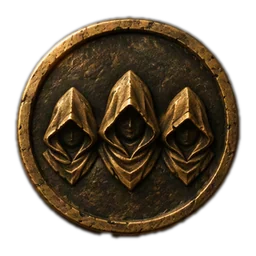
Road Marshal
Measured, patient, observant, and careful with public promises. Her caution is a genuine strategy, but it sometimes leaves people in immediate danger waiting for proof.
- The Hearth Council7 members
Sets shared policy, approves emergency ration transfers, and negotiates with outside powers. Decisions ordinarily require five votes; during a declared emergency, the Marshal can act for one day before the council must review the action.
- Road Marshal1 member
Coordinates patrols, courier escorts, and emergency responses. The Marshal may redirect fuel or personnel in a crisis but cannot permanently change settlement quotas alone.
- Route Captains34 members
Each captain oversees a route or cluster of settlements, maintains local contacts, checks warning equipment, and reports freight arrivals. Captains have considerable influence because they see conditions before the council does.
- Ash Hands126 members
Volunteer or contracted members who staff watches, deliver supplies, maintain relays, escort travelers, and help with evacuation. Members retain their ordinary livelihoods where possible.
- Ledger Keepers19 members
Record supplies, medical requests, fuel use, and disputes. They are nominally neutral, but their control over what counts as proof gives them unusual political power.
Other key members
- Bram Route Captain for the eastern settlements and likely successor to the Marshal
- Xochitl Vey Senior Ledger Keeper
- Kesh Council negotiator and liaison to The Distillery Combine
- Tamsin Holt Route Captain and potential internal dissident
How they are organised
- Accept the shared obligation to assist settlements on a registered route during emergencies.
- Complete a supervised night run or an equivalent act of service suited to the applicant's abilities.
- Declare any paid work for an outside security or transport power that could conflict with Warden duties.
- Agree not to sell route maps, clinic inventories, or emergency cache locations without council approval.
Relations
8 factionsA cautious working arrangement: the Ash Wardens provide route guides and warning beacons, while the Combine assigns freight slots and sells refinery fuel. Each side keeps records it does not share with the other.
Operations
What they do
How they do it
Services for hire
- Road ReadingA modest fee, a reciprocal delivery, or recorded volunteer hoursRoute guidance, local condition reports, and introductions to trusted drivers.
- Ash EscortFuel or supplies at cost, plus a public record of the loanEmergency transport for people, clinic goods, and essential equipment between registered settlements.
- Safe StopDonation to the shared stores when ableTemporary shelter, basic first aid, and a message relay for stranded travelers. Availability depends on the outpost's current stock.
- Witness LedgerA verified delivery record and a small contribution to relay upkeepIndependent counting and documentation of freight handoffs. The Wardens do not claim their count is legally binding, but settlements often accept it as a neutral record.
What they can do
What they have
Where they are weak
Territory
Headquarters
Hearthline, a settlement whose name is a worn corruption of an older word for the ridge where charcoal burners once kept a night fireThe council meets in a repurposed freight weighhouse with a low roof, a stone cistern, and a patched radio mast. Its walls are covered with route maps, clinic tallies, and small boards listing requests from each settlement. The council keeps the central room open to petitioners, though the locked record room contains disputed ration ledgers and copies of Combine manifests.
Lands they hold
Outposts
- Keeper's StepA wind-exposed pass between the northern clinics and the main freight roadA relay shelter with a signal mast, dry fuel stores, and a cot for stranded couriers. Its name preserves the lost title of the Ash Wardens' first organizer.
- The Nineteen GateA decommissioned pumping station beside the southern roadA checkpoint and repair bay named for nineteen workers who maintained the route through its first winter. It is also where disputed freight loads are counted.
- Cinder FoldA cluster of homes beside an old rail spurA small depot for exchanging clinic supplies and storing copied manifests away from the Hearth Council's main archive.
Secrets
Plot hooks
5 hooks- 1The Light CratePersonal to moderateReward: Payment, Warden trust, or access to route recordsA Warden courier asks a character with medical, mechanical, or accounting expertise to check a clinic shipment. The crate is sealed and correctly labeled, but its contents do not match its weight. The courier needs an answer before the next Combine truck arrives.
- 2Quota at the North RoadModerateReward: Local allies, supplies, or a negotiated route charterA remote settlement refuses to surrender its fuel quota after a clinic delivery fails to arrive. The party must escort a replacement shipment, mediate a tense council meeting, or discover whether the shortage was caused by bad records, theft, or deliberate diversion.
- 3The Keeper's SignalModerate to highReward: A consequential secret, political leverage, or a chance to reconcile rival settlementsThe signal at Keeper's Step begins repeating a pattern used only during the Gray Convoy Winter. The Wardens ask the party to investigate quietly. The trail leads to a missing page from the original council minutes and a living witness who insists the old diversion saved an entire settlement.
- 4Manifest of SmokeHighReward: Faction standing, powerful enemies or allies, and influence over the Warden-Combine relationshipCombine freight is due through a dangerous corridor, and a regional crisis has made the shipment politically explosive. The party can help the Wardens protect it, expose evidence of deliberate withholding, or prevent hardliners from seizing the cargo before its contents are verified.
- 5A Fire of Their OwnCampaign-scaleReward: A new regional power base, lasting settlement alliances, or control over a crucial resourceA chain of remote settlements asks the party to help establish an independent fuel reserve. The project could free the Wardens from Combine pressure, but it requires scarce equipment and risks provoking a shutdown of current deliveries. The council is split on whether the plan is salvation or a reckless gamble.
Work they offer
What gets in the way
Rumours
Media
0 imagesNo images yet.
Turn The Ash Wardens into a sheet
A high-res, share-ready sheet you can post or print.