
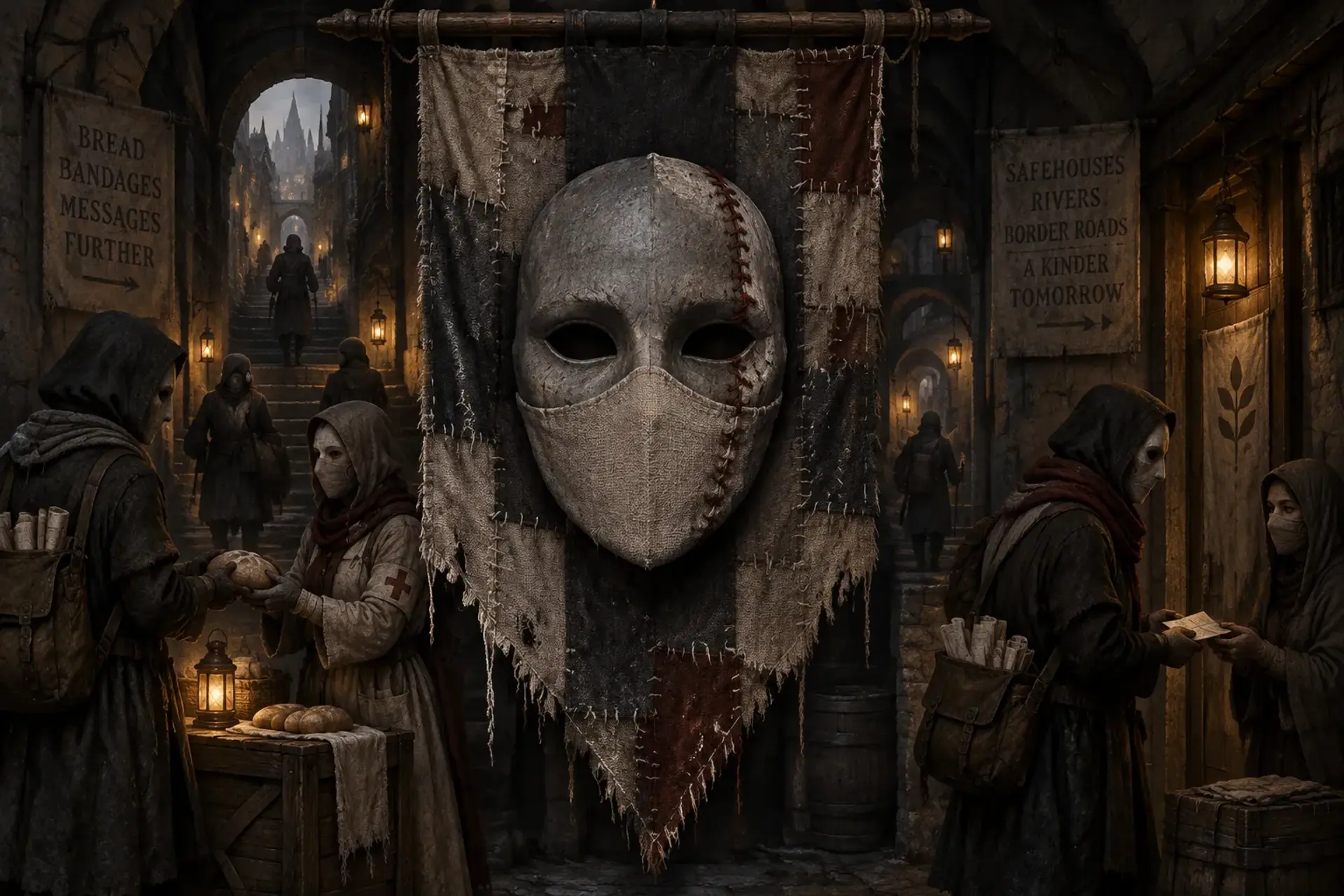
The Hollowed
In its first years, the Hollowed was a rescue custom, not a faction. Workers hid those who refused Vigil, smuggled food to families cut off from ration access, and passed warnings through shift changes. Its first major triumph came when a coordinated evacuation emptied several dormitories before an Accord sweep. No one involved knew the whole plan, and the authorities found only abandoned rooms and masks sewn from work cloth. The watershed moment came during the Shard Lockdown. After an inspection team sealed a transit crossing, a local cell disrupted the crossing's control system long enough for a convoy of refugees to escape. The action succeeded, but a misdirected diversion exposed a nearby shelter. Several members were arrested, and families who had trusted the network suffered reprisals. The Hollowed adopted two lasting rules afterward: no cell should know every route, and no operation should call civilian exposure an acceptable cost without the people at risk having a say. The network grew as new work crews and refugee groups copied its mask signal and mutual-aid practices. It became more than a rescue chain, developing couriers, safehouses, medical contacts, and a loose council. During a later food seizure, Hollowed members returned stolen supplies to several blocks instead of keeping them for their own cells. The gesture won public trust but drew harsher attention from Accord administrators. Today, the Hollowed are stronger and less united than they were at the beginning. Younger members argue that the old caution protects the network more than the people it claims to serve. Survivors of the Shard Lockdown insist that caution is what keeps a rescue from becoming a massacre. Meanwhile, the network is discovering that refusing Vigil can leave people vulnerable to pain, exhaustion, and social exclusion, and that protecting them requires more than hiding them from inspectors.
The Hollowed
- Type
- Masked
- Size
- 230 members
- Reach
- Small but consequential
- Base
- No permanent settlement. The network maintains temporary shelters across several shards.
Overview
In its first years, the Hollowed was a rescue custom, not a faction. Workers hid those who refused Vigil, smuggled food to families cut off from ration access, and passed warnings through shift changes. Its first major triumph came when a coordinated evacuation emptied several dormitories before an Accord sweep. No one involved knew the whole plan, and the authorities found only abandoned rooms and masks sewn from work cloth. The watershed moment came during the Shard Lockdown. After an inspection team sealed a transit crossing, a local cell disrupted the crossing's control system long enough for a convoy of refugees to escape. The action succeeded, but a misdirected diversion exposed a nearby shelter. Several members were arrested, and families who had trusted the network suffered reprisals. The Hollowed adopted two lasting rules afterward: no cell should know every route, and no operation should call civilian exposure an acceptable cost without the people at risk having a say. The network grew as new work crews and refugee groups copied its mask signal and mutual-aid practices. It became more than a rescue chain, developing couriers, safehouses, medical contacts, and a loose council. During a later food seizure, Hollowed members returned stolen supplies to several blocks instead of keeping them for their own cells. The gesture won public trust but drew harsher attention from Accord administrators. Today, the Hollowed are stronger and less united than they were at the beginning. Younger members argue that the old caution protects the network more than the people it claims to serve. Survivors of the Shard Lockdown insist that caution is what keeps a rescue from becoming a massacre. Meanwhile, the network is discovering that refusing Vigil can leave people vulnerable to pain, exhaustion, and social exclusion, and that protecting them requires more than hiding them from inspectors.
How it began
The Hollowed began after the winter ration count at a labor dormitory on a shard later remembered for the smell of wet ash. Accord officials had made access to food and work conditional on Vigil. A group of workers refused. When the first among them collapsed, others carried the sick and their dependents through a freight passage before the doors could be sealed. The survivors covered their faces with torn mask liners so that witnesses could not identify the people who had helped them. One of the rescued workers called them the Hollowed, meaning those whom the system had emptied but not made obedient. The name began as an insult and stayed because changing it felt like inviting the same fate again.
How to know them
- Unbleached grey
- Dull rust red
- The natural color of whatever cloth a cell can spare
- An unpainted lower half on a work mask
- A single rust-red stitch on otherwise ordinary clothing
- Two taps followed by a pause, a warning sound whose meaning changes by location
Standing
What they say they want
What they are doing now
Where it leads
A life across the shards in which refusing Vigil does not mean losing food, shelter, work, or the right to travel. Some members imagine a network of independent mutual-aid communities. Others want the Accord dismantled. The Hollowed has not resolved whether these visions can share a future.
How others see them
To the people it has helped, the Hollowed is proof that the Accord's demands are not the only way to survive. To many officials, it is a dangerous criminal network hiding behind charity. Most ordinary people have heard of its masks but cannot tell which stories are true.
People
6 ranks
Unmasked Seat
Patient, observant, and compassionate without being sentimental. She gives people room to disagree, then expects them to name the consequences of their choices.
- The Unmasked Seat1 member
A temporary coordinating role held by one trusted organizer. It sets priorities across shards and mediates disputes, but cannot issue binding orders to a cell. The seat changes hands after a major operation or when its holder asks to step down.
- The Quiet Table7 members
A rotating council of messengers, medics, route keepers, and worker delegates. It approves shared resources and broad policy by consent where possible. Each member can refuse an operation that would expose their own cell.
- Route Keepers18 members
Trusted links who maintain cross-shard contacts, verify requests, and distribute warnings. They know only the routes and identities necessary for their work.
- Maskholders30 members
Cell coordinators who arrange local aid, recruitment, forged papers, and defensive actions. They are accountable to their own members rather than directly to the council.
- Hands180 members
Couriers, medics, lookouts, shelter hosts, workers, and other active members. Many take part in one task at a time and do not know the network's wider structure.
- Sheltered500 members
People protected or aided by the network who are not members. They owe no service, though some later choose to join.
Other key members
- Brenk Tal Maskholder advocating direct sabotage
- Oisín Refugee advocate and mediator
- Grþa Route Keeper and keeper of the disputed Vigil evidence
How they are organised
- Accept that the Hollowed does not require refusal of Vigil as a test of worth; no one should be pressured into a dangerous choice.
- Agree not to expose shelters, routes, or identities to outsiders without consent from those affected.
- Respect the right of people receiving aid to refuse recruitment.
- Demonstrate reliability through small tasks before being trusted with sensitive information.
Relations
8 factionsA loose association of shard-crossing haulers who pass people and supplies through legitimate cargo routes. Their cooperation depends on the Hollowed never asking them to carry weapons.
Operations
What they do
How they do it
Services for hire
- A Night Without QuestionsA favor, supplies, or no payment in an emergencyTemporary shelter and a basic assessment of immediate risks. The Hollowed does not promise that a shelter will remain safe once discovered.
- Crossing AdviceShared transport costs or a future nonviolent taskA discreet introduction to a route keeper who can arrange passage between shards when a viable route exists.
- Quiet HandsMedical supplies, information, or help locating a healerBasic first aid and referrals to sympathetic practitioners. The faction is not a substitute for specialist care.
What they can do
What they have
Where they are weak
Territory
Headquarters
No permanent settlement. The network maintains temporary shelters across several shards.The Hollowed have no central headquarters. Their closest equivalent is a rotating set of safe rooms, back corridors, and supply caches maintained by local cells. A room is never kept for long after it becomes known to more than a handful of members.
Lands they hold
Outposts
- Bitter AirA decommissioned transfer platform on a shard where the air carries a persistent metallic tangA short-term sorting point for travelers. It is abandoned whenever the route is compromised.
- Last RinseAn unused laundry annex near worker housingA supply cache and discreet place to exchange clean clothing, basic medicine, and messages.
- The Sinking PassageA freight corridor marked on old plans with a warning that it floods during pressure changesAn emergency route used only when ordinary crossings are watched.
Secrets
Plot hooks
6 hooks- 1The Name on the RosterPersonal, low to moderateReward: Safe passage, trust, or a personal favorA worker who once sheltered a character is accused of falsifying Vigil records. The Hollowed asks the character to escort the worker's child to safety, while the child insists on finding a missing parent first.
- 2An Empty ShelfLocal investigation and negotiationReward: Medicine, allies among the Sheltered, or evidence of a planted informantA cell's medicine cache has vanished, and evidence points to a frightened refugee rather than an Accord informant. The party must decide whether to pursue the suspect, protect them from an angry Maskholder, or discover who is manipulating both sides.
- 3The Map That Should Not TravelRegional, with a difficult moral choiceReward: A major route, faction standing, or the release of a detained allyA captured courier offers the party a route map in exchange for safe conduct. The map could expose a security weakness, but it also marks shelters where families are still hiding.
- 4A Door Held ShutHigh-risk infiltration or internal mediationReward: Influence over the Hollowed's next decision and access to its cross-shard networkBrenk Tal's allies plan to disable an Accord crossing during a crowded shift. Sethri believes the timing will trap civilians. The party is asked to stop the operation without handing the saboteurs to the Accord.
- 5The First ListCampaign-scale political crisisReward: The truth of the founding bargain, reconciliation, or a permanent change in faction leadershipA family recognizes a founder's name in a fragment of the original evacuation records and claims the Hollowed knowingly sacrificed one of their own. The Quiet Table wants time to investigate; the family is preparing to make the evidence public.
- 6What Refusal RevealsCampaign-scale investigation across several shardsReward: Evidence capable of changing public opinion, plus dangerous attention from the AccordGrþa's Vigil archive suggests that the Accord has a reason to monitor people who refuse. Before the party can verify it, a Route Keeper disappears and rival cells begin accusing one another of withholding the proof.
Work they offer
What gets in the way
Rumours
Media
0 imagesNo images yet.
Turn The Hollowed into a sheet
A high-res, share-ready sheet you can post or print.