
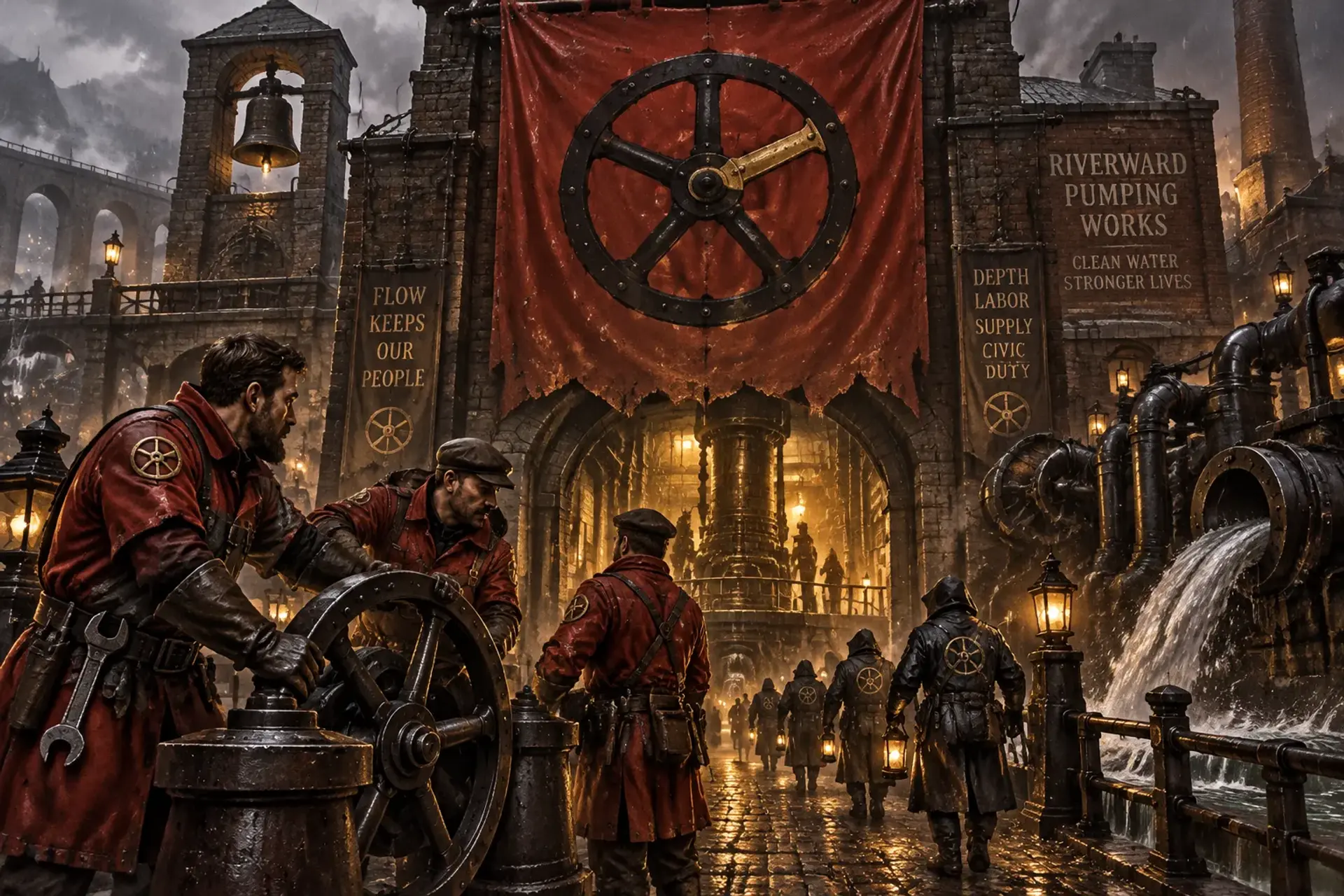
Redford Municipal Works
The office's first decades were defined by improvisation. Its crews repaired water gates, relit public lamps, and converted abandoned workshops into stores for salvageable machinery. As Redford grew, the council expanded the office's remit to include lifts and drainage, but never gave it a budget proportionate to those responsibilities. The first major triumph came when Works crews kept the lower pumps running through a severe flood, evacuating trapped residents by hand-operated lifts after the main power lines failed. The watershed moment came thirty-one years ago, during the Week of Dark Lamps. A Guild cable fault disabled public lighting and two lifts at once. The Furnace Guilds offered immediate repairs, but only if the council signed a long contract granting them exclusive maintenance rights. With streets dark and water rising, the superintendent accepted. The city avoided a worse disaster, but the agreement made the Works dependent on Guild parts and left it paying for years. Some employees call this the bargain that saved Redford; others call it the day the office surrendered its independence. Since then, Works has become a respected but chronically underfunded institution. It developed careful salvage practices, built a skilled night crew, and earned residents' trust through visible labor. It also learned to hide delays, keep unofficial inventories, and treat every emergency as a negotiation. Today its public reputation rests on steady service, while its future hinges on whether it can remain a public office without becoming either a Guild client or a council weapon.
Redford Municipal Works
- Type
- Civic public-works…
- Size
- Approximately 138 staff
- Reach
- High within municipal…
- Base
- Redford
Overview
The office's first decades were defined by improvisation. Its crews repaired water gates, relit public lamps, and converted abandoned workshops into stores for salvageable machinery. As Redford grew, the council expanded the office's remit to include lifts and drainage, but never gave it a budget proportionate to those responsibilities. The first major triumph came when Works crews kept the lower pumps running through a severe flood, evacuating trapped residents by hand-operated lifts after the main power lines failed. The watershed moment came thirty-one years ago, during the Week of Dark Lamps. A Guild cable fault disabled public lighting and two lifts at once. The Furnace Guilds offered immediate repairs, but only if the council signed a long contract granting them exclusive maintenance rights. With streets dark and water rising, the superintendent accepted. The city avoided a worse disaster, but the agreement made the Works dependent on Guild parts and left it paying for years. Some employees call this the bargain that saved Redford; others call it the day the office surrendered its independence. Since then, Works has become a respected but chronically underfunded institution. It developed careful salvage practices, built a skilled night crew, and earned residents' trust through visible labor. It also learned to hide delays, keep unofficial inventories, and treat every emergency as a negotiation. Today its public reputation rests on steady service, while its future hinges on whether it can remain a public office without becoming either a Guild client or a council weapon.
How it began
Redford Municipal Works began after a winter of blackouts and flooded cellars, when a private pumping concern abandoned its contracts rather than repair a cracked intake. Residents hauled water by hand while the council argued over who owned the machinery. A crew of canal fitters, lamp-lighters, and lift mechanics formed a temporary public office to keep the pumps running. Their first superintendent, a former pumpwright, insisted that a service used by everyone could not depend on a single private owner's goodwill. The council gave the office a narrow charter and a shed of tools. The name Redford Municipal Works came from the old fordside repair trade that first maintained the city's water gates.
How to know them
Brick red, Lampblack, Dull brass
- A brass handwheel with one darkened spoke
- Red work tickets pinned to doors where a repair is overdue
- Black grease on the cuffs of formal coats, treated by crews as a sign that an official has actually visited the works
Standing
What they say they want
What they are doing now
Where it leads
A city where essential infrastructure is maintained as a public trust: openly budgeted, repairable with locally made parts, and managed with the knowledge of the people who use and maintain it. The faction disagrees on whether that vision requires cooperation with the Furnace Guilds or a deliberate break from them.
How others see them
Residents generally regard the office as tired, understaffed, and indispensable. Its workers are respected for showing up in bad weather and dangerous places, while its administrators are blamed for delays they may not control.
People
6 ranks
Superintendent
Calm under pressure, cautious with promises, and more comfortable with crews than councilors. He will bend a rule to prevent immediate harm, then insist on recording the breach once the danger passes.
- Superintendent1 member
Sets priorities, negotiates contracts, answers to the council, and carries final responsibility for service failures. May authorize emergency spending but is expected to explain it afterward.
- Works Board5 members
Senior engineers and ward commissioners who review budgets and disputes. Decisions are usually made by majority vote, but emergency orders from the superintendent take effect immediately.
- Section Keepers18 members
Oversee pumps, lifts, public lighting, drainage, and records. They assign crews, certify repairs, and negotiate access with district representatives.
- Street Crews74 members
Inspect, repair, and operate municipal equipment. Their practical knowledge gives them considerable informal power, especially when maps or official manuals are wrong.
- Counters and Runners29 members
Maintain work orders, answer complaints, carry messages, record parts, and gather reports from residents. They often learn about a failure before the engineers do.
- Night Hands11 members
A rotating crew of trusted workers called out for floods, fires, lift failures, and dangerous shutdowns. Their work is loosely documented, and their loyalty is to one another as much as to the office.
Other key members
- Nera Keeper of Pumps and principal contract negotiator
- Brk Sefu Foreman of the Night Hands
- Ilyan of the Fordside Chief map archivist
- Toma Grev Lift engineer and likely successor to the superintendent
How they are organised
- Demonstrate a practical skill or a willingness to learn one of the office's trades.
- Accept that emergency duty may interrupt ordinary work and personal obligations.
- Pass a safety and trust review before receiving access to restricted infrastructure.
- Agree to record repairs and parts used, even when the work was unauthorized or performed under emergency conditions.
Relations
5 factionsA transactional ally. Redford Municipal Works relies on the Guild's cable, pumps, lift gears, and specialist crews. In return, it provides access to municipal sites, steady contracts, and the permits needed to work beneath streets and public buildings. The arrangement is increasingly strained by opaque pricing and emergency repairs that come attached to long-term contracts.
Operations
What they do
How they do it
Services for hire
- Safety inspectionFree for urgent public hazards; ordinary requests are prioritized by risk and available staff.Inspections of municipal pumps, lifts, drainage, and lighting, with written findings when records permit.
- Emergency patchPublicly funded when authorized; emergency work may be charged to a district budget later.Temporary stabilization of a failing public mechanism while a permanent repair is planned.
- Infrastructure records accessA formal request and a promise to return items in usable condition.Limited access to service maps, old repair patterns, and records for legitimate safety or maintenance work.
- Crew instructionUsually a small fee or a reciprocal labor favor.Training in safe tool use, basic maintenance, and hazard recognition for neighborhood volunteers.
What they can do
What they have
Where they are weak
Territory
Headquarters
RedfordA soot-darkened brick works yard beside the oldest municipal pumping station. It contains a public complaints counter, a cramped map room, a gear store, a bell tower used to signal crews, and a basement workshop where retired parts are catalogued or quietly cannibalized. The roof leaks, the front steps are worn smooth, and its walls carry layers of maintenance notices.
Lands they hold
Outposts
- The Old IntakeBelow the eastern market wardA small pump station used as a parts cache and flood-monitoring post. Its original trade-built name refers to the intake works that once served the district.
- The Cable and Chain ShedAt the northern lift terminusA repair store shared by lift crews and Guild contractors, where arguments over ownership of tools and replacement parts are routine.
Secrets
Plot hooks
5 hooks- 1The Uncounted SealsLow to moderate; investigation, negotiation, or a short retrieval mission.Reward: A favor from a Street Crew, access to restricted service routes, or useful local information.A character who works for, lives near, or owes a favor to the office is asked to find a missing box of pump seals before the next shift. The official inventory says it was never delivered, but a crew member swears they saw it unloaded.
- 2Terms Before SunsetModerate; time pressure, technical problem-solving, and a difficult public choice.Reward: Payment, a public reputation shift, and leverage in future Guild negotiations.A lift fails during a crowded market day. The Guild offers a rapid repair if the council signs an exclusive contract before sunset. Works asks the characters to keep the lift safe, uncover the actual fault, or buy time for a competing repair.
- 3The Route Beneath the WardModerate to high; exploration, conflicting claims, and a consequential engineering decision.Reward: A lasting alliance with a ward, access to hidden infrastructure, or proof of a contractor's wrongdoing.A map archivist discovers that an apparently empty drainage run connects a neighborhood cistern to an old industrial intake. The route may solve a water shortage, but opening it could flood homes or expose a concealed Guild installation.
- 4A Fault Made by HandHigh; hazardous exploration, sabotage investigation, and divided loyalties.Reward: Evidence, technical salvage, and the trust of the crew, at the cost of angering whoever benefits from the failures.The Night Hands ask the party to escort them into a sealed pump chamber after a series of failures. Inside is evidence that someone has been altering equipment to make the office's emergency repairs appear incompetent.
- 5The Clause in the DarkCampaign-scale; political maneuvering, document recovery, and choosing who bears the cost of reform.Reward: Major political influence, a transformed relationship with the Guilds, or control over the future of municipal infrastructure.A council inquiry threatens to expose the old side agreement with the Furnace Guilds. The characters must decide whether to help Mosi contain the scandal, reveal the clause, or find a way to prove it has been abused without crippling public services.
Work they offer
What gets in the way
Rumours
Media
0 imagesNo images yet.
Turn Redford Municipal Works into a sheet
A high-res, share-ready sheet you can post or print.