
The Ninth Bell
The Ninth Bell formed in the aftermath of the Bellwinter Expedition, first as a mutual-aid compact among bereaved families and survivors. Its earliest service was humble: training young guides, sharing maps, and keeping a public list of expeditions that had not returned. During its first decades, it began certifying contract leaders so patrons could distinguish prepared crews from reckless bands. The watershed moment came about sixty years after its founding, when two rival armies hired guild members to fight on opposite sides of a river campaign. A mixed group of members refused orders to attack one another and instead opened a crossing for trapped civilians. The dead and the resulting accusations nearly split the guild. The Charter Table adopted the Articles of the Open Door: members could accept lawful work for competing patrons, but no branch could compel a member to take arms against another guild member, and guild halls had to offer a hearing before expulsion. The articles did not end the wars; they gave the guild a rule to argue over. In later generations, the guild expanded into the capitals and major cities of the world, adding common rank examinations and contract standards. It partnered with the Aurum Synod to make payment safer across borders. The partnership brought dependable exchange, but also dependence on an outside institution with its own interests. The guild prospered through monster hunts, exploration, escort work, and recovery contracts, then suffered scandals when patrons used its members as deniable soldiers. Today, The Ninth Bell is a huge international institution whose reputation rests on training and impartial service, even as its members are drawn into the wars it cannot stop.
The Ninth Bell
- Type
- Multinational adventurers'…
- Size
- 1,000 members
- Reach
- Global
- Base
- A neutral market town, intentionally unnamed in public ledgers
Overview
The Ninth Bell formed in the aftermath of the Bellwinter Expedition, first as a mutual-aid compact among bereaved families and survivors. Its earliest service was humble: training young guides, sharing maps, and keeping a public list of expeditions that had not returned. During its first decades, it began certifying contract leaders so patrons could distinguish prepared crews from reckless bands. The watershed moment came about sixty years after its founding, when two rival armies hired guild members to fight on opposite sides of a river campaign. A mixed group of members refused orders to attack one another and instead opened a crossing for trapped civilians. The dead and the resulting accusations nearly split the guild. The Charter Table adopted the Articles of the Open Door: members could accept lawful work for competing patrons, but no branch could compel a member to take arms against another guild member, and guild halls had to offer a hearing before expulsion. The articles did not end the wars; they gave the guild a rule to argue over. In later generations, the guild expanded into the capitals and major cities of the world, adding common rank examinations and contract standards. It partnered with the Aurum Synod to make payment safer across borders. The partnership brought dependable exchange, but also dependence on an outside institution with its own interests. The guild prospered through monster hunts, exploration, escort work, and recovery contracts, then suffered scandals when patrons used its members as deniable soldiers. Today, The Ninth Bell is a huge international institution whose reputation rests on training and impartial service, even as its members are drawn into the wars it cannot stop.
How it began
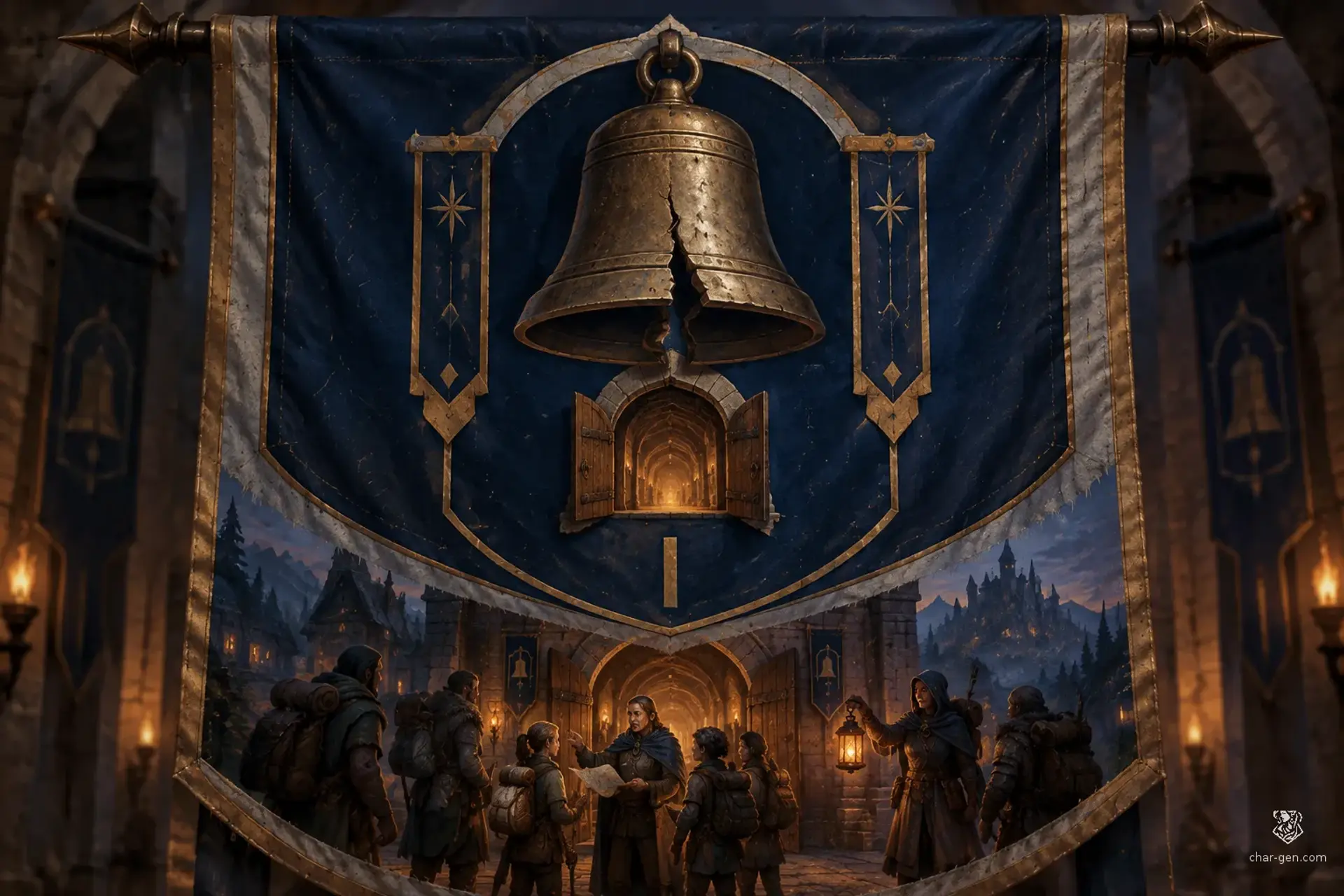
The guild says it began after the Bellwinter Expedition, when a band of treasure-seekers entered a collapsed border fortress and vanished during a blizzard. Their families rang a warning bell at the road gate every night until the search ended. On the ninth night, one survivor stumbled back, carrying the bell's cracked clapper and a list of the dead. The story says the survivors and the families swore that no young adventurer should be sent out without training, a known route, and someone responsible for asking whether they returned. The actual founding was less tidy: surviving companions, caravan guards, a retired quartermaster, and several rival sponsors argued for months over who would pay for the first hall. They kept the name The Ninth Bell because changing it felt like tempting the same fate.
How to know them
Dull brass, Deep blue, Ash grey
- A cracked brass bell
- An open doorway
- A ninth stroke marked by a short vertical line in branch ledgers
Standing
What they say they want
What they are doing now
Where it leads
A world in which anyone willing to learn the work can find honest training, fair contracts, and a path home, without having to swear loyalty to a ruler or temple. The practical vision is less grand: preserve enough trust between branches that a member can seek shelter in a foreign capital during a war.
How others see them
To young adventurers, The Ninth Bell is a way into a dangerous profession without needing a rich patron or famous family. To patrons, it is a convenient source of trained and documented specialists. To governments, it is useful until its neutrality obstructs military plans. Common people respect its rescue work but know that guild badges do not make a battlefield safe.
People
7 ranks
First Bell
Measured and humane, with a controlled anger toward leaders who treat young adventurers as expendable. She can seem indecisive because she insists on hearing people who disagree with her.
- First Bell1 member
The elected chair of the central council. Represents the charter, arbitrates disputes between branches, and cannot personally command a branch's members in the field.
- Charter Table12 members
Senior representatives elected from the major branches and service offices. Sets common rules, hears appeals, and approves changes to rank standards. Decisions require a supermajority, which makes action slow during crises.
- Capital Branchmasters9 members
Each leads a capital branch: Szith, Kociru, Thetford, Helstovil, Park, Ruena, Milseave, Portscom, and Rij'jas. They control local hiring, training schedules, and responses to government pressure.
- Hallwardens90 members
Lead regional halls in other major cities. Manage lodging, local contracts, safety procedures, and relations with nearby authorities.
- Examiners and Tutors140 members
Teach fieldcraft and assess rank applications. They can recommend a member for a rank but cannot grant it alone. Experienced members include scouts, scholars, healers, craftspeople, and retired adventurers.
- Ledger Stewards35 members
Maintain membership rolls, contract records, travel notices, and compensation accounts. Aurum Synod fabricator mages serving on staff handle metal assay and currency conversion under a separate agreement.
- Chartered Members and Probationers900 members
The working body of the guild, from new trainees to veteran contract leaders. They accept contracts, teach one another, and are expected to observe the charter even when local governments do not.
Other key members
- Bram Branchmaster of Thetford and advocate for tighter restrictions on mercenary work
- Katalin Varga Senior examiner and likely successor to the First Bell
- Tosh Aurum Synod fabricator mage assigned to central currency exchange
- Jurek Sorn Retired contract leader and instructor in expedition safety
How they are organised
- Accept the charter's basic duties, including the obligation to report a missing member and to hear a member's account before supporting their expulsion.
- Pass a practical assessment appropriate to the candidate's chosen work. Candidates may demonstrate field skill, scholarship, healing, logistics, negotiation, or another useful discipline.
- Declare relevant conflicts of interest and disclose whether a patron, government, or armed organization currently commands the candidate.
- Agree that a guild rank reflects assessed capability and conduct, not noble birth, wealth, magical power, or a particular class of adventurer.
Relations
11 factionsAurum Synod fabricator mages staff exchange desks in guild halls, converting precious metals into usable currency and verifying suspicious coin. The arrangement is profitable and mutually necessary, but the Synod's control of exchange rates gives it leverage over the guild.
Operations
What they do
How they do it
Services for hire
- Training and examinationMembership fee or approved service in kind, varying by branchInstruction in practical skills, field planning, contract etiquette, and safe expedition procedure. Specialized lessons depend on local tutors and available facilities.
- Contract registrationA small posting fee, sometimes waived for urgent public-safety workReview and public posting of a contract, including known hazards and recommended member rank. The guild does not guarantee a patron's truthfulness.
- Hall lodging and noticesUsually a modest fee or reciprocal lodging dutyBasic beds, secure storage when available, local notices, and a place to contact other members. Space may be limited during crises.
- Metal assay and currency exchangeA negotiated fee charged by the Aurum Synod, not set by the guildAssay and conversion of precious metals into usable currency. Large or suspicious deposits may be held for verification.
- Contract mediationFree for members; patrons may pay for a formal proceedingA branchmaster or appointed panel hears disputes over contract terms, pay, missing equipment, or a member's conduct. The guild can offer a ruling and impose membership consequences, but it cannot replace a local court.
What they can do
What they have
Where they are weak
Territory
Headquarters
A neutral market town, intentionally unnamed in public ledgersThe guild has no single sovereign headquarters. Its central registry and arbitration chamber occupy a fortified hall in a neutral market town whose location is deliberately omitted from public records. The building is plain by design: a courtyard for drills, sleeping rooms, a map archive, a contract room, and an Aurum Synod exchange desk. Every branch keeps a brass bell with a crack painted across it, but only the central hall's bell is said to have belonged to the original search party.
Lands they hold
Outposts
- Szith capital branchSzithTraining, contracts, and support for members working in the Szithan Empire.
- Kociru capital branchKociruTraining, contracts, and support for members working in the Lintanar Empire.
- Thetford capital branchThetfordTraining, contracts, and support for members working in the Kingdom of Basings.
- Helstovil capital branchHelstovilTraining, contracts, and support for members working in the Divine Kingdom of Newces.
- Park capital branchParkTraining, contracts, and support for members working in the Narus League.
- Ruena capital branchRuenaTraining, contracts, and support for members working in the Principality of Ruenia.
- Milseave capital branchMilseaveTraining, contracts, and support for members working in the Principality of Milseavia.
- Portscom capital branchPortscomTraining, contracts, and support for members working in the Republic of Dodbronia.
- Rij'jas capital branchRij'jasTraining, contracts, and support for members working in the Grand Duchy of Soras.
- Regional guild hallsOther major cities throughout the worldProvide local training, contract postings, lodging, and a place for members to report in.
Secrets
Plot hooks
5 hooks- 1The Rank That Wasn't EarnedPersonal to localReward: Rescue, information, and possible guild favorA new member's family asks the party to find them after a routine escort contract went silent. The branch records show the recruit was assigned a rank well above their training, and the examiner insists the paperwork was altered after approval.
- 2Two Names on the MusterRegionalReward: Safe passage, diplomatic credit, or a dangerous debtTwo guild members, one serving a Szithan patron and one a Lintanar patron, are trapped on opposite sides of a contested road. Their commanders demand that the party identify the other as an enemy combatant. The local branchmaster asks for a third way before the Articles of the Open Door are tested in public.
- 3False AssayLocal to regionalReward: Payment restored, access to records, or leverage over a branchA string of counterfeit Aurum Synod seals has caused the guild to freeze several members' accounts. The party must trace the forgeries without handing the evidence to either the Synod or a wartime intelligence office that wants the ledgers.
- 4The Contract Beneath the ContractParty-scaleReward: Coin, recovered evidence, or a new enemy among the patronsA patron offers excellent pay for a ruin-clearing contract, but the guild's archived reports mark the site as unsafe and the patron's name appears in a sealed older ledger. The party can accept, investigate, or force the branch to explain why it still posted the work.
- 5The Ninth NightCampaign-scaleReward: A major secret, a lasting ally, or a fracture in the guildThe central archive's sealed Bellwinter file has been stolen. The thief claims the document proves the guild was founded to bury a crime, while the council says exposing it will spark reprisals against current members. The party must find the file and decide who deserves the truth.
Work they offer
What gets in the way
Rumours
Media
0 imagesNo images yet.
Turn The Ninth Bell into a sheet
A high-res, share-ready sheet you can post or print.