
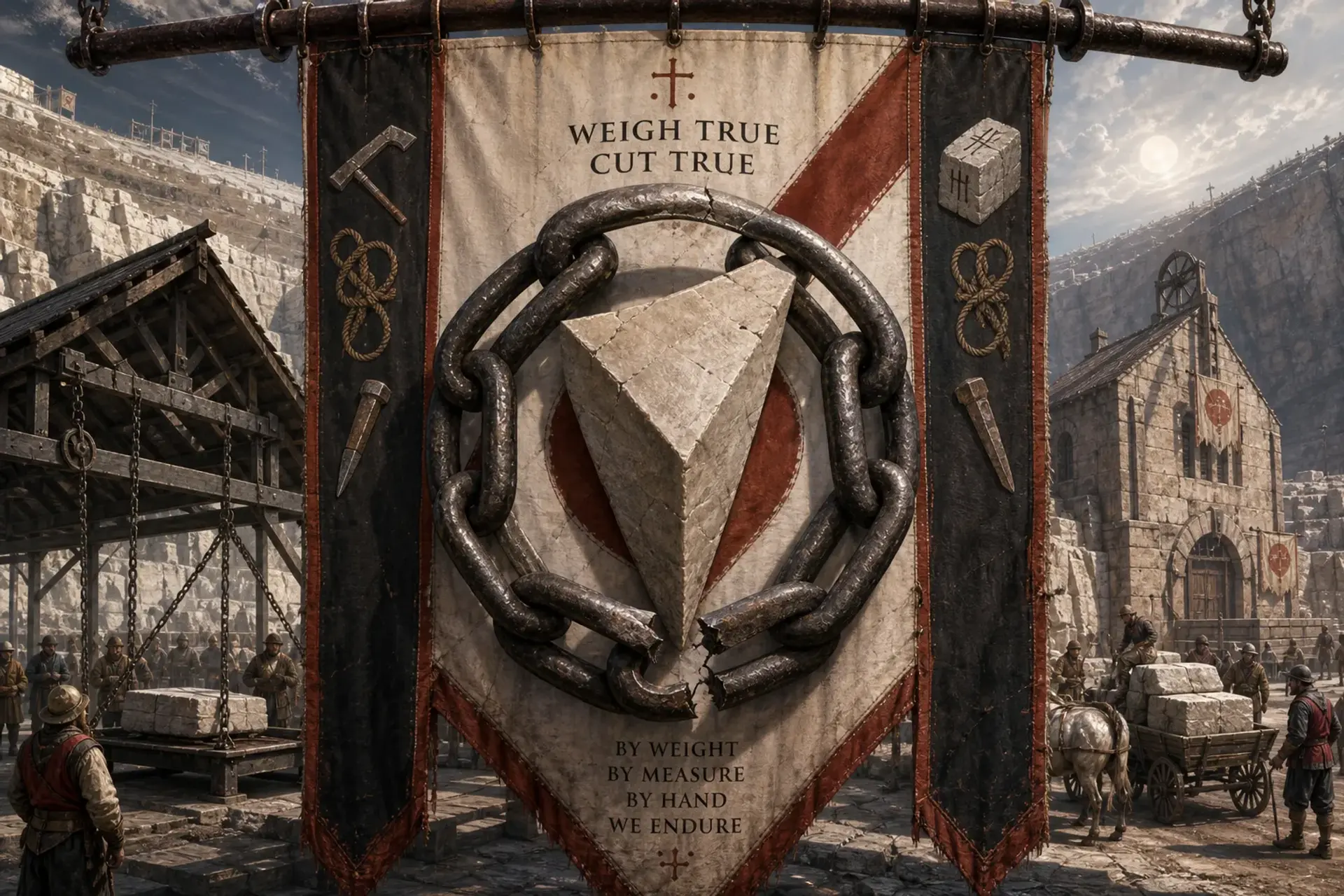
The Rattle Chain
The Rattle Chain began as a mutual bargain among quarry crews and caravaners, then became the body that defined common weights and paid compensation after accidents. Its authority grew after the Red Load winter, when it stopped shipments until grades could be checked and accepted the resulting hunger and lost income as the price of safer roads. That choice gave it a public reputation for responsibility and a lasting claim over quality certification. During the following decades, it pooled funds for road repair, established weigh floors at major depots, and negotiated bulk sales. Its leaders also used the new system to exclude cutters who would not submit to inspection. A major strike forced the introduction of accident stipends and local crew votes, but never wrested control of price-setting from the council. The syndicate now regards itself as guardian of the trade, while many workers see it as a cartel that has inherited the language of mutual aid without its original limits.
The Rattle Chain
- Type
- Industrial syndicate and…
- Size
- Approximately 650 full and provisional…
- Reach
- Strong across major…
- Base
- Slate Yard
Overview
The Rattle Chain began as a mutual bargain among quarry crews and caravaners, then became the body that defined common weights and paid compensation after accidents. Its authority grew after the Red Load winter, when it stopped shipments until grades could be checked and accepted the resulting hunger and lost income as the price of safer roads. That choice gave it a public reputation for responsibility and a lasting claim over quality certification. During the following decades, it pooled funds for road repair, established weigh floors at major depots, and negotiated bulk sales. Its leaders also used the new system to exclude cutters who would not submit to inspection. A major strike forced the introduction of accident stipends and local crew votes, but never wrested control of price-setting from the council. The syndicate now regards itself as guardian of the trade, while many workers see it as a cartel that has inherited the language of mutual aid without its original limits.
How it began
The Rattle Chain traces its origin to a winter when three quarry crews and a caravan train were trapped by a collapse on the haul road. The crews had stone, the drivers had food, and neither side trusted the other enough to share. A forewoman called Nera, remembered in later songs as the First Link, struck a length of loose chain against a wagon rim until everyone came out to argue. She proposed a bargain: the crews would reinforce the road and mark safe stone, while the caravaners would provision the camps and carry their agreed measure beyond the shard. The first chain-link tokens were receipts for those exchanges, not badges of authority. The name Rattle Chain comes from the sound of those tokens clinking on the wagon rim. For decades the syndicate was a useful compact, setting common weights and paying families after accidents. Its watershed moment came during the Red Load winter, when a badly graded shipment broke loose on a descent and killed several travelers. The syndicate halted all anchor-stone traffic, even as hungry camps demanded wages. That costly pause established its authority to certify quality and its claim that safe trade sometimes requires a monopoly. In later years the Rattle Chain built depots, standardized cuts, and forced smaller crews into its measure system. A strike won accident stipends and elected crew delegates, but leadership retained control of prices. Today it is both a practical source of dependable stone and a powerful private government over the trade.
How to know them
Chalk white, Oxide red, Coal black
- A single loose iron link worn at the belt by elected crew delegates.
- A pale diagonal slash painted on certified cargo.
- Three measured taps on a wagon rim to call a load dispute.
Standing
What they say they want
What they are doing now
Where it leads
A trade system in which every load of anchor stone has a traceable grade, every worker has protection after injury, and no single caravan lord or quarry owner can dictate terms. Whether Sada's vision can coexist with the syndicate's control of the grade stamp is an open question.
How others see them
To buyers, the Rattle Chain is a reliable certifier whose loads can be trusted. To workers, it is a hard but familiar institution that sometimes pays when no one else will. To independent operators, it is a cartel that dresses exclusion in the language of safety.
People
5 ranks
First Link
Measured, observant, and quietly formidable. She prefers a costly compromise to a clean victory, though opponents mistake her restraint for weakness.
- The Five Links5 members
An elected council of quarry and caravan representatives. It approves price bands, major contracts, and stoppages. The chair can act in emergencies, but must later answer to the council.
- Weighkeepers18 members
Senior graders, contract clerks, safety assessors, and depot liaisons. They interpret the common measures and report local conditions to the council.
- Chain bosses76 members
Crew forepersons and depot supervisors who assign shifts, maintain equipment, negotiate local disputes, and enforce syndicate decisions.
- Bound hands430 members
Quarry workers, haulers, cutters, teamsters, and clerks with voting rights in local crew meetings and access to accident stipends.
- Loose links120 members
Seasonal laborers, probationary members, and contracted specialists. They receive limited benefits and are most vulnerable to pressure from bosses.
Other key members
- Beko Mgeladze Senior Weighkeeper for pricing and contracts
- Taviri Lead safety assessor
- Kesi of the Rain Rattle Caravan liaison and likely successor to a council seat
How they are organised
- Complete a trial period on a quarry crew, depot team, or recognized caravan route.
- Accept the shared measures for weight, grade, and safety, including inspection of one's own work.
- Contribute a small portion of wages to the accident and relief fund.
- Name a sponsor who will answer for your conduct during the trial period.
Relations
7 factionsCaravan masters rely on the Rattle Chain to certify loads and settle disputes before costly journeys. Their support weakens whenever prices rise.
Operations
What they do
How they do it
Services for hire
- Load certificationA negotiated fee, commonly a fraction of the shipment valueIndependent grading and weighing of anchor stone. The certificate is useful, but accepting the inspection may expose a seller to syndicate fees.
- Accident reliefMember dues and a claim reviewLimited payments and practical assistance after an injury sustained on recognized syndicate work.
- Caravan matchingContract fee or reciprocal delivery agreementAccess to shared loading slots, standard measures, and a broker who can match a quarry crew with a caravan buyer.
What they can do
What they have
Where they are weak
Territory
Headquarters
Slate YardA broad counting house and covered weigh floor beside the main stone road in Slate Yard. Its walls are faced in pale quarry rejects, while iron chains hang from the rafters to display disputed loads. The public hall hosts grievance hearings and safety demonstrations. Behind it, locked ledgers, a private inspection bay, and rooms for questioning debtors reveal the less charitable side of the operation.
Lands they hold
Outposts
- The Rain RattleThe largest northern quarry campsA covered sorting floor and tool store named for the sound of rain striking its iron roof; it handles wet-season grading.
- The Long HaulThe eastbound caravan depotA chain yard and contract office named for a single disastrous journey that outsiders insist was completed in one day, though it took five.
- The Hush CutThe lower cutting terracesA small inspection station named for the uncanny quiet that follows a clean deep cut; it also serves as a meeting place for safety assessors.
Secrets
Plot hooks
5 hooks- 1The Missing ShiftLow to moderate; investigation, negotiation, or a dangerous night visit to a locked tool store.Reward: Personal favor, access to the syndicate hall, or a worker's loyaltyA character's relative is injured at work, but the crew boss claims the accident happened off shift. Taviri asks the characters to find a missing tool record before the family loses its stipend.
- 2A Crack in the MarkModerate; compare samples, question witnesses, and navigate competing claims.Reward: Payment, safe passage, or a valuable relationship with one sideA load stamped by the Rattle Chain fractures during an ordinary journey. The syndicate blames sabotage, the caravaners blame bad grading, and the independent cutters offer to prove their own stone is sound. The party must inspect the evidence before the next shipment is halted.
- 3False LinksModerate to high; the party can retrieve the stamps, broker a public hearing, or help the crew prove its case.Reward: A syndicate contract, evidence of corruption, or leverage with the independent cuttersKesi hires the party to recover a stolen set of grade stamps before they are used to pass inferior stone. The stamps are in the hands of a crew that says it stole them only to expose the council's price manipulation.
- 4The Ledger Beneath the StoneHigh; dangerous terrain, a tense labor dispute, and a choice about revealing a history that could fracture the faction.Reward: A major ally, access to hidden records, or influence over the syndicate's futureTaviri asks for an escort to a remote quarry where workers have vanished from the books. The site contains proof connected to the Red Load winter, but its current boss is preparing to ship a valuable seam before the council can intervene.
- 5The Price of a LinkCampaign-scale; involves commerce, political alliances, and consequences for communities beyond Slate Yard.Reward: Regional influence, lasting contracts, or a changed balance of powerThe Five Links cannot agree on a price band as several settlements face a shortage. Sada wants a temporary cap; Beko wants to reserve the remaining stone for high-paying buyers. The party must secure a supply, expose a manipulated shortage, or decide who gets the last dependable loads.
Work they offer
What gets in the way
Rumours
Media
0 imagesNo images yet.
Turn The Rattle Chain into a sheet
A high-res, share-ready sheet you can post or print.