
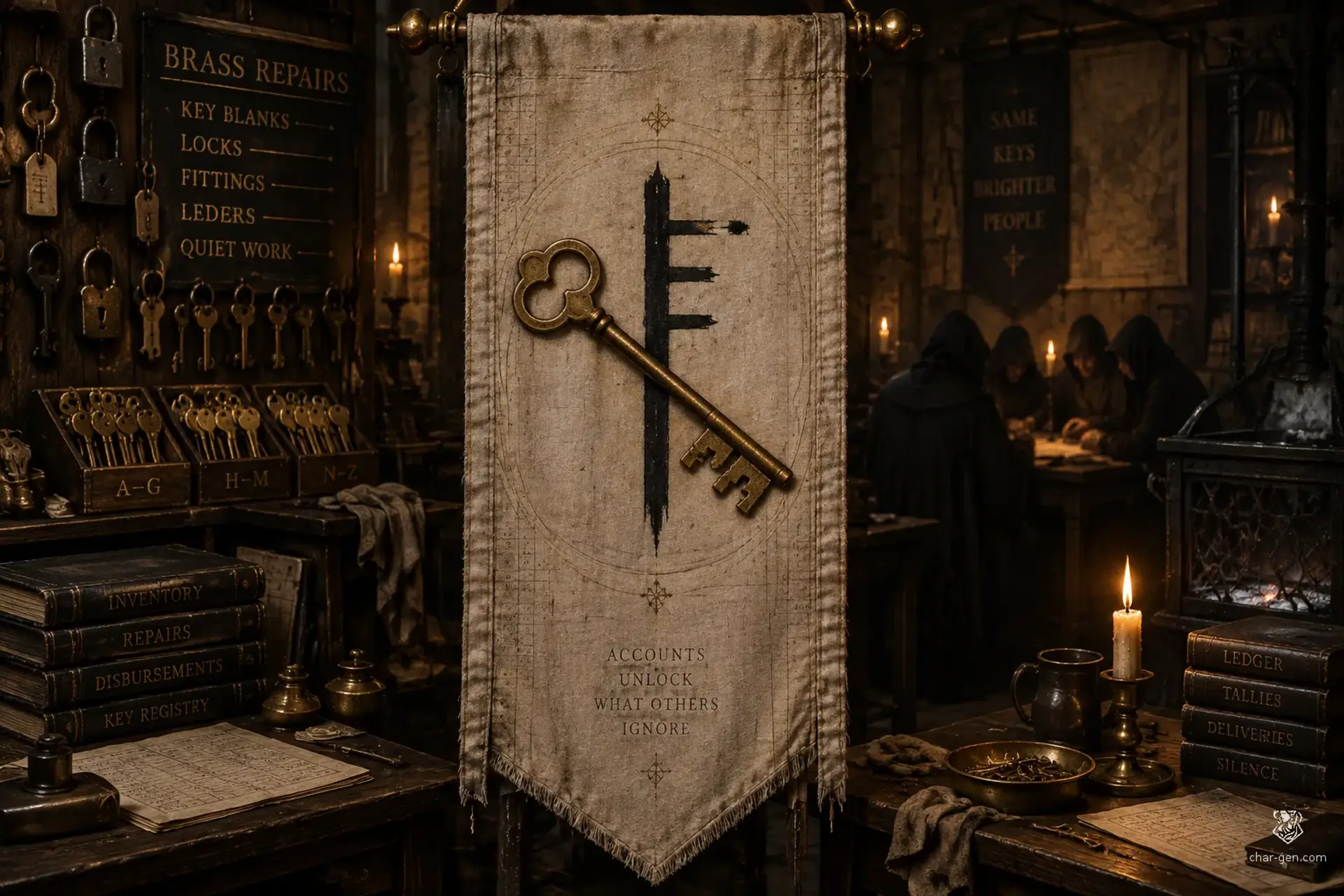
The Latchcount
In its first decades, the Latchcount was a loose circle of locksmiths, copyists, and people who knew how to move through a city without attracting notice. It grew by selling access and useful facts rather than trying to control whole streets. During the Three Winter Audit, a royal inquiry began arresting clerks and tradespeople whose names appeared in stolen tax ledgers. The guild's founders scattered their records among independent keepers, a practice that became its defining structure. A generation later, the guild helped expose a grain official who had falsified storehouse tallies during a famine. The evidence forced a public inquiry and won the guild a reputation among ordinary people as thieves with a conscience. It also taught them how effectively a truthful accusation could be used to hide a self-serving one. The watershed moment came thirty-one years ago, during the Brass Registry Fire. A fire destroyed part of the capital's official registry, including records that could have revealed the guild's network. The guild arranged the theft of several documents before the blaze, but the fire itself was not theirs. In the aftermath, they sold selected copies to competing nobles, preventing any single faction from controlling the surviving evidence. The kingdom avoided a purge, and the Latchcount gained national influence. It also quietly profited from the chaos and helped one guilty official escape justice. Today the guild remains small, scattered, and difficult to map. It does not rule a criminal district or command a host of cutpurses. Its power comes from knowing which door is unlatched, which clerk is desperate, and which version of a story will survive a hearing. Recent royal efforts to centralize records threaten that advantage, while the discovery of a missing page from the First Tally has reopened old arguments about what the guild was founded to do.
The Latchcount
- Type
- Thieves' Guild
- Size
- 32 members
- Reach
- National
- Base
- The kingdom's capital, with the exact district changed every few years.
Overview
In its first decades, the Latchcount was a loose circle of locksmiths, copyists, and people who knew how to move through a city without attracting notice. It grew by selling access and useful facts rather than trying to control whole streets. During the Three Winter Audit, a royal inquiry began arresting clerks and tradespeople whose names appeared in stolen tax ledgers. The guild's founders scattered their records among independent keepers, a practice that became its defining structure. A generation later, the guild helped expose a grain official who had falsified storehouse tallies during a famine. The evidence forced a public inquiry and won the guild a reputation among ordinary people as thieves with a conscience. It also taught them how effectively a truthful accusation could be used to hide a self-serving one. The watershed moment came thirty-one years ago, during the Brass Registry Fire. A fire destroyed part of the capital's official registry, including records that could have revealed the guild's network. The guild arranged the theft of several documents before the blaze, but the fire itself was not theirs. In the aftermath, they sold selected copies to competing nobles, preventing any single faction from controlling the surviving evidence. The kingdom avoided a purge, and the Latchcount gained national influence. It also quietly profited from the chaos and helped one guilty official escape justice. Today the guild remains small, scattered, and difficult to map. It does not rule a criminal district or command a host of cutpurses. Its power comes from knowing which door is unlatched, which clerk is desperate, and which version of a story will survive a hearing. Recent royal efforts to centralize records threaten that advantage, while the discovery of a missing page from the First Tally has reopened old arguments about what the guild was founded to do.
How it began
The Latchcount takes its name from the locksmith's trade that first paid its members. During the winter of the Salt Levy, the Crown's collectors seized the tools and homes of locksmiths who could not pay a new tax on metalwork. One locksmith, Oru, began keeping duplicate keys to the seized workshops and a tally of which officials had ordered each seizure. A dismissed toll clerk named Baret helped Oru copy the records; a laundress called Zuri hid the keys in bundles of mended uniforms. Their first theft was not coin but the original tax roll, which they used to prove that collectors had charged the same households twice. The Crown quietly cancelled the levy rather than admit the fraud. Oru's circle learned that a key was useful, but a record of who needed it was more valuable.
How to know them
Soot black, Old brass, Unbleached linen
- A key crossed over a single tally mark
- Two close notches with a deliberate gap, used as a subtle sign on work orders
- A strip of unbleached linen tied around a brass key blank
Standing
What they say they want
What they are doing now
Where it leads
Remain a small network that can preserve its independence through change of ruler, law, and fashion. Sela's private version of this vision includes a kingdom where no official can make a person disappear into an unchallenged record, though she has not decided whether the guild should help bring that about or merely retain the power to interfere.
How others see them
Among common people, the Latchcount is an occasional source of help when law and wealth are stacked against them, though few would say so openly. To merchants, it is an irritating but sometimes useful criminal concern. To the Crown, it is a persistent rumor that becomes real whenever an important document goes missing.
People
4 ranks
First Seat of the Brass Measure
Measured, observant, and protective in practical ways rather than sentimental ones. She will save a member from a cell, but not necessarily from the consequences of a bad choice.
- The Brass Measure3 members
Three senior members decide major policy, approve national jobs, and settle disputes that could expose the network. Decisions require two votes, but unanimity is expected for actions that risk public bloodshed.
- Tallykeepers6 members
Maintain separate pieces of the guild's accounts, contacts, and coded records. Each keeper knows only a portion of the whole. They can veto a job if its risk threatens the network.
- Keyhands8 members
Experienced operators who plan entries, train recruits, manage fences, and carry messages between distant cells. They can propose jobs but cannot authorize a national operation alone.
- Runners15 members
Full members who specialize in scouting, forgery, surveillance, concealment, and discreet theft. They maintain the day-to-day relationships that make the guild's reach possible.
Other key members
- Baret Vell Senior Tallykeeper and keeper of court records
- Zgum Keyhand responsible for recruitment and field operations
- Nandi Runner and principal contact among the royal clerks
How they are organised
- Show patience, discretion, and a useful skill. Quick hands alone are not enough.
- Complete a low-risk task that demonstrates judgment, not merely obedience.
- Accept that the guild may refuse to explain a decision if explaining it would expose another member.
- Never sell a member's identity, even if that member has been expelled. The rule is enforced more consistently than any other.
Relations
7 factionsThe guild supplies discreet information about road tolls and patrol changes. In return, the couriers sometimes carry sealed messages without asking what is inside. Neither side trusts the other with names.
Operations
What they do
How they do it
Services for hire
- Quiet MeasureA modest fee, a useful fact, or a reciprocal favorA discreet assessment of a lock, route, document, or security weakness. This is a custom service, not a rules-defined D&D feature.
- A Counted FactPayment in coin plus a verifiable piece of informationA narrow answer about a person's movements, a shipment's timing, or a public record's recent changes. They do not promise complete dossiers.
- Borrowed DoorA significant favor, or a share of recovered goodsAn introduction to a fence, courier, or discreet clerk. The contact is not guaranteed to accept the client or remain available.
What they can do
What they have
Where they are weak
Territory
Headquarters
The kingdom's capital, with the exact district changed every few years.The guild has no single fortress. Its central meeting place is a cramped counting room above a shuttered brass-repair shop, entered through a false panel behind a rack of broken locks. The room contains no master archive. Ledgers are split into small sections and stored in ordinary homes, workshops, and rented rooms across the capital. A visitor who expects a treasure vault finds stools, a cold brazier, and a wall of carefully labeled key blanks.
Lands they hold
Outposts
- The Keywright's BenchA market district in the capitalA repair stall that provides introductions to locksmiths and a place to leave coded messages in ordinary work orders. The name comes from the old key-making trade practiced there.
- The Ferry TallyA busy river crossing in the northA counting shed where members compare freight schedules and quietly learn which passengers are avoiding official notice. It is named for the ferry toll clerks who first used it.
- The Certain PassageA provincial court townA modest lodging house used for temporary shelter and document exchanges. Its boastful name was chosen by a former owner who promised every traveler a safe crossing; the guild now uses it as an unremarkable meeting point.
Secrets
Plot hooks
5 hooks- 1The Name in the MarginLow to moderateReward: A personal debt cleared, useful information, or a contact in the capitalA character's family name appears in a stolen tax roll, and a Latchcount Runner offers to remove it in exchange for one discreet favor. The character can discover that the entry is evidence of a real injustice, not merely a mistake.
- 2A Seal That Should Not ExistModerateReward: Coin, legal documents, or the support of a communityA clerk asks the party to recover a sealed charter before it reaches the Lantern Court. The Latchcount claims the charter is forged, but Baret Vell believes it may prove that a village was unlawfully stripped of its land.
- 3The Open DoorModerate to highReward: Faction favor, a safehouse, or access to the guild's information networkA safe room has been exposed, and the guild blames an informant who insists that Nandi sold the route. The party must determine whether this is a genuine betrayal, an attempt to remove a rival, or a trap arranged by the Lampmen.
- 4The Kingdom in One BookHighReward: A major political contact, valuable leverage, or a chance to shape a regional lawThe Crown is preparing to centralize land and tax records. The Latchcount hires the party to steal a registry key, while a reform-minded Tallykeeper separately asks them to preserve evidence that could protect tenants from fraudulent claims. These goals may not be compatible.
- 5The First TallyCampaign-scaleReward: A lasting alliance, a reformed guild, or powerful enemies among its eldersA missing page from the First Tally has surfaced in the hands of a provincial magistrate. It names informants abandoned after the Brass Registry Fire. The party must choose whether to return it to Sela, reveal it to the named families, or use it to force the guild to change.
Work they offer
What gets in the way
Rumours
Media
0 imagesNo images yet.
Turn The Latchcount into a sheet
A high-res, share-ready sheet you can post or print.