
Deep Delvers
After the Ninth Descent collapse, the survivors formed an informal rescue compact. Their numbers grew as unlicensed miners and displaced crews discovered that the Delvers would guide them through dangerous workings without asking who held the paper claim. For years they were a small mutual-aid network, marking safe air pockets, maintaining ladders, and retrieving the lost. Their watershed moment came when a surface syndicate sealed a known bypass during a dispute over ownership, trapping a crew behind a fresh collapse. Varek's people breached the seal from below and brought the miners out. The operation saved lives but destroyed claim records and machinery, turning a tolerated nuisance into a declared hostile network. In the years since, the Delvers have expanded into old shafts and lower root passages, learned to work around shifting gravity, and built a reputation for finding routes others deny exist. Their reach is now substantial, but their authority remains local and earned. They have never agreed whether they are a union, a rescue compact, or an insurgency that has not yet admitted what it is.
Deep Delvers
- Type
- Subterranean hostile…
- Size
- Medium
- Reach
- Quiet but persistent in…
- Base
- No permanent settlement; mobile caches and temporary junction camps in the lower passages surrounding the Verdant Heart Nexus.
Overview
After the Ninth Descent collapse, the survivors formed an informal rescue compact. Their numbers grew as unlicensed miners and displaced crews discovered that the Delvers would guide them through dangerous workings without asking who held the paper claim. For years they were a small mutual-aid network, marking safe air pockets, maintaining ladders, and retrieving the lost. Their watershed moment came when a surface syndicate sealed a known bypass during a dispute over ownership, trapping a crew behind a fresh collapse. Varek's people breached the seal from below and brought the miners out. The operation saved lives but destroyed claim records and machinery, turning a tolerated nuisance into a declared hostile network. In the years since, the Delvers have expanded into old shafts and lower root passages, learned to work around shifting gravity, and built a reputation for finding routes others deny exist. Their reach is now substantial, but their authority remains local and earned. They have never agreed whether they are a union, a rescue compact, or an insurgency that has not yet admitted what it is.
How it began
The Deep Delvers began among miners, shadow-dwarf irregulars, and pathfinders trapped below the Ninth Descent when a root surge folded the shaft and broke its lift chain. The licensed rescue crews turned back after the first aftershock. Varek Iron-Lung, then a mine-runner and sapper, organized the survivors into small teams that followed warm drafts, tapped hollow stone, and cut a bypass through a flooded seam. Vala Deep-Gaze, already known for finding paths through lightless passages, led the first group out and then went back for the injured. They emerged days later through a disused drain, carrying the names of those still missing and the location of a safe route no official map acknowledged. The survivors returned for the lost, then kept the bypass open. Their first rule was simple: no one seals a way out while people may still need it.
How to know them
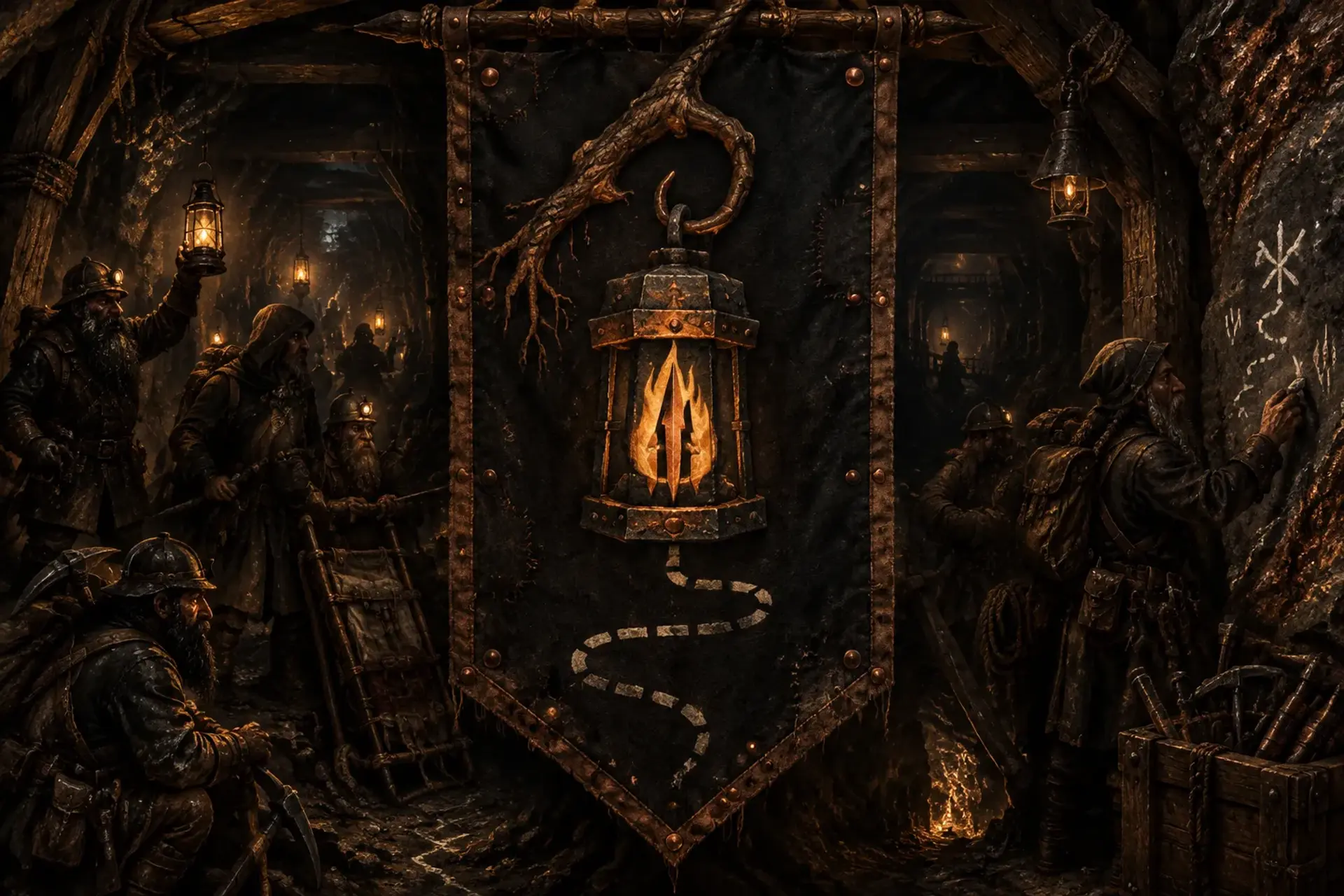
Soot black, Root-brown, Dull copper
- A hand-lamp cut beneath a hooked root
- Three short scratches beside a usable route
- A broken chalk line marking a path that should not be taken
Standing
What they say they want
What they are doing now
Where it leads
A network of dependable rescue corridors and shared hazard knowledge that no single syndicate, authority, or faction can close for profit or political leverage. Varek imagines a discreet compact; Vala wants the routes and their risks understood by everyone who must travel them. Neither has persuaded the other that their version can survive contact with power.
How others see them
High-strata authorities describe the Deep Delvers as trespassers, ward-breakers, and saboteurs. Miners who have been guided out of a collapse often call them the only people who came back. To outsiders, their marks are ominous signs of a hidden network; to those who travel below, the same marks can mean that a path is still safe enough to try.
People
5 ranks
Commander
Controlled, pragmatic, and wary of spectacle. He can be generous to people in immediate danger and ruthless toward anyone who knowingly seals a way out.
- The Breath and the Far-Eye2 members
Varek Iron-Lung and Vala Deep-Gaze share command. Varek directs operations, discipline, and demolitions; Vala controls scouting, route knowledge, and field safety. Either can veto a mission that risks the network's survival.
- Passage Stewards13 members
Experienced route captains who maintain caches, assign patrols, and settle disputes over passage use. They advise the leaders, but cannot compel a crew to accept a dangerous order.
- Pathfinders84 members
Veteran scouts who test routes, carry signals, escort travelers, and update maps. They often work in pairs and report hazards through coded marks.
- Cutters and Sappers191 members
Miners, tunnel engineers, and combat sappers who shore, open, or collapse workings. Teams are trained to stabilize a route before extracting salvage.
- The Holds560 members
The broader membership: miners, shadow-dwarf irregulars, guides, supply carriers, and proven survivors. Members keep their own crews and may refuse jobs that violate the network's rescue obligations.
Other key members
- Chief Scout Vala Deep-Gaze Chief Scout; adult female shadow-dwarf, level 15 Gloom Stalker Ranger. She oversees reconnaissance, route marking, and survival training.
- Kjell Sumpwise Senior sapper and likely successor to the Passage Stewards' council. He argues for publishing verified hazard warnings, even when they reveal Delver routes.
- Iivana Pathfinder and informal negotiator. She may become a bridge to outsiders or a source of dangerous leaks.
- Oskari of the Lower Root Scout and keeper of unusual hazard reports. He has found signs of a pattern in tremors and charged-metal odors near the lower root passages.
How they are organised
- Demonstrate practical skill in mining, scouting, engineering, rescue, or subterranean survival.
- Complete a supervised route test without abandoning a partner or ignoring a marked hazard.
- Accept the rescue custom: anyone encountered in immediate danger is to be helped when doing so does not knowingly doom the rescuers.
- Agree not to sell route knowledge or cache locations without consent from the Passage Steward responsible for them.
Relations
8 factionsSome Root-Sovereign route-keepers quietly trade safe passage for warnings about unstable ground. Their cooperation is local and conditional; neither side accepts the other's authority over the lower passages.
Operations
What they do
How they do it
Services for hire
- Passage escortA fair share of recovered supplies, a reciprocal rescue favor, or an agreed payment in provisions and tools.A guided crossing through a known route. The guide may refuse entry if the route has changed or the traveler intends to exploit it.
- Working surveyLabor, materials, or a favor for the crew that maintains the route.A practical assessment of a shaft, support system, air pocket, or suspected collapse hazard. It is a field judgment, not a guarantee of safety.
- Emergency recoveryNo fixed fee during an immediate emergency; later assistance may be requested to replace used supplies.A rescue team dispatched when people are trapped in a reachable working. The Delvers will not promise recovery where entry would predictably kill the rescuers.
- Claim examinationA contribution of reliable reports, route maintenance, or supplies; payment alone cannot buy access to restricted maps.A review of suspected fraudulent claim marks using local testimony and physical evidence. The Delvers do not issue legal rulings, but their findings can undermine a claim.
What they can do
What they have
Where they are weak
Territory
Headquarters
No permanent settlement; mobile caches and temporary junction camps in the lower passages surrounding the Verdant Heart Nexus.The Delvers have no fixed headquarters. Their closest equivalent is a concealed junction chamber beneath an old mine spur, fitted with hand winches, rescue stretchers, spare lamp oil, chalk boards, and a low stone cistern. Its entrance is disguised as a collapsed dead end. The chamber is rotated among several locations as routes become unsafe or compromised.
Lands they hold
Outposts
- Ninth Descent cacheAn abandoned mine spur above the lower root passagesStores rescue gear and preserves a memorial list of those lost in the founding collapse. Its exact location is known to the leadership and a few senior pathfinders.
- The Warm SeamA shifting bypass near a stable route toward the Verdant Heart's outer cavernsProvides a temporary refuge, water, and a place to shelter injured travelers during tremors. It is abandoned whenever the air grows metallic.
- The Chalk TurnA disused junction among older shaftsServes as a training point where new members learn route marks, rope work, and the difference between a warning sign and a claim sign.
Secrets
Plot hooks
5 hooks- 1The Route That Wasn't TherePersonal; moderate danger from unstable passages, with social tension over trust and route secrecy.Reward: A rescued contact, safe passage through a restricted region, and the Delvers' cautious confidence.A character's relative or former crewmate has disappeared in a shaft officially listed as sealed. The Delvers offer a route in, but Vala insists the party leave the map behind when they return.
- 2Marks on Borrowed StoneLocal; a time-sensitive investigation that can become a rescue or confrontation.Reward: Evidence of claim fraud, a negotiated passage agreement, or valuable access to a cache.A syndicate begins installing claim markers around an abandoned working that the Delvers use as an emergency corridor. The party must determine whether the claim is fraudulent, protect trapped miners, or broker a compromise before the Delvers cut the access supports.
- 3The Tilted PassageRegional; hazardous exploration with competing obligations and uncertain terrain.Reward: A rare route into the deeper caverns, Delver support, and clues about the changing surges.A tremor strands a group of travelers near a lower root passage where gravity has begun tilting without warning. Varek needs outside help to recover them, but the only viable route crosses a warded boundary and passes close to a site the Delvers are concealing.
- 4The False EchoFaction-scale; demands investigation, negotiation, and survival under pursuit.Reward: A chance to expose an infiltrator, recover part of Varek's evidence, and influence the Delvers' next direction.A copied Delver signal draws several crews into a dead-end shaft where a trap has been prepared. The party can hunt the imitator, protect the survivors, or follow the signal's trail toward evidence connected to the Ninth Descent.
- 5A Pulse Beneath the RootsCampaign-scale; the route is perilous and the consequences of discovery could alter alliances across the Verdant Heart Nexus.Reward: A major revelation about local instability, new allies among the Delvers, and leverage in disputes over access to the lower passages.Oskari reports a repeating pattern of tremors, charged-metal odors, and shifting routes near the core. Vala wants a discreet survey; Varek fears the finding will draw prospectors. The party may help establish what is happening, then decide who deserves to know.
Work they offer
What gets in the way
Rumours
Media
0 imagesNo images yet.
Turn Deep Delvers into a sheet
A high-res, share-ready sheet you can post or print.