
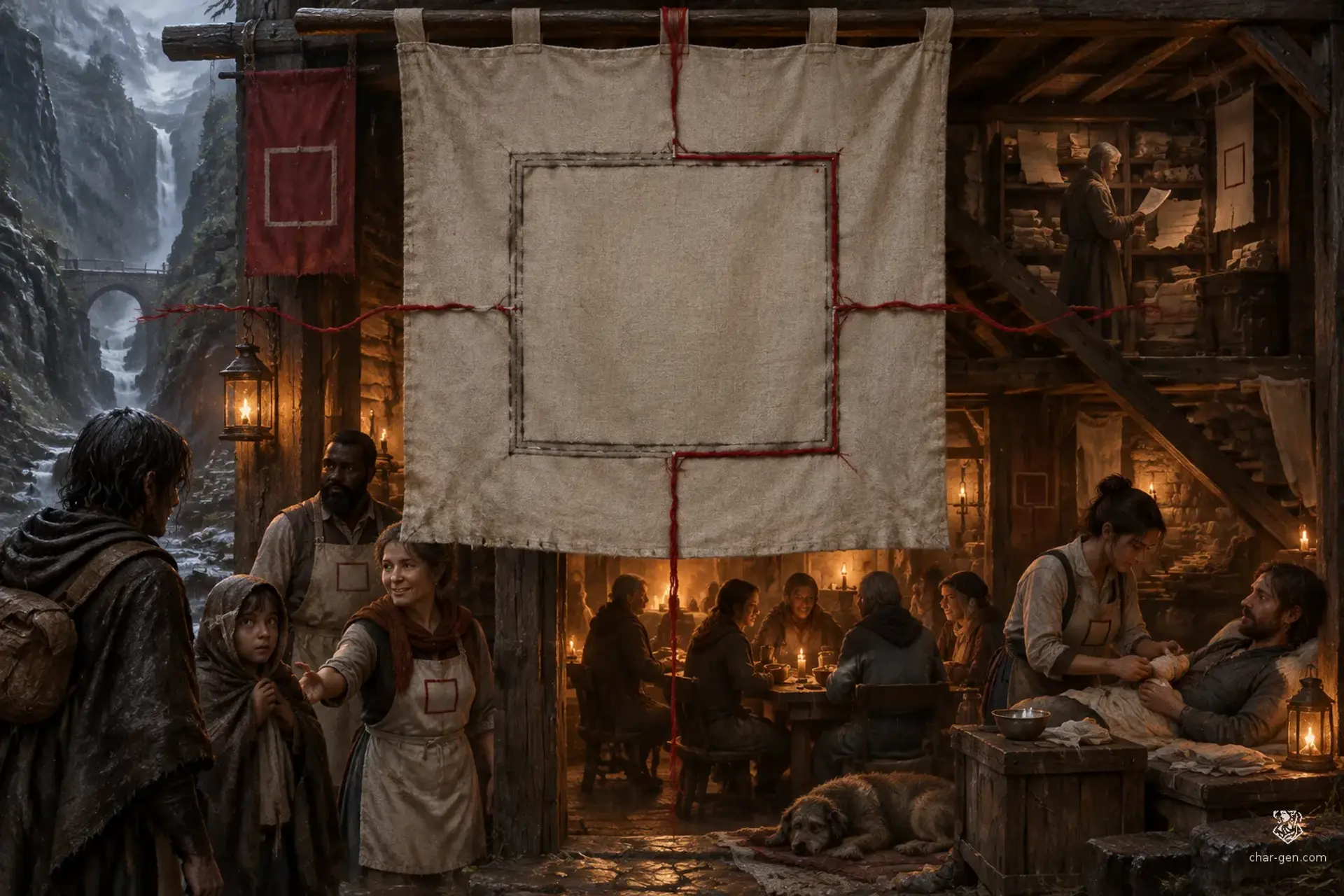
The Unentered of the Ninth Roll
In its first years, the refuge was a place to hide children whose families had rejected them or whose existence threatened a household's inheritance. Heddik's careful record keeping and Salla's network of midwives, servants, and ferrymen gave the group an unusual strength: it could prove who had been erased and move them before the people responsible returned. The first major triumph came when a fever swept through three villages. The Crown Tally Office refused aid to unregistered households, arguing that no recognized residents lived there. Unentered members carried medicine and food under cover of a funeral procession. Survivors remembered the blank cloth they hung from doorways, and the sign spread beyond the original refuge. The watershed moment came twenty-six years after the founding, during the Sallowbridge registry fire. A magistrate's men raided a shelter to seize a child whose inheritance would have blocked a powerful claimant. The child escaped, but the raid exposed several safe houses. In the chaos, Road Keepers burned the local registry to destroy the confiscated names. The fire also destroyed records that could have established the innocence of dozens of people. The faction saved lives and harmed people in the same night. Since then, its members have argued over whether records are weapons to seize, evidence to preserve, or chains best broken. The Unentered later became more than an escape network. They maintained informal records of abandoned children, disgraced soldiers, dismissed apprentices, and people declared dead by mistake or design. Their help expanded to adults cast out for failing an expected role: the child who would not inherit, the spouse unable to produce an heir, the veteran who returned changed, the bastard whose birth offended a treaty, or the person whose family insisted they should never have been born. Their growth brought patrons and compromise. A few noble families quietly used them to remove inconvenient relatives, then denounced them in public. The Unentered accepted payment from some of those families to fund shelter for people with no patron at all. Today the faction is large enough to be useful to rulers and dangerous to expose, but still too small to protect everyone who comes to its doors.
The Unentered of the Ninth Roll
- Type
- Mutual-aid refuge
- Size
- Approximately 71 sworn Witnesses
- Reach
- Local and regional
- Base
- A concealed refuge near Sallowbridge
Overview
In its first years, the refuge was a place to hide children whose families had rejected them or whose existence threatened a household's inheritance. Heddik's careful record keeping and Salla's network of midwives, servants, and ferrymen gave the group an unusual strength: it could prove who had been erased and move them before the people responsible returned. The first major triumph came when a fever swept through three villages. The Crown Tally Office refused aid to unregistered households, arguing that no recognized residents lived there. Unentered members carried medicine and food under cover of a funeral procession. Survivors remembered the blank cloth they hung from doorways, and the sign spread beyond the original refuge. The watershed moment came twenty-six years after the founding, during the Sallowbridge registry fire. A magistrate's men raided a shelter to seize a child whose inheritance would have blocked a powerful claimant. The child escaped, but the raid exposed several safe houses. In the chaos, Road Keepers burned the local registry to destroy the confiscated names. The fire also destroyed records that could have established the innocence of dozens of people. The faction saved lives and harmed people in the same night. Since then, its members have argued over whether records are weapons to seize, evidence to preserve, or chains best broken. The Unentered later became more than an escape network. They maintained informal records of abandoned children, disgraced soldiers, dismissed apprentices, and people declared dead by mistake or design. Their help expanded to adults cast out for failing an expected role: the child who would not inherit, the spouse unable to produce an heir, the veteran who returned changed, the bastard whose birth offended a treaty, or the person whose family insisted they should never have been born. Their growth brought patrons and compromise. A few noble families quietly used them to remove inconvenient relatives, then denounced them in public. The Unentered accepted payment from some of those families to fund shelter for people with no patron at all. Today the faction is large enough to be useful to rulers and dangerous to expose, but still too small to protect everyone who comes to its doors.
How it began
The story begins with the winter census of Year 0, when a royal surveyor's clerk was ordered to mark forty-three children as dead so their family stipends could be reclaimed. Among them were legitimate heirs, children born outside marriage, and infants whose families had simply failed to pay the proper fee. The clerk, Heddik, carried the original Ninth Roll to an abandoned waystation and asked a disgraced midwife, Salla, to help hide the children. They had been rivals: he trusted paper, she trusted witnesses. They joined their efforts because neither could save the children alone. The first people sheltered there called themselves unentered, meaning absent from the official roll and therefore beyond its protection. The name became a promise as much as a condition.
How to know them
Unbleached linen, Dried-blood red, Ash gray
- An open rectangle of unbleached cloth
- One red thread crossing the edge of a blank square
- A deliberately empty line in a ledger
Standing
What they say they want
What they are doing now
Where it leads
A world where no authority can make a person disappear by striking out a name, and where families do not control whether their rejected kin deserve shelter. Some members imagine a sanctuary; others want a network of witnesses powerful enough to make erasure impossible.
How others see them
Among the poor, the Unentered are remembered as the people who will open a door without asking what your father did. Among officials, they are regarded as forgers, kidnappers, and troublemakers. Wealthy families praise their charity in public and quietly fear the archive in private.
People
6 ranks
The Speaker
Measured, observant, and conciliatory until someone treats a dependent as property. He prefers compromise but can hold a grudge for years.
- The Speaker1 member
Coordinates refuge, speaks for the faction in negotiations, and can authorize an emergency extraction. The Speaker cannot permanently commit the faction to war or expose the central archive without a hearing.
- The Table of Witnesses5 members
A council of members chosen for service rather than ancestry. It decides on resource allocation, admissions, and major operations. Each member is expected to bring testimony from people affected by a decision.
- Road Keepers18 members
Operate safe routes, arrange false papers, escort people between shelters, and maintain local contacts. Each Road Keeper oversees a small network and reports only what the council needs to know.
- Hearth Stewards34 members
Run food stores, clinics, workshops, and temporary lodgings. They are often the faction's most trusted members and its most frequent critics.
- Witnesses71 members
Members who have taken the faction's oath. They may carry messages, offer shelter, or keep records. Membership does not require criminal work or permanent residence.
- The Uncounted120 members
People temporarily protected by the network, including children and adults who have not chosen whether to join. They owe no service and may leave freely.
Other key members
- Shesh Senior Road Keeper and likely successor to the Speaker
- Khrast of the Ninth Roll Archivist and leading voice among the Cutters
- Tikk Hearth Steward who runs the refuge kitchen and advises new arrivals
How they are organised
- No one must prove that their family rejected them. A credible need for refuge is enough to be heard.
- Members may use a chosen name and may keep their former name private.
- Members who take the Witness oath must agree not to sell another person's identity or location.
- New members are never required to commit a crime, surrender money, or provide family secrets.
- A person accused of endangering the refuge receives a hearing before exclusion, except during an immediate threat.
Relations
7 factionsThe Lantern Court accepts the Unentered's testimony in cases where a noble's lineage or a temple's records have been altered. In return, the Court quietly warns them when arrests are being prepared. The arrangement strains whenever evidence implicates a powerful patron.
Operations
What they do
How they do it
Services for hire
- First HearthA voluntary contribution if the person can afford one; never a condition of emergency shelterA warm meal, temporary bed, basic first aid, and a private conversation about immediate danger.
- Road PassageA favor or service may be requested, but may be refused without loss of emergency aidAn escort along a known route, arranged through several contacts rather than one exposed guide.
- Witness SearchPayment in coin, useful supplies, or trustworthy testimony; waived for members in dangerResearch into a missing, altered, or disputed record. The faction shares only what it can safely verify.
- Open TableNegotiated individually, often involving restitution rather than moneyMediation between a cast-out person and a family, employer, or local authority. The faction will not promise reconciliation.
What they can do
What they have
Where they are weak
Territory
Headquarters
A concealed refuge near SallowbridgeA converted grain store in a rain-cut ravine, its upper floor used as a dormitory and its root cellar divided into a kitchen, records vault, and two rooms for people who cannot be seen. The entrance is through a cooper's yard. There is no sign, and the rooms are rearranged after any suspected visit. Visitors are asked what they need before they are asked who they are.
Lands they hold
Outposts
- Third Ferry LedgerA ferry landing outside SallowbridgeA message drop and overnight waiting place disguised as a toll booth. Its old survey number is still painted beneath the counter.
- Salt and Sickle HouseA disused watch post on a northern roadA shared shelter maintained with the allied Salt and Sickle. The two groups argue over who is responsible for its roof.
- Sixth Measure KitchenA busy market districtA public meal hall where members can identify people in danger without requiring them to explain their past.
Secrets
Plot hooks
4 hooks- 1Letters Under the HearthPersonal; social investigation, moral choice, or a discreet theftReward: A trusted contact, shelter, and a piece of evidence relevant to a character's backgroundA frightened newcomer asks the characters to return a small tin of letters before a Road Keeper retrieves it. The letters would prove that the newcomer was not responsible for a sibling's death, but also identify several people hiding under borrowed names.
- 2The Name in the MarginLocal; investigation with competing witnessesReward: Faction favor, access to the archive, or proof that can change a local legal disputeA local clerk is found dead beside a copied register. The Crown Tally Office accuses the Unentered, while the faction insists the clerk had come to them for help. The characters must determine whether the killer wanted to silence the clerk, frame the faction, or erase a particular person's history.
- 3The Bundle That Was Not BurnedRegional; negotiation, pursuit, and a consequential choiceReward: A powerful ally, a new identity, or leverage over a ruling householdKhrast hires the party to find the missing Ninth Roll bundle before it reaches a noble claimant. Shesh separately asks them to destroy it. Both insist they are trying to protect the same endangered person.
- 4A Hearing for the UncountedCampaign scale; political maneuvering and protection under pressureReward: Influence over a regional crisis and the lasting trust or enmity of the UnenteredThe Speaker's health fails as a wave of arrests closes in on several refuges. The Table of Witnesses asks the party to carry sealed testimony to a hearing, but one packet contains the name of a person who may be the lawful heir to a disputed seat. Public delivery could free many prisoners and trigger a succession crisis.
Work they offer
What gets in the way
Rumours
Media
0 imagesNo images yet.
Turn The Unentered of the Ninth Roll into a sheet
A high-res, share-ready sheet you can post or print.