
Rendrakian Assembly
The Rendrakian Assembly traces its lineage to the Rendraki nomads of the Red Plateaus, whose communities existed long before Zandros conquered the region and the Red Wars began. During the wars, Rendraki families were displaced, divided, and drawn into competing armies and settlements. At the wars' conclusion, Drakos and Radella Avyngard formed the broken land into the kingdom of Redrein. The majority voted for their monarchy, but not all Rendraki accepted the result as a reason to abandon their identity or their criticism of inherited rule. The Assembly began as a network of people who kept cultural records and argued that the Rendraki should not vanish into the new kingdom. For generations, its work was quiet and local: teaching fragments of language, recording family testimony, keeping customary practices alive, and preserving practical knowledge of the plateaus. Its character changed as the old nomadic way of life became less familiar. Five hundred years later, none of its descendants has known life before the Red Wars, and none can simply return to the old routes as their ancestors did. The Assembly now preserves a culture partly through reconstruction, debate, and careful admission of what has been lost. Its defining crisis arrived when the Shroud of siros seized the kingdom. The Assembly could feed and arm people but lacked the warriors to defend them. When the Drakos heir promised court representation in return for aid, the Assembly accepted an alliance with a bloodline it had long criticized. That decision made it a political actor rather than only a custodian of memory, and exposed old disagreements about legitimacy, independence, and survival.
Rendrakian Assembly
- Type
- Revolutionary movement and…
- Size
- 521 members
- Reach
- Regional
- Base
- A Redrein settlement near the central routes across the Red Plateaus; the Assembly keeps its exact meeting site private.
Overview
The Rendrakian Assembly traces its lineage to the Rendraki nomads of the Red Plateaus, whose communities existed long before Zandros conquered the region and the Red Wars began. During the wars, Rendraki families were displaced, divided, and drawn into competing armies and settlements. At the wars' conclusion, Drakos and Radella Avyngard formed the broken land into the kingdom of Redrein. The majority voted for their monarchy, but not all Rendraki accepted the result as a reason to abandon their identity or their criticism of inherited rule. The Assembly began as a network of people who kept cultural records and argued that the Rendraki should not vanish into the new kingdom. For generations, its work was quiet and local: teaching fragments of language, recording family testimony, keeping customary practices alive, and preserving practical knowledge of the plateaus. Its character changed as the old nomadic way of life became less familiar. Five hundred years later, none of its descendants has known life before the Red Wars, and none can simply return to the old routes as their ancestors did. The Assembly now preserves a culture partly through reconstruction, debate, and careful admission of what has been lost. Its defining crisis arrived when the Shroud of siros seized the kingdom. The Assembly could feed and arm people but lacked the warriors to defend them. When the Drakos heir promised court representation in return for aid, the Assembly accepted an alliance with a bloodline it had long criticized. That decision made it a political actor rather than only a custodian of memory, and exposed old disagreements about legitimacy, independence, and survival.
How it began
The oldest Assembly account says the first keepers met after the Red Wars, when the Red Plateaus were broken by conquest and the Rendraki scattered among new settlements. They had opposed Zandros's conquest, then watched the majority choose Drakos and Radella Avyngard as king and queen to end the wars and give the damaged land a government. A smaller number of Rendraki believed that one ruler had merely replaced another. They particularly distrusted Drakos's dragon nature and the precedent of rule descending through his bloodline, even though his descendants were human. The first keepers did not claim that the vote had been false. Instead, they argued that a kingdom could be lawful and still erase the people who had helped make it possible. They collected songs, family accounts, customary judgments, and fragments of route knowledge, and formed an assembly to preserve them. Across five centuries, war, settlement, and the loss of elders turned the keepers into a regional network with stores, scribes, and local delegates. The watershed moment came during the Shroud of siros seizure of Redrein. The Assembly had food, rations, and weapons, but not enough warriors to fight a determined force alone. The Drakos heir asked for aid and offered a political voice in return. Facing an enemy that would likely destroy both the monarchy and Rendrakian communities, the Assembly accepted the compact. The decision ended its posture of absolute refusal toward Drakos rule, but did not settle whether the bargain was wise.
How to know them
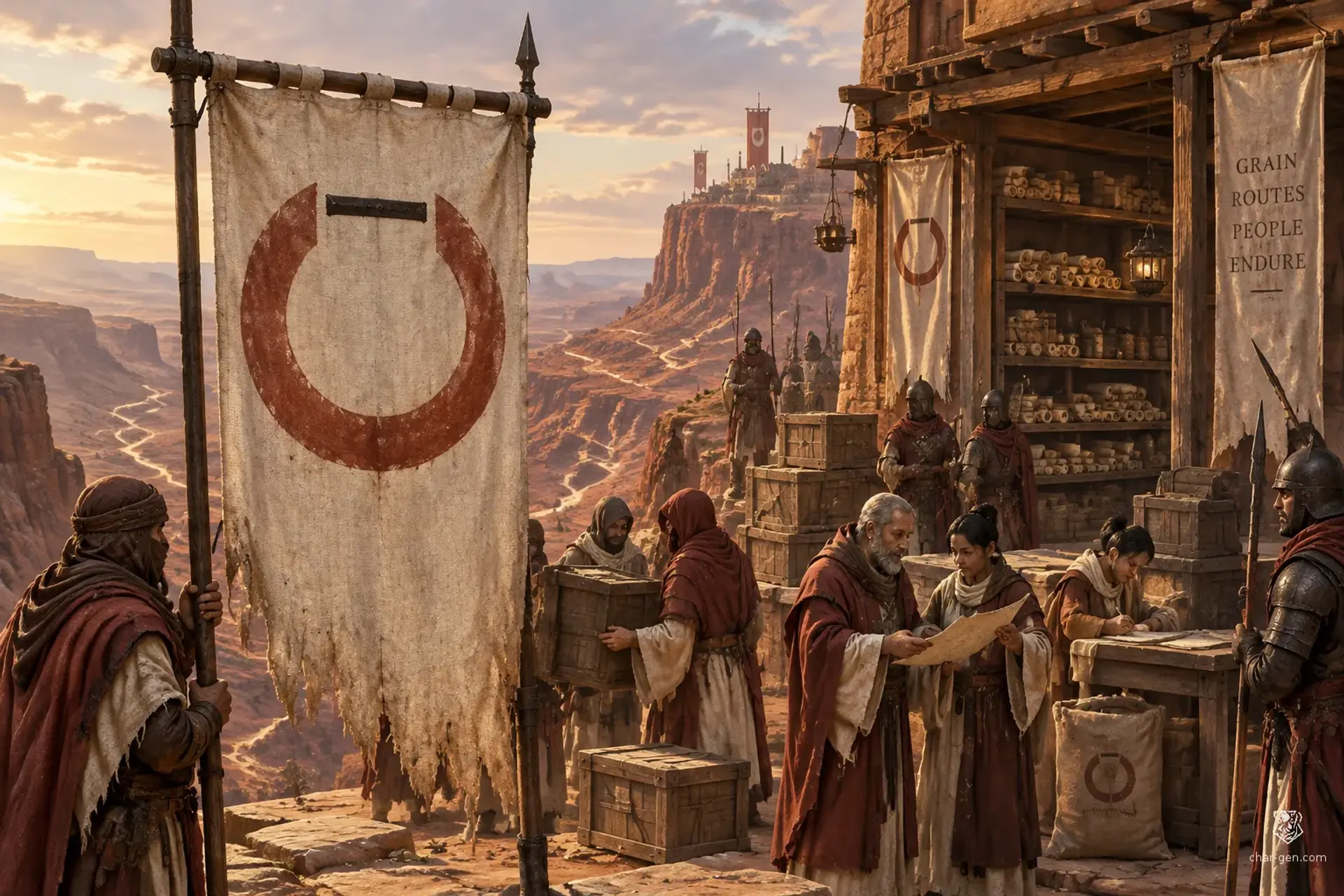
Dust red, Sun-bleached linen, Dark iron
- An open red circle, representing a culture whose line was interrupted but not ended.
- A dark iron crossline, representing the obligations people carry between generations.
- A strip of undyed cloth worn inside a sleeve by members who serve as messengers.
Standing
What they say they want
What they are doing now
Where it leads
A Redrein in which Rendrakian people can maintain their traditions, teach their history, and take part in decisions that affect them without having to choose between cultural survival and political loyalty. The Assembly has not agreed whether this future is best secured within the monarchy, through regional self-rule, or through a constitutional arrangement that neither side has yet imagined.
How others see them
Among people who have received food or shelter, the Assembly is known as organized, dependable, and stubbornly protective of its own. Supporters see it as the keeper of a people whom the kingdom forgot. Critics call it a political movement disguising a bid for privilege as cultural preservation. Many ordinary Rendreinians respect its relief work but fear that a court seat and supply network could give it too much power.
People
4 ranks
Speaker of the Red Table
Composed, procedural, and empathetic without being sentimental. She listens closely, speaks sparingly, and can mistake patience for a virtue even when urgent action is needed.
- The Red Table9 members
The central council, made up of delegates chosen by regional circles. It sets policy, approves major uses of shared stores, and interprets the wartime compact. Decisions normally require a two-thirds vote; urgent defensive actions can be authorized by the Speaker and three council members, then reviewed afterward.
- Route Speakers34 members
Regional delegates who carry decisions between settlements, negotiate with local authorities, and report disputes to the Red Table. Their influence rests on trust and reliable testimony rather than command over every member.
- Keepers118 members
Archivists, teachers, quartermasters, healers, messengers, and organizers responsible for preserving culture and maintaining local supplies. Most members belong to this tier.
- Hands360 members
Supporting members, sympathizers, and trained volunteers who distribute aid, copy records, host meetings, and provide local knowledge. Membership is broad, but not every Hand is a combatant.
Other key members
- Barek Chief quartermaster and Sada's chief internal critic
- Oruwa Kesh Keeper of testimony and archives
- Torm Organizer of local Hands and possible successor to Sada
- Ilyan Coordinator of armed escorts and security
How they are organised
- A prospective member must accept that Rendraki identity is a living community, not a blood test or a claim of perfect knowledge about the past.
- Members must protect the confidentiality of vulnerable stores, records, and meeting arrangements.
- Those who take responsibility for supplies or testimony must keep accurate accounts and submit to review.
- Members are expected to help preserve or serve the community, through teaching, logistics, care, advocacy, or defense.
Relations
7 factionsThe Assembly entered a wartime compact with the Drakos heir when the Shroud of siros seized Redrein. In return for Rendrakian aid, the heir promised them a political voice at court and protection for their cultural practices. The compact is real, but its terms are disputed and its future depends on who holds the throne.
Operations
What they do
How they do it
Services for hire
- Route escortPayment in coin, useful supplies, or an agreed contribution to local reliefArranges guarded passage between settlements when the route is open and the travelers do not endanger local communities.
- Emergency ration and shelterA modest fee or a reciprocal act of serviceProvides food, temporary shelter, and basic aid to displaced people, subject to available stores and local need.
- Record consultationA contribution to copying materials and an agreement not to misrepresent uncertain sourcesShares accessible copies of histories, testimony, and cultural records. Sensitive records require review by the appropriate Keepers.
- Community mediationA promise to respect the circle's safety and a small contribution to its costsIntroduces visitors to a local circle that can help arrange mediation, petitions, or contact with a Route Speaker.
What they can do
What they have
Where they are weak
Territory
Headquarters
A Redrein settlement near the central routes across the Red Plateaus; the Assembly keeps its exact meeting site private.The Assembly has no single fortress. Its central council meets in a storehouse and archive maintained in a Redrein settlement, with its location shared only with trusted delegates. The building is practical rather than grand: thick walls, a guarded ration room, a meeting floor marked with travel routes, and shelves of copied testimonies. The name of the settlement is deliberately not treated as secret knowledge that belongs to outsiders; its security comes from decoy stores and dispersed records, not from claiming a hidden capital.
Lands they hold
Outposts
- The Split Rock storeA settlement on the eastern plateau routesMaintains a food cache and provides shelter for messengers and displaced families.
- The Burnt Track roomA market settlement on a route between several Redrein communitiesHosts teaching circles, copies testimony, and coordinates petitions and public meetings.
- The Cleared Slope postA small settlement overlooking an old descent from the Red PlateausOrganizes guarded supply movements and watches for Shroud patrols.
Secrets
Plot hooks
6 hooks- 1The Record in the DustLow to moderate; travel, negotiation, and a likely ambushReward: Payment, safe passage, and the trust of an Assembly circleA Keeper asks the characters to escort a box of copied testimony to a local circle. The documents include a disputed account of Rendraki support for the first monarchy. Someone has learned of the delivery and wants the records destroyed before either the Assembly or the court can decide what to do with them.
- 2The Last MeasureModerate; investigation and conflicting claims, with no purely clean solutionReward: Supplies, local allies, and a choice that changes the Assembly's standingA settlement's ration store is nearly empty, and the local Keeper refuses to release the reserve without the Red Table's approval. The characters must determine whether the store is truly needed for a coming threat, whether its ledger has been altered, or whether the Keeper is protecting a private arrangement.
- 3A Promise Under ArmsModerate to high; political negotiation under wartime pressureReward: Political access, military support, or a revised compactThe Drakos heir requests Assembly escorts and supplies for a campaign against the Shroud. At the same time, the heir has delayed confirming the promised court representation. Sada wants the compact honored without endangering civilians; Torm wants leverage before the army moves. The party can negotiate, gather proof of the delay, or decide which side of the bargain to support.
- 4The Routes That Must Not TravelHigh; investigation, pursuit, and a choice about whether to expose internal dissentReward: A cache location, the confidence of a faction within the Assembly, and a possible new enemyA member of the Assembly has disappeared with route notes that reveal several supply caches. The evidence points toward a traitor, but the missing member may have taken the notes to prevent a reckless raid authorized by Ilyan's volunteers. The party must find them before the Shroud does.
- 5The Price of RecognitionCampaign scale; evidence gathering and high-stakes diplomacyReward: A lasting treaty, regional influence, or a contested political settlementA regional council offers the Assembly lasting cultural protections in exchange for disarming its escorts and surrendering control of its stores. The offer could save lives and bring legal recognition, but it may also leave the settlements helpless if the Shroud returns. The party is asked to investigate the council's motives and advise competing Assembly blocs.
- 6Three Things to CarryHigh; time pressure, combat or stealth, and a consequential sacrificeReward: The survival of a settlement, an important archive, or a decisive allianceThe Shroud is preparing to destroy a settlement's archive and seize its food stores. The Assembly can evacuate families, save the records, or hold the route long enough for the Drakos heir's forces to arrive, but it cannot do all three. The characters' choice may decide what survives of both the community and its past.
Work they offer
What gets in the way
Rumours
Media
0 imagesNo images yet.
Turn Rendrakian Assembly into a sheet
A high-res, share-ready sheet you can post or print.