
The White Faces
The White Faces began as a neighborhood defense band after the Hunger Week Riots, then learned that a loaded pistol could protect a trader as effectively as it could defend a family. Their first profitable contracts were escorts for night barges and market carts. They soon found themselves deciding which cargoes could pass safely and which were too dangerous to tolerate. Their watershed moment came twenty-one years ago during the Lantern Quay Massacre. The Red Ledger had begun trafficking altered people through the kingdom's capital. When a shipment of captives was discovered in a company safehouse, three captains argued that the contract had already been paid for and should be honored. The company's then-leader ordered the doors opened and the captives freed. In the fighting that followed, the company destroyed the Ledger's riverside depot, but a fire killed dozens of bystanders and two company members. The survivors rewrote the rules: no person could be treated as cargo, and no captain could accept a contract involving unwilling subjects. The massacre made the company beloved in some neighborhoods and feared by the kingdom's authorities. It also made the company rich. Night traders who could no longer rely on the Red Ledger turned to the White Faces for safe passage and dispute resolution. Over the next two decades, the company spread from the capital to border towns, ports, and mining settlements. It now has enough members and leverage to interrupt trade across the kingdom, yet still claims to be a neighborhood defense band with better guns. Today, the company is caught between its own founding myth and its practical power. It protects people from exploitation, controls much of the trade that makes exploitation profitable, and cannot agree whether its dislike of mutation is a humane refusal to alter people or a superstition that has become an excuse for exclusion.
The White Faces
- Type
- Mercenary company with a…
- Size
- 715 members
- Reach
- National
- Base
- Kestrel's Drain, the market ward built over a filled-in canal
Overview
The White Faces began as a neighborhood defense band after the Hunger Week Riots, then learned that a loaded pistol could protect a trader as effectively as it could defend a family. Their first profitable contracts were escorts for night barges and market carts. They soon found themselves deciding which cargoes could pass safely and which were too dangerous to tolerate. Their watershed moment came twenty-one years ago during the Lantern Quay Massacre. The Red Ledger had begun trafficking altered people through the kingdom's capital. When a shipment of captives was discovered in a company safehouse, three captains argued that the contract had already been paid for and should be honored. The company's then-leader ordered the doors opened and the captives freed. In the fighting that followed, the company destroyed the Ledger's riverside depot, but a fire killed dozens of bystanders and two company members. The survivors rewrote the rules: no person could be treated as cargo, and no captain could accept a contract involving unwilling subjects. The massacre made the company beloved in some neighborhoods and feared by the kingdom's authorities. It also made the company rich. Night traders who could no longer rely on the Red Ledger turned to the White Faces for safe passage and dispute resolution. Over the next two decades, the company spread from the capital to border towns, ports, and mining settlements. It now has enough members and leverage to interrupt trade across the kingdom, yet still claims to be a neighborhood defense band with better guns. Today, the company is caught between its own founding myth and its practical power. It protects people from exploitation, controls much of the trade that makes exploitation profitable, and cannot agree whether its dislike of mutation is a humane refusal to alter people or a superstition that has become an excuse for exclusion.
How it began
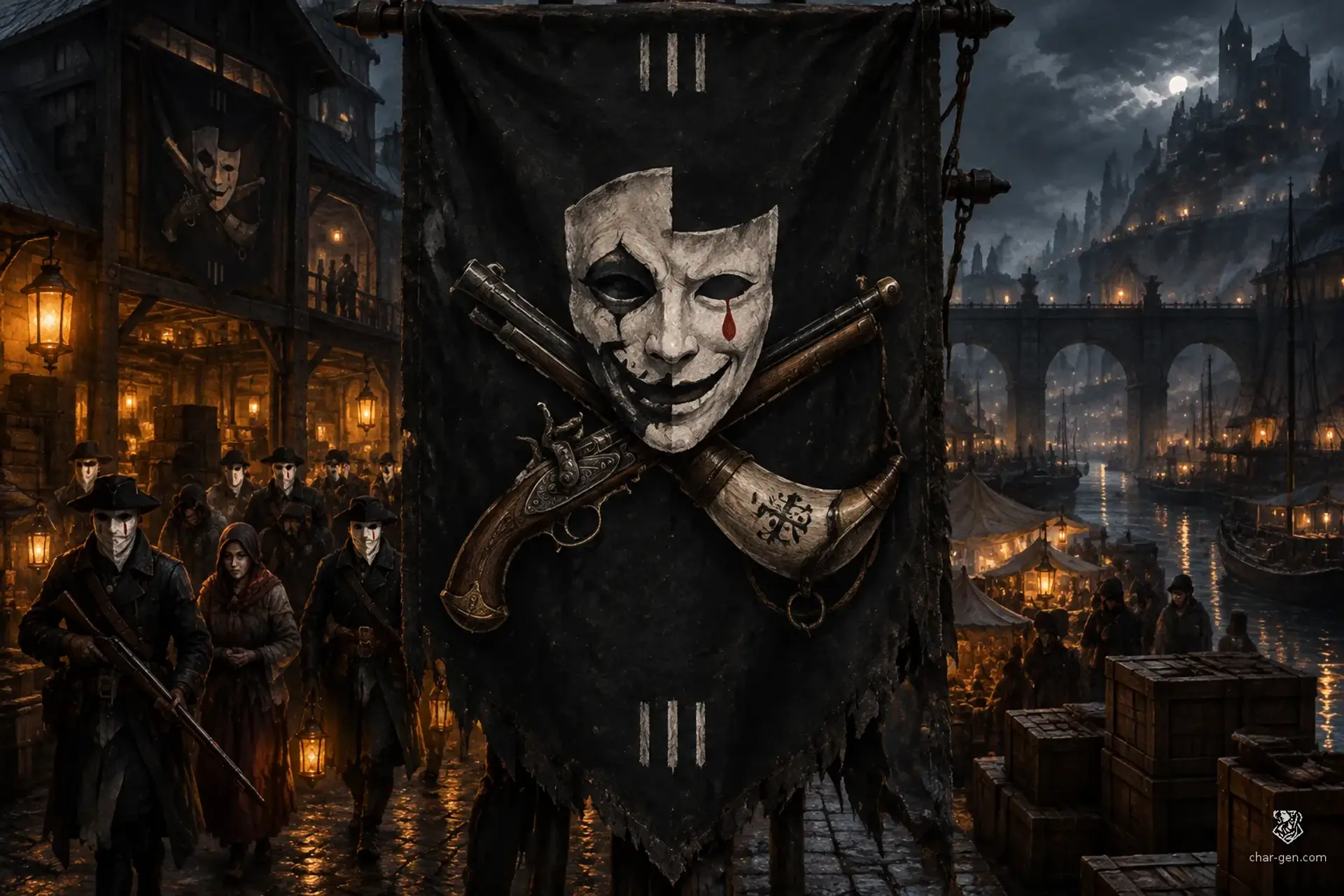
The company says its founders were six gunmen and a clown who defended the residents of an old riverside quarter during the Hunger Week Riots. The clown, a former fairground performer called Vaska, used painted masks and false processions to get children and wounded people past the soldiers. The gunmen held a bridge long enough for the neighborhood to flee. The survivors called their little band the White Faces, after the mask Vaska left hanging from the bridge. In time, they sold armed protection to night traders, but wrote a rule into their first ledger: no payment could buy the right to sell a person.
How to know them
Chalk white, Ox-blood red, Gunmetal gray
- A chalk-white half-mask
- A single ox-blood tear beneath one eye
- A crossed pistol and powder horn
- Three short chalk bars on a safe door, meaning the household requests passage rather than protection
Standing
What they say they want
What they are doing now
Where it leads
A kingdom where no ruler, merchant, or criminal cartel can make a person helpless by controlling the roads, markets, or means of self-defense. The company has never agreed on whether that means ending its own monopoly over the night.
How others see them
To residents of poor districts, the White Faces are dangerous protectors who sometimes arrive when no lawful help will. To merchants, they are an expensive nuisance whose rules are more predictable than a rival gang's. To the crown, they are an armed criminal power hiding behind a sentimental founding story.
People
5 ranks
First Mask
Empathetic, tactically patient, and willing to carry a terrible reputation if it keeps violence away from civilians. She dislikes being seen as a saint and worries that her secret work will cause a split.
- The Round Table7 members
Seven elected captains who set company policy, approve major contracts, and settle disputes between crews. Each has one vote. The leader can call a vote but cannot overrule it.
- Night Captains36 members
Leaders of local companies, safehouses, and market districts. They negotiate protection, organize armed work, and answer to the Round Table.
- Licensed Hands164 members
Experienced gunmen, scouts, couriers, negotiators, healers, and quartermasters trusted to work without direct supervision.
- Powder Faces301 members
Full members who have sworn the company's rules. They serve as guards, escorts, and night patrols, and may be assigned to a captain's crew.
- Borrowed Coats207 members
Probationers, informants, mechanics, and temporary contractors. They receive limited protection but cannot vote or handle the common ledger.
Other key members
- Brask Voj Night Captain of the capital's market district and chief rival to Zoraya
- Omi Keeper of safehouses and quiet successor candidate
- Sethra Keeper of the common ledger and internal investigator
How they are organised
- Applicants must name a person or community they are willing to protect at real personal cost.
- They must submit to a probationary season under a local crew and accept that refusal of a contract is permitted, but betrayal of a protected client is not.
- They must swear that no person is property, whether the claim is made by a trader, official, employer, or the company itself.
- Applicants with visible mutations are not formally barred, but local captains may reject them under the company's anti-mutation tradition, a contradiction Zoraya is trying to change.
Relations
8 factionsThe Lantern Kitchens distribute food in districts where the company breaks up predatory lending rings. Their volunteers provide safe beds and information, though they object to the company's use of armed intimidation.
Operations
What they do
How they do it
Services for hire
- Night PassageNegotiated fee, usually paid in coin, ammunition, information, or a favorA small armed escort through a district where the company has influence. Protection is not guaranteed against government forces or a direct challenge by a rival company.
- Broker's IntroductionA substantial fee or a favor of equal riskA discreet meeting with a trusted black-market broker, provided the requested trade does not involve people as property.
- Borrowed CoatNo set fee, but applicants must accept a review by a local captainTemporary shelter and a concealed route for someone fleeing a violent employer, trafficker, or abusive official.
- Market SettlementA percentage of recovered goods, or a promise to settle the matter without harming bystandersMediation of a dispute between traders, crews, or local power brokers. The company expects both sides to respect its decision.
What they can do
What they have
Where they are weak
Territory
Headquarters
Kestrel's Drain, the market ward built over a filled-in canalA sprawling fortified warehouse district concealed behind a legitimate powder-and-carriage depot. Its walls are layered with old posters, painted faces, and marks showing which doors are safe after dark. The central meeting room has no throne or raised chair. Captains sit in a rough circle around a scarred table, while a white mask hangs above the only exit.
Lands they hold
Outposts
- The Silt StepsThe capital's old canal wardA hidden market entrance and emergency shelter for couriers and fleeing residents.
- The Cut OrchardA mountain pass on the western trade roadA fortified rest stop built on land cleared for a road that was never completed, used to escort caravans and watch the border.
- The Drowned BellThe kingdom's southern river portA meeting place for barge crews, smugglers, and company negotiators, with a concealed boat landing.
Secrets
Plot hooks
5 hooks- 1The List Under the MaskPersonal, low to moderateReward: Safe passage, a company favor, or evidence useful against a government officialA Powder Face asks a player character to escort a frightened courier carrying a list of altered people marked for arrest. The courier insists the list must reach Zoraya, but a company patrol has orders to seize it.
- 2A Fair Price for SafetyLocal, moderateReward: Community support, a negotiated truce, or an enemy among the captainsA neighborhood asks the characters to stop a company crew from collecting protection dues. The crew claims the payments fund a shelter and says a rival gang will take the district if they are driven out. Both claims are true.
- 3The Broker's Other BookLocal to regional, moderate to highReward: Black-market access, leverage over a captain, or the gratitude of trafficking victimsThe Red Ledger offers the party a fortune to recover a captured broker. The broker knows the location of a trafficking operation, but also holds records proving that a respected White Faces captain once took contracts from the Ledger.
- 4The Order Beneath the AshRegional campaign, highReward: A decision that can reform, fracture, or radicalize the companySethra asks the characters to find the original Lantern Quay order before Brask does. Brask wants to expose it to force Zoraya from leadership. Zoraya wants to bury it until she can prove who authorized the fire.
- 5The Contract at the BorderRegional campaign, highReward: A refuge network, an armed ally, or a major enemy in the governmentA border governor hires the company to guard a district while secretly planning to register and remove its altered residents. Zoraya wants the contract rejected, Brask sees a chance to secure the frontier, and the residents ask the characters to help them escape.
Work they offer
What gets in the way
Rumours
Media
0 imagesNo images yet.
Turn The White Faces into a sheet
A high-res, share-ready sheet you can post or print.