
The Pale Stone Measure
The monks' practice began as informal instruction by pilgrims who believed physical discipline should serve ordinary people. For years they moved between villages, teaching balance, controlled breathing, and safe ways to break a fall. Their reputation grew after the winter of the Broken Cart, when they helped evacuate families from a flooded road and carried the injured to higher ground. Thirty-one years ago, five regular teachers settled beside the flat stone outside the road-fork settlement. A local landholder granted them use of the ground, in return for lessons for his household's guards. The arrangement ended badly: one guard used a restraint the monks had taught him to beat a prisoner. The monks publicly condemned the abuse and refused further payment. Their refusal cost them their shelter and their patron, but earned the trust of ordinary travelers. That dispute, remembered as the Measure's Turning, defined the order's belief that skill without restraint is merely another weapon. In later years the order became a familiar roadside presence. They helped travelers, taught children, and sometimes stood between local authorities and people they considered at risk. Their high point came during a bandit scare, when their escorts helped keep the road open without a major battle. Their greatest setback came when a frightened member injured a robber during a night ambush. The robber's kin accused the monks of maintaining a hidden fighting school, and several townspeople withdrew their support. Today they remain a tiny, respected, and inconvenient presence. They speak of service and discipline, but differ sharply over what service requires when patience fails. Their future depends on whether they can preserve their independence while earning the settlement's trust again.
The Pale Stone Measure
- Type
- Religious Order
- Size
- Tiny
- Reach
- Local
- Base
- The settlement at the fork of the old north road, whose locals call it Flatstone Fork after the pale slab beside the track.
Overview
The monks' practice began as informal instruction by pilgrims who believed physical discipline should serve ordinary people. For years they moved between villages, teaching balance, controlled breathing, and safe ways to break a fall. Their reputation grew after the winter of the Broken Cart, when they helped evacuate families from a flooded road and carried the injured to higher ground. Thirty-one years ago, five regular teachers settled beside the flat stone outside the road-fork settlement. A local landholder granted them use of the ground, in return for lessons for his household's guards. The arrangement ended badly: one guard used a restraint the monks had taught him to beat a prisoner. The monks publicly condemned the abuse and refused further payment. Their refusal cost them their shelter and their patron, but earned the trust of ordinary travelers. That dispute, remembered as the Measure's Turning, defined the order's belief that skill without restraint is merely another weapon. In later years the order became a familiar roadside presence. They helped travelers, taught children, and sometimes stood between local authorities and people they considered at risk. Their high point came during a bandit scare, when their escorts helped keep the road open without a major battle. Their greatest setback came when a frightened member injured a robber during a night ambush. The robber's kin accused the monks of maintaining a hidden fighting school, and several townspeople withdrew their support. Today they remain a tiny, respected, and inconvenient presence. They speak of service and discipline, but differ sharply over what service requires when patience fails. Their future depends on whether they can preserve their independence while earning the settlement's trust again.
How it began
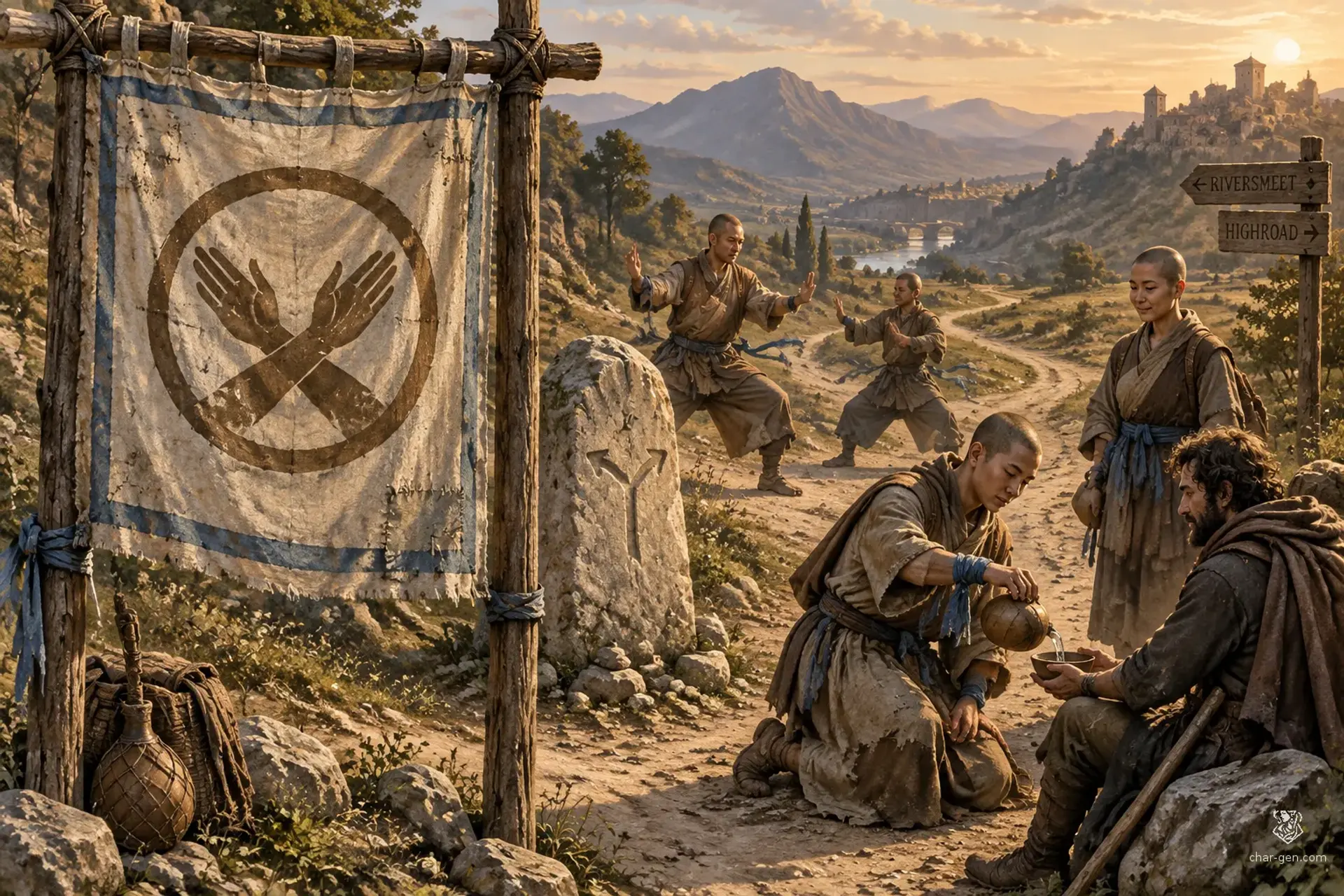
The order says it began when five pilgrims stopped beside a flat, pale rock at a road fork to treat a driver beaten by toll collectors. They had been trained in a monastery far away, but had left after arguing over whether their discipline belonged behind walls or among ordinary people. While they waited for the injured driver to recover, they practiced forms in the dirt and invited passing travelers to join. A local widow brought them bread, then asked them to teach her children how to fall without breaking an arm. The monks stayed for a season, and their roadside lessons became a habit. They took their name from the broad, flat stone that marked their first practice ground, a feature still visible beside the old road.
How to know them
- Road-dust brown
- Undyed linen
- A narrow stripe of faded blue
- Two crossed open hands within a brown circle
- A strip of faded blue cloth tied around the wrist during practice
- The pale slab at the roadside fork
Standing
What they say they want
What they are doing now
Where it leads
A loose chain of small roadside teaching circles, each rooted in its local community and answerable to no central temple or lord. The order's elders disagree about whether this is a vision of service or a way to avoid the responsibilities that come with permanence.
How others see them
Many travelers regard them as helpful, calm, and a little eccentric: monks who stop to practice forms in the dust rather than seek a proper hall. Some locals admire their willingness to help the vulnerable. Others think they interfere in matters best left to the authorities, or suspect that any group skilled at fighting must be concealing a more ambitious purpose.
People
4 ranks
Keeper of the Measure
Patient and compassionate, with a quiet stubbornness. He dislikes direct confrontation, but once he believes a boundary is necessary, he will hold it even when it costs the order support.
- Keeper of the Measure1 member
The senior teacher keeps the practice calendar, settles internal disputes, and speaks for the order in public. The title carries influence rather than command; members may refuse an instruction they judge harmful.
- Road Teachers2 members
Experienced members lead lessons, guide travelers who ask for help, and mentor novices. They disagree about how often the order should intervene in local affairs.
- Open-Hand Companions4 members
Full members who maintain the practice ground, teach basic balance and safe falling, and take turns accompanying travelers through dangerous stretches.
- Learners2 members
Newcomers who have not yet made the order's vow. They may leave freely and are expected to learn first aid, de-escalation, and the order's basic forms before teaching others.
Other key members
- Ševi of the North Track Road Teacher and lead escort
- Tömik Open-Hand Companion and former deputy of the Reeve's Watch
- Nadi Learner
How they are organised
- A prospective member must be willing to serve travelers and local people without demanding payment for basic help.
- They must learn and demonstrate the order's safety principles before teaching any physical technique.
- They must accept that a person may leave the order without punishment or shame.
- They must take part in a season of service before making the order's informal vow.
Relations
4 factionsThe settlement's healers welcome the monks' practical first aid and send them travelers who need escort. Their support is warm but conditional: they dislike the order's habit of taking in disputes that are not theirs.
Operations
What they do
How they do it
Services for hire
- Roadside LessonFree; voluntary donations of food or travel supplies are accepted.A short lesson in balance, safe falling, and awareness of one's surroundings. They do not promise mastery or combat training in a single session.
- A Place to SitUsually free for those in need; otherwise a meal or a modest donation.Basic first aid, clean water, and help deciding whether a traveler needs a healer. They are not miracle workers and may refer serious injuries to local professionals.
- Walking CompanyA shared meal, supplies for the journey, or a reciprocal service.A short escort along a nearby stretch of road when the order has enough members available. They refuse requests to escort people for intimidation or retaliation.
What they can do
What they have
Where they are weak
Territory
Headquarters
The settlement at the fork of the old north road, whose locals call it Flatstone Fork after the pale slab beside the track.They own no hall or monastery. Their home ground is a level patch of packed earth beside a pale, waist-high slab at the fork outside the settlement. A weatherproof chest holds spare wraps, a kettle, chalk, and a few donated blankets. In bad weather they practice under the eaves of a cooper's shed by permission, but they do not treat it as their headquarters.
Lands they hold
Outposts
- The Dry ArchA sheltered stretch beneath the stone culvert one short walk north of the settlementA fallback place to rest, practice in light rain, and leave water for travelers. Its name comes from the broad arch that stays dry except during floods.
Secrets
Plot hooks
5 hooks- 1The Pack at the Watch HouseLow to moderate; social negotiation, stealth, or a carefully arranged exchange can resolve it.Reward: Personal favor, local contacts, or a safe escortA learner asks a player character to help retrieve a travel pack left at the Reeve's Watch station. The pack contains a letter that may prove the learner's family is being pressured, but the learner has not told the order why they left home.
- 2A Mark on the StoneModerate; investigation and diplomacy matter as much as combat.Reward: Settlement goodwill and evidence that can redirect blameSomeone has scratched a threat into the pale roadside slab. The Reeve's Watch blames the monks, while the monks suspect a robber gang is trying to drive witnesses from the road. Investigating reveals that the mark imitates a boundary sign.
- 3The Lesson Used CruellyModerate to high; the central challenge is establishing what happened without escalating the feud.Reward: A meaningful alliance, testimony, or a custom training session in safe falling and defensive movementA local guard uses a restraint learned from a former monk to injure a prisoner. The order asks the characters to find out who taught the guard and whether the lesson was deliberately altered. The answer could exonerate the order or expose one member's unauthorized teaching.
- 4Who Owns the RoadsideHigh; legal research, local politics, and the monks' disagreement over whether to confess all matter.Reward: A protected practice ground, a new local patron, or the order's trustA property claimant presents a valid-looking deed for the roadside ground. The monks' hidden land grant cannot withstand scrutiny. The characters can search for the original boundary record, negotiate a public easement, or help the order move without losing its relationship with the settlement.
- 5The Measure Under StrainCampaign-scale; the decision changes the order's future and its relationship with the settlement.Reward: A durable faction alliance, a safe haven, or a major shift in local politicsDuring a regional crisis, the order's small practice ground becomes a meeting point for displaced families, local officials, and armed escorts. The monks cannot help everyone and must choose whether to shelter fugitives, preserve neutrality, or publicly confront an abusive authority.
Work they offer
What gets in the way
Rumours
Media
0 imagesNo images yet.
Turn The Pale Stone Measure into a sheet
A high-res, share-ready sheet you can post or print.