
Hydra Fleet
The Hydra Fleet began as a desperate evacuation and became a durable maritime society. In its first generations, its people survived by taking escort, salvage, and mercenary work, while learning to recognize the signs of demonic contamination. Its first great triumph came when Hydra crews guided an allied force through storm-torn waters to break a demonic siege of a northern port. The victory won the refugees docking rights and a place in the alliance that defeated the invading armies. It did not restore their home. The watershed moment came when the six errant-fleets returned to the ancestral waters after the war and found whole islands still occupied by demons, cults, and the consequences of the Rift. A Hydra landing party established a foothold, only for a trusted local guide to betray its position. The Fleet withdrew with heavy losses. Survivors brought home evidence that some demons were not simply remnants of the invasion, but were being summoned and organized by mortal agents. After that retreat, the Fleet's purpose shifted from eventual repatriation to active containment, investigation, and reconquest. The shift created a lasting divide: those who prioritize protecting the living versus those who believe every year of delay gives the demons a stronger hold. Trade agreements and mercenary contracts kept the Fleet supplied. Over time, its crews developed schools, family customs, courts, and a shared identity that did not depend on a single shore. Its modern treaty rights brought stability but also entangled it with northern politics. Today, it is a large people at sea, an armed commercial power, and a community whose claim to return is both a promise and a source of internal strain.
Hydra Fleet
- Type
- Errant-fleet
- Size
- 2,400 members
- Reach
- Continental
- Base
- The Fleet's principal anchorage shifts among treaty ports and sheltered waters near the Scarred Lands.
Overview
The Hydra Fleet began as a desperate evacuation and became a durable maritime society. In its first generations, its people survived by taking escort, salvage, and mercenary work, while learning to recognize the signs of demonic contamination. Its first great triumph came when Hydra crews guided an allied force through storm-torn waters to break a demonic siege of a northern port. The victory won the refugees docking rights and a place in the alliance that defeated the invading armies. It did not restore their home. The watershed moment came when the six errant-fleets returned to the ancestral waters after the war and found whole islands still occupied by demons, cults, and the consequences of the Rift. A Hydra landing party established a foothold, only for a trusted local guide to betray its position. The Fleet withdrew with heavy losses. Survivors brought home evidence that some demons were not simply remnants of the invasion, but were being summoned and organized by mortal agents. After that retreat, the Fleet's purpose shifted from eventual repatriation to active containment, investigation, and reconquest. The shift created a lasting divide: those who prioritize protecting the living versus those who believe every year of delay gives the demons a stronger hold. Trade agreements and mercenary contracts kept the Fleet supplied. Over time, its crews developed schools, family customs, courts, and a shared identity that did not depend on a single shore. Its modern treaty rights brought stability but also entangled it with northern politics. Today, it is a large people at sea, an armed commercial power, and a community whose claim to return is both a promise and a source of internal strain.
How it began
The Fleet's oldest account says its founders were not sailors, but survivors who had never expected to leave their land. Nearly sixteen centuries ago, demons poured from the Maelstrom Rift and overran the islands and coasts where the Storm-Born lived. Families crowded aboard fishing vessels, workboats, and half-built warships while fires spread inland. A handful of captains lashed their vessels together in the storm and kept the flotilla from scattering. They gave the joined fleet the name Hydra because, as one warning scratched onto a mast put it, 'cut off one course and five more must be found.' The name remained. The survivors eventually escaped to open water. An alliance of nations later defeated the demon armies, but the nearby islands and shores remained infested with demons and cults. The refugees had no single home to return to, so the flotilla became a moving homeland. Over generations it grew into six errant-fleets, each with its own calling. The Hydra Fleet took responsibility for fighting demons and studying their incursions, while also building a trading and mercenary livelihood that could sustain a people at sea.
How to know them
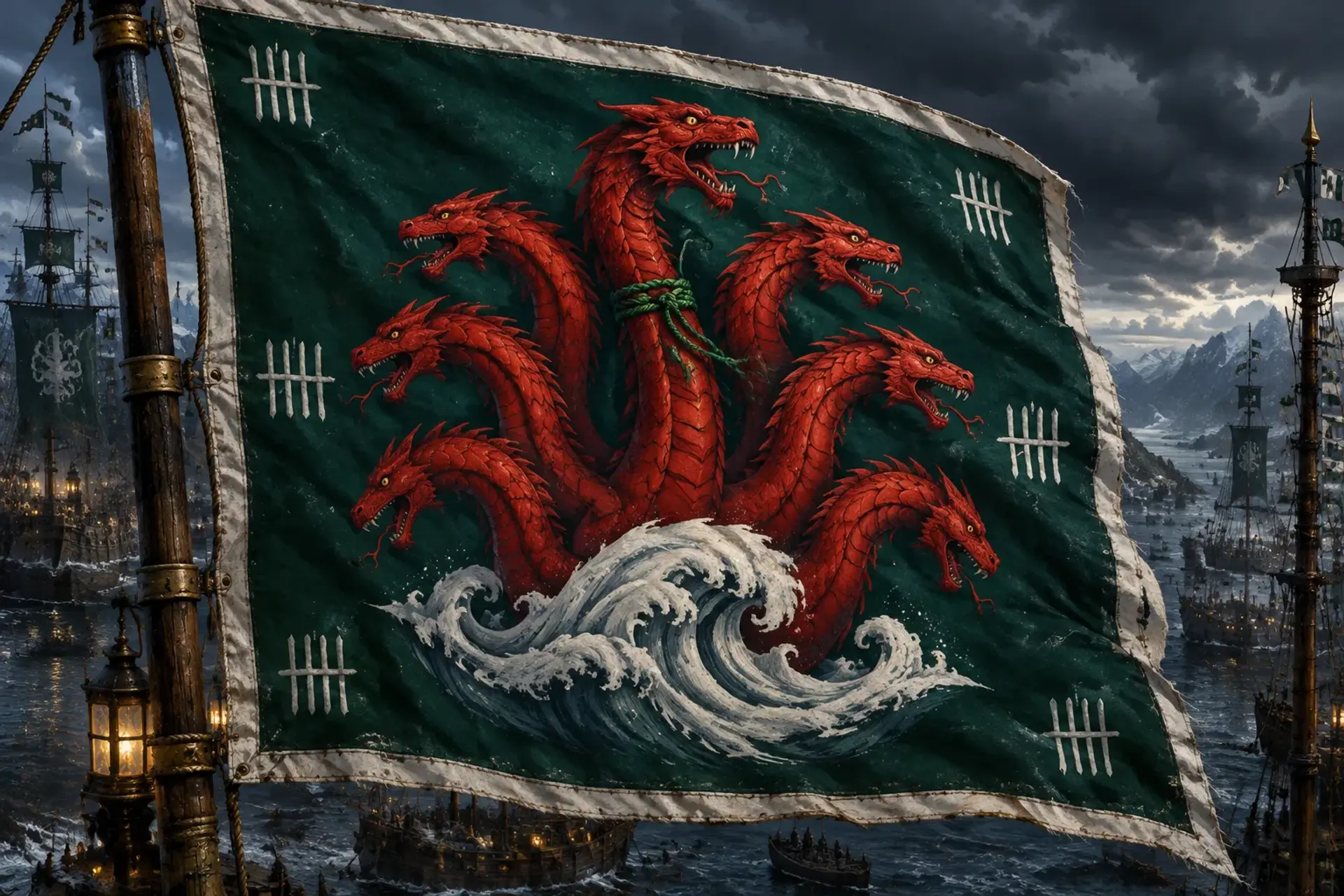
Deep sea-green, Salt-white, Blood-red
- A many-headed sea serpent
- A red neck cord worn by some patrol crews
- A white breaker painted beneath the Fleet emblem
- The number six, recalling the evacuation tally and the six errant-fleets
Standing
What they say they want
What they are doing now
Where it leads
The Hydra Fleet wants to reclaim and resettle its ancestral lands, dismantle demonic networks in the mortal world, and ensure that no people are ever again forced to become a fleet of refugees. Its leaders disagree on whether that future means restoring an old homeland, creating a new shared territory for all six errant-fleets, or making the sea itself a secure and permanent home.
How others see them
In northern ports, the Hydra Fleet is widely regarded as disciplined, useful, and a little unnerving. Its members are seen as capable sailors and dependable demon-hunters, but some locals fear their armed presence and their willingness to seize suspected contraband. In the Scarred Lands, communities often welcome their patrols while resenting the Fleet's assumption that it knows what dangers justify intervention.
People
6 ranks
Fleet Speaker
Measured, practical, and persuasive. She listens closely, speaks carefully, and treats a signed agreement as a weapon that can protect the weak as readily as it can bind them.
- Fleet Speaker1 member
The elected public voice and treaty signatory. The Speaker is chosen by a conclave of ship captains and shore delegates, and cannot command individual vessels without the captains' consent.
- Red Neck Captains24 members
Senior captains responsible for warships, major housing ships, and regional patrol groups. They advise the Speaker and can collectively challenge an order they consider unlawful or disastrous.
- Sounding Council92 members
Representatives of the Fleet's military, merchant, research, and community arms. It debates contracts, patrol priorities, discipline, and settlement claims. Decisions require a majority, but a war declaration requires the captains' assent.
- Keelwardens380 members
Ship officers, quartermasters, healers, navigators, teachers, and specialist leaders. They keep ships and communities functioning and are expected to report hazards to the council.
- Stormhands700 members
Experienced sailors, marines, traders, craftspeople, and demon-hunters. Many hold more than one duty depending on the ship and season.
- Wakefolk1,440 members
The wider Fleet population, including families, apprentices, passengers under protection, and newly accepted members. They have a voice in ship and community matters through elected delegates.
Other key members
- Mett Red Neck Captain and leading Landward voice
- Ilyara of the Ninth Sounding Demonologist and keeper of the Fleet's restricted research records
- Boro Delegate for the housing ships and advocate for non-Storm-Born members
- Halan Quaymark Merchant captain and head of a powerful trading bloc
How they are organised
- Accept the Fleet's responsibility to protect its people and oppose demonic influence, while recognizing that members may disagree about methods.
- Swear to obey shipboard safety rules and lawful council decisions while aboard Fleet vessels.
- Declare any known tie to a demonic cult, cursed object, or hostile power before taking a position of trust.
- Newcomers may serve as passengers, paid crew, or protected residents before being considered for full membership. Service and community consent matter more than ancestry, though the Fleet has not fully overcome its old prejudices.
Relations
10 factionsThe other five errant-fleets are bound by shared exile, mutual defense, and old obligations. Their alliance is durable but frequently strained by competing priorities and disputes over who bears the greatest cost.
Operations
What they do
How they do it
Services for hire
- Sea EscortNegotiated contract, usually paid in coin, supplies, docking rights, or intelligenceArmed escort through dangerous waters, including patrol support when the threat is credible and the route serves Fleet interests.
- Taint SurveyA fee, a useful map, or reciprocal informationAssessment of suspected demonic traces, cult markings, or dangerous cargo. The Fleet may refuse to disclose its full findings.
- Flotilla ProvisioningTrade price, treaty voucher, or a favor to a ship's communityAccess to repair work, provisions, navigational charts, and shipboard lodging when space and security allow.
What they can do
What they have
Where they are weak
Territory
Headquarters
The Fleet's principal anchorage shifts among treaty ports and sheltered waters near the Scarred Lands.The Hydra Fleet has no fixed capital. Its command vessels, family ships, workshops, and markets form a shifting harbor wherever its flotilla anchors. Its largest gathering is a crowded anchorage of housing ships and tenders, screened by warships and watched by signal crews. The gathering point changes with season, threat, and treaty obligations. A chart room aboard the command ship holds maps of the Scarred Lands, evacuation records, and disputed claims to ancestral shores.
Lands they hold
Outposts
- Red Neck ShoalAn island claimed under a northern treaty near the outer approaches to the Scarred LandsA signal and patrol station where crews report suspicious sails, storms, and demonic signs. The name began as a warning on an old chart about the red surf that hides reefs.
- Marker NineA treaty port on the northern trade routesA bonded warehouse, crew exchange, and negotiation house. Its name is the number on an old customs map, retained because changing a long-established marker invites confusion.
- The Salt WarningA small coastal town held by agreement with a northern nationA guarded storehouse and staging point for expeditions toward the Maelstrom Rift. Its name comes from a warning painted on its first seawall after contaminated water ruined the original wells.
Secrets
Plot hooks
5 hooks- 1The Hold That Was LockedLow to moderateReward: Personal favor, pay, and access to Fleet contactsA newly recruited deckhand asks the characters to find her missing crewmate, who vanished after being assigned to clean a locked research hold. The officer in charge insists the sailor deserted, but the hold has fresh claw marks on the inside of its door.
- 2Boats Taken at DawnModerateReward: Local influence, a treaty favor, or the settlement's gratitudeA small coastal settlement claims Hydra patrols seized its fishing boats without cause. The Fleet says the boats carried a cult courier. The characters are asked to find the missing crew and determine whether the accusation is true before the settlement drives out the Fleet's garrison.
- 3The Evidence AfloatHighReward: Access to dangerous intelligence, equipment, or a substantial contract paymentThe Hydra Fleet offers a contract to escort a research vessel into waters near the Maelstrom Rift. A demon-hunting ally demands that the vessel's cargo be destroyed, while the researchers insist it contains the only evidence of a new summoning method. Both sides have reasons to fear the other is right.
- 4A Claim Under SealHighReward: Regional political leverage and potential command of a future expeditionA northern government is preparing to void the Fleet's island treaty after a series of attacks. The Fleet suspects a cult has staged the violence to force its removal. The party must investigate the attacks, navigate local resentment, and decide whether to reveal evidence implicating a treaty official.
- 5The First PassageCampaign-scaleReward: A defining choice about the Fleet's leadership, alliance, and futureFragments of the Fleet's restricted archive surface in the hands of several parties. Each fragment points to the old pact made during the evacuation, but none proves whether it remains active. The council asks the characters to recover the records quietly. Other errant-fleets may insist that the truth be made public.
Work they offer
What gets in the way
Rumours
Media
0 imagesNo images yet.
Turn Hydra Fleet into a sheet
A high-res, share-ready sheet you can post or print.