
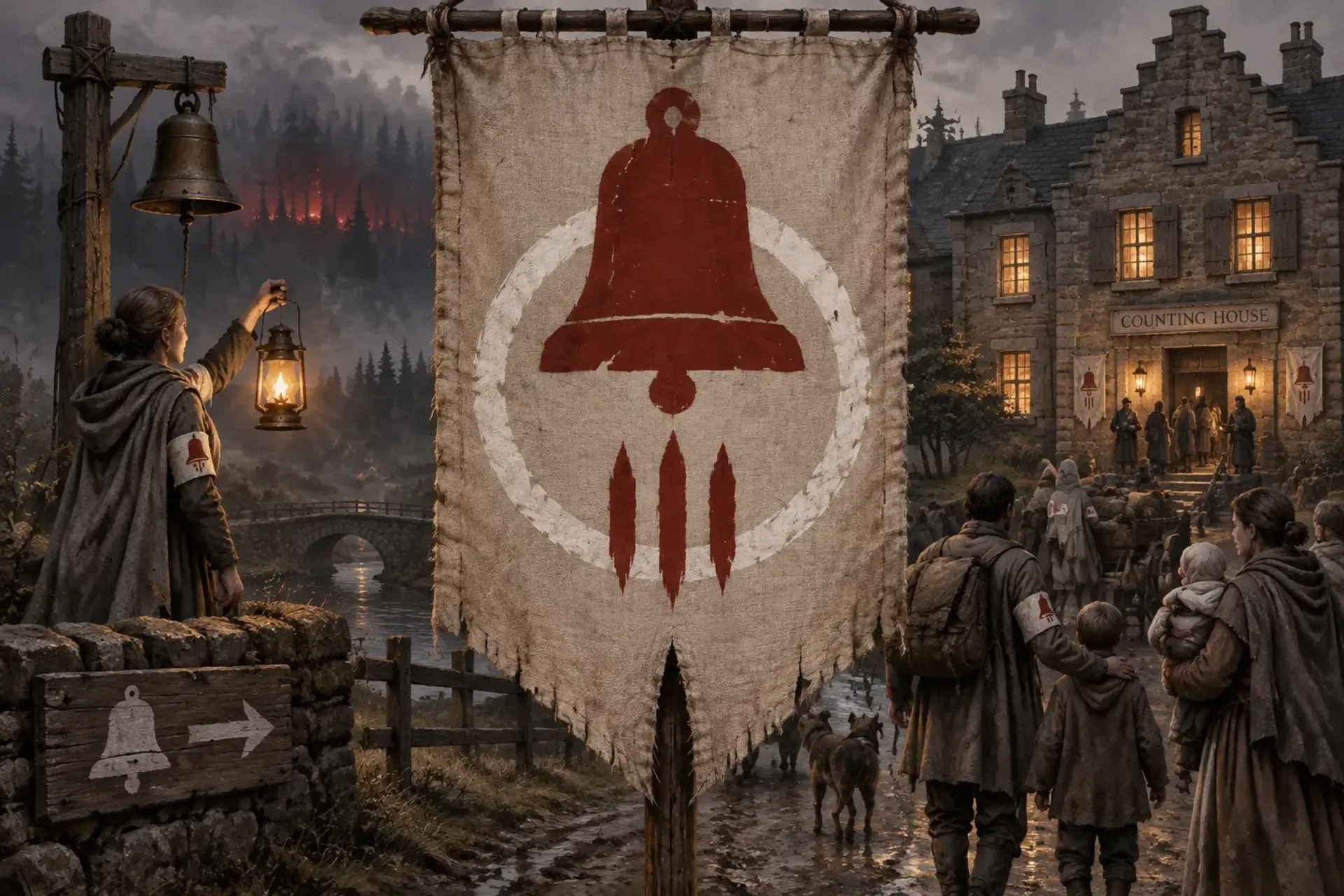
The Third Boundary Bell
The Brackenfield Reckoning began with a bargain made by a grieving miller's family, who hoped a fey visitor could restore a child taken by fever. The child recovered, but the bargain's unclear terms brought months of dangerous distortions: paths looped back on themselves, animals spoke in familiar voices, and a stream briefly ran uphill through the settlement. Other families suffered injuries and losses while trying to help. Afterward, neighbors formed informal night watches. They began recording testimony, marking affected paths, and escorting people away from strange lights. Their first major success was guiding three hamlets through a week of shifting roads without losing anyone. Their first major setback came when an overconfident watch burned a harmless shrine, provoking retaliation that injured several volunteers. The defining watershed was the Second Bell Night, when a pattern of red lights appeared across the fields and the militia rang its warning. Most people fled to a safe ridge. One village, persuaded by a local patron that the alarm was a falsehood, stayed behind and suffered a lethal surge of uncontrolled magic. The disaster convinced the Bell Table that warnings had to be shared across village lines, not left to individual landholders. It also hardened the faction's belief that delay could be deadly. Over the following years, minor lords and villages began funding patrols, while civic authorities disputed the militia's right to act. It became a permanent, locally rooted force without becoming an officially recognized one. Today it is better organized than it was, but its members still argue over whether their mission is to protect people from dangerous bargains, stop fey influence, or prevent all wild magic at any cost.
The Third Boundary Bell
- Type
- Volunteer anti-fey militia…
- Size
- About 175 regular and part-time members
- Reach
- Regional but uneven
- Base
- The settlement of Brackenfield, named for the field once assessed as the third parcel on an old tax roll
Overview
The Brackenfield Reckoning began with a bargain made by a grieving miller's family, who hoped a fey visitor could restore a child taken by fever. The child recovered, but the bargain's unclear terms brought months of dangerous distortions: paths looped back on themselves, animals spoke in familiar voices, and a stream briefly ran uphill through the settlement. Other families suffered injuries and losses while trying to help. Afterward, neighbors formed informal night watches. They began recording testimony, marking affected paths, and escorting people away from strange lights. Their first major success was guiding three hamlets through a week of shifting roads without losing anyone. Their first major setback came when an overconfident watch burned a harmless shrine, provoking retaliation that injured several volunteers. The defining watershed was the Second Bell Night, when a pattern of red lights appeared across the fields and the militia rang its warning. Most people fled to a safe ridge. One village, persuaded by a local patron that the alarm was a falsehood, stayed behind and suffered a lethal surge of uncontrolled magic. The disaster convinced the Bell Table that warnings had to be shared across village lines, not left to individual landholders. It also hardened the faction's belief that delay could be deadly. Over the following years, minor lords and villages began funding patrols, while civic authorities disputed the militia's right to act. It became a permanent, locally rooted force without becoming an officially recognized one. Today it is better organized than it was, but its members still argue over whether their mission is to protect people from dangerous bargains, stop fey influence, or prevent all wild magic at any cost.
How it began
The organization began when the people of several scattered hamlets pooled money to search for missing children and contain a magical disturbance that followed a local bargain. Its founders were not trained monster hunters. They were parents, siblings, spouses, and neighbors who had watched ordinary decisions turn into consequences no one understood.
How to know them
Dried-blood red, Unbleached linen, Ash gray
- A handbell, signifying warning before judgment
- A broken circle, signifying that boundaries can fail
- Three short red strokes on a doorpost, marking a known safe meeting place
Standing
What they say they want
What they are doing now
Where it leads
A network of locally controlled watches, shelters, and trained responders able to recognize and contain dangerous fey incidents without relying on distant authorities. The hard question is whether containment means helping people understand a bargain, preventing further contact, or forcing a separation between the mortal world and fey influence.
How others see them
To supporters, the militia is the only group that comes when a road bends the wrong way or a neighbor returns with a promise they cannot explain. To skeptics, it is an unofficial band of frightened locals with bells, weapons, and too much power over anyone suspected of dealing with fey.
People
5 ranks
First Bell
Measured, stubborn, empathetic without being soft. She knows the militia has harmed people and fears that admitting it publicly will destroy the only organization responding to the danger.
- The Bell Table7 members
A council of elected watch captains, bereaved representatives, and village delegates. It sets policy, approves major operations, and can overrule the commander by a five-vote majority.
- First Bell1 member
The elected field commander. Coordinates patrols and emergency responses, but cannot declare someone guilty of a bargain or order a punishment without the Bell Table.
- Road Captains12 members
Lead local watches, train volunteers, maintain warning bells, and report incidents. They are powerful in their own districts but often resent decisions made far away.
- Ringers46 members
Regular members who patrol, escort travelers, maintain shelters, and respond to alarms. Some have combat experience; many do not.
- Lantern Hands110 members
Part-time supporters who carry messages, record testimony, provide food and shelter, and raise an alarm. Their numbers change with the season and local fear.
Other key members
- Tomas Rell Road Captain and leading hardliner
- Ketti Keeper of testimony and supplies
- Gunnar Vale Patron's liaison and Road Captain
How they are organised
- Accept that the militia is a civilian defense organization, not a court with power to determine guilt.
- Agree to answer an alarm within one's ability, or arrange a replacement when unable.
- Record what was witnessed separately from what is suspected.
- Disclose any personal tie to a suspected incident to one's Road Captain.
- No member is required to have suffered a fey bargain, but members who have are offered a private hearing before assignment to a triggering duty.
Relations
8 factionsSeveral small landholders pay for patrols and provide grain, but their support is conditional. They want protection without giving the militia authority over their tenants.
Operations
What they do
How they do it
Services for hire
- Alarm ShelterA voluntary contribution of food, supplies, or laborProvides a temporary safe place to stay, a local escort, and help notifying relatives after a suspected magical incident.
- Road EscortA modest fee or a day of volunteer serviceArranges a watch and guides travelers around a reported disturbance. The militia cannot guarantee the route is safe.
- Witness BookFree for affected families, when supplies allowRecords a witness's account and connects them with a healer, advocate, or village representative. The record is not legally protected everywhere.
What they can do
What they have
Where they are weak
Territory
Headquarters
The settlement of Brackenfield, named for the field once assessed as the third parcel on an old tax rollA former grain tally house, reinforced with shutters and used for storing dry food, medical supplies, bells, and written testimony. Its walls are crowded with hand-copied incident reports. The militia has no permanent garrison there; most members return to farms, shops, and households between watches.
Lands they hold
Outposts
- Third Mile ShelterAlong the old north road, at the third mile marker on a discontinued military surveyA refuge for travelers during alarms and a place to post written warnings.
- Fifth Landing WatchBeside the old ferry crossing, at the site listed as the fifth landing in a tax registerKeeps track of crossings, reports strange lights over the water, and escorts people away from the riverbank.
Secrets
Plot hooks
5 hooks- 1The Summons Under the DoorPersonal; suitable for one session or a character subplotReward: A trusted local contact, evidence about a fey bargain, or a lasting obligation to the militiaA character's relative receives a militia summons after an incident the family insists was ordinary bad luck. The character can investigate, negotiate for a fair hearing, or help the relative flee a search.
- 2Wrong PatternLocal; investigation and tense crowd managementReward: Local goodwill, a rescued witness, or proof of deliberate sabotageA village bell rings the evacuation pattern, but the watch captain swears no alarm was given. Someone has swapped the signal ropes, and frightened residents are gathering in the wrong place.
- 3Before the Second BellParty-scale; social conflict with the possibility of violenceReward: An alliance with either faction within the militia, access to its records, or leverage over the leadershipTomas Rell plans to detain a suspected bargain-maker before the Bell Table can review the testimony. Halla asks the characters to stop the detention without provoking a split in the militia.
- 4A Road Made ClearRegional; travel, investigation, and competing obligationsReward: Patronage, evidence of corruption, or a chance to prevent an unjust evictionA patron offers the characters a substantial reward to escort militia members on a supposedly routine patrol. The route passes through land the patron wants cleared, and the disturbance may be a pretext for seizing it.
- 5The Page That Stayed DryCampaign-scale; multiple factions race to obtain or suppress the evidenceReward: A major revelation, a new enemy or ally, and influence over the militia's futureThe missing page from the founding ledger appears in a market, offered to the highest bidder. Its contents could expose the hidden bargain behind Brackenfield and trigger retaliation from both the fey and the militia's patrons.
Work they offer
What gets in the way
Rumours
Media
0 imagesNo images yet.
Turn The Third Boundary Bell into a sheet
A high-res, share-ready sheet you can post or print.