
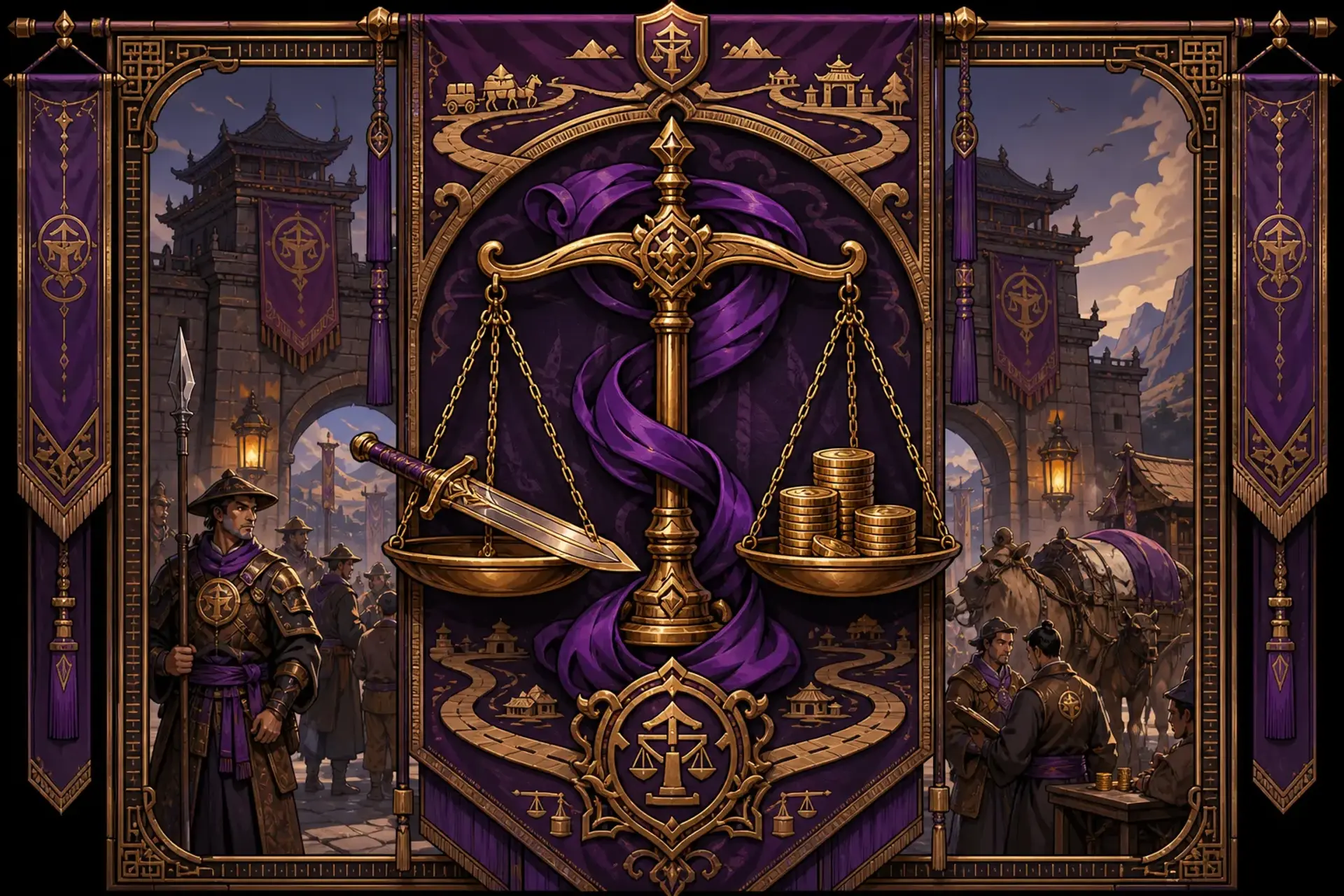
Cathnorunz Order
The Order began as scattered merchant guards and Temple devotees who shared food, information, and protection along dangerous roads. The principality later recognized their service and granted them a charter, allowing them to bear arms openly as a religious order. Their first generations were small and dependent on merchant donations. They grew when the principality's trade expanded and caravans began crossing regions where local authority was weak. Their watershed moment came during the Bronze Ledger Crisis, when a succession of caravan attacks coincided with falsified toll records. The Order uncovered that some toll collectors and raiders had been working together, charging merchants twice and then robbing those who refused. The Order's officers exposed the scheme publicly, returned much of the stolen money, and protected witnesses despite pressure from powerful interests. The principality renewed the Order's charter, but added limits requiring the Order to record its fees and submit serious accusations to civic courts. That compromise remains a point of pride to reformers and resentment to commanders who consider it an obstacle. In the decades since, the Order has become a national institution with more than a thousand members. It has defended trade during border conflicts, escorted refugees and merchants alike, and helped standardize safe-conduct practices. It has also been drawn into disputes where commercial protection shades into political influence. Today its reputation rests on a difficult promise: a merchant's safety matters, but no merchant should be above the measure of the law.
Cathnorunz Order
- Type
- Religious Order
- Size
- 1,761 members
- Reach
- National
- Base
- The principality's seat of government
Overview
The Order began as scattered merchant guards and Temple devotees who shared food, information, and protection along dangerous roads. The principality later recognized their service and granted them a charter, allowing them to bear arms openly as a religious order. Their first generations were small and dependent on merchant donations. They grew when the principality's trade expanded and caravans began crossing regions where local authority was weak. Their watershed moment came during the Bronze Ledger Crisis, when a succession of caravan attacks coincided with falsified toll records. The Order uncovered that some toll collectors and raiders had been working together, charging merchants twice and then robbing those who refused. The Order's officers exposed the scheme publicly, returned much of the stolen money, and protected witnesses despite pressure from powerful interests. The principality renewed the Order's charter, but added limits requiring the Order to record its fees and submit serious accusations to civic courts. That compromise remains a point of pride to reformers and resentment to commanders who consider it an obstacle. In the decades since, the Order has become a national institution with more than a thousand members. It has defended trade during border conflicts, escorted refugees and merchants alike, and helped standardize safe-conduct practices. It has also been drawn into disputes where commercial protection shades into political influence. Today its reputation rests on a difficult promise: a merchant's safety matters, but no merchant should be above the measure of the law.
How it began
The Temple teaches that Cathnorunz, gnoll god of commerce, persuasion, and protection over merchants, first revealed the Order's purpose through a caravan that vanished on a dangerous road. In the story, the caravan's surviving guards and traders argued over whether to spend their last coins on weapons or bribes. A gnoll pilgrim invoked Cathnorunz, and the group instead pooled both their money and their weapons, negotiated safe passage with one band of raiders, and fought off another. The tale's lesson is not that every threat can be bargained away, but that protection and commerce must be weighed together. The first sworn protectors were merchants, guards, and pilgrims who adopted that principle. Their names have not survived in reliable records.
How to know them
Bronze, Purple
- Bronze scale wrapped in a purple banner.
- A sword balanced against a pile of coins, representing force and wealth held to the same standard.
- Bronze badges worn openly by sworn members; novices wear a plain purple cord until they complete their probation.
Standing
What they say they want
What they are doing now
Where it leads
A principality where travel and trade do not depend on wealth or armed escorts, and where the Order is eventually needed less because roads, courts, and communities can protect one another. The contradiction is that achieving this vision may require the Order to gain enough political power to make itself difficult to disband.
How others see them
Merchants generally consider the Order dependable, professional, and expensive. Ordinary travelers value its presence when danger is near, but some see it as a force that protects commerce before people. The principality praises its service while watching carefully for any attempt to become a private army.
People
6 ranks
First Scale
Patient, quietly observant, and difficult to provoke. She listens closely, then makes decisions with unnerving finality. She dislikes public displays of piety when practical help is needed.
- First Scale1 member
National commander. Leads the Order, represents it before the principality, and cannot alter the charter without Temple approval.
- Bronze Seats12 members
Senior officers responsible for major regions, the treasury, training, discipline, and relations with the Temple. They advise the First Scale and vote on national policy.
- Roadwardens48 members
Regional commanders who assign escorts, coordinate patrols, investigate attacks, and maintain relations with local merchants and officials.
- Scale-Captains180 members
Lead local houses or traveling companies. Keep rosters and accounts, hear complaints, and decide how to divide limited guards among routes.
- Sworn Shields920 members
Full members who escort caravans, guard markets and waystations, train recruits, and carry out investigations.
- Road Novices600 members
Probationary members and support staff learning route law, negotiation, first aid, logistics, and the Order's vows. They may travel with escorts but do not command them.
Other key members
- Shessa of the Lower Road Roadwarden and leading advocate for protecting small merchants
- Tamas Varga Bronze Seat responsible for treasury and charter negotiations
How they are organised
- Swear to protect merchants and those traveling with them without treating a protection fee as permission to exploit them.
- Accept the Order's rules for recording fees, losses, and use of force.
- Complete a probationary period on an escort, at a waystation, or in a Temple service role.
- Demonstrate practical judgment under pressure. Combat skill is valued, but members must also learn negotiation, observation, and safe travel procedures.
- Members may worship other faiths, but must not use Cathnorunz's name to justify fraud, extortion, or needless violence.
Relations
7 factionsThe principality recognizes the Order as a legitimate religious military body and relies on it to protect commerce. The arrangement is strained whenever the Order refuses a politically convenient seizure or exposes corruption among officials.
Operations
What they do
How they do it
Services for hire
- Caravan escortA negotiated fee based on route danger, cargo, and available guards; some hardship cases are subsidized.A trained escort for a merchant party, including route advice and basic defensive support.
- Road-house refugeA small fee or donation, waived during emergencies.Temporary shelter, route warnings, and access to a guarded yard at an Order road house.
- Scale hearingUsually a donation or reciprocal service.A mediated hearing for disputes involving travel contracts, escort fees, damaged goods, or alleged misconduct by an Order member. The Order cannot replace a court's judgment.
- Recovery inquiryNo standard fee for urgent threats; wealthy clients may be asked to fund the response.A search or recovery effort for missing travelers, stolen cargo, or lost route records, subject to available personnel.
What they can do
What they have
Where they are weak
Territory
Headquarters
The principality's seat of governmentThe Order's national command works from a fortified compound adjoining the Temple of Cathnorunz in the principality's seat of government. Its bronze-clad gate opens onto a public counting court where merchants can register complaints, request escorts, and challenge a protection fee. Behind the court are barracks, a stable yard, a shrine, and an archive of route reports. The archive's oldest section is sealed by a custom lock and can be opened only by the Temple's senior clerics and the Order's senior officers together.
Lands they hold
Outposts
- Road housesAt major road junctions throughout the principalityProvide guarded rest, basic supplies, route warnings, and a place to file complaints.
- Scale courtsAt busy markets and caravan yardsRegister escorts, mediate commercial disputes, and record fees and losses.
- Watch sheltersOn exposed stretches of roadOffer a lookout point and emergency refuge. Most are modest and staffed only when danger is expected.
Secrets
Plot hooks
5 hooks- 1The Missing PursePersonal, low to moderateReward: A sworn ally, access to a road house, or evidence connecting the merchant to a wider schemeA novice is accused of stealing a purse from an escorted merchant. The novice insists the money was planted to silence them after they found a discrepancy in the merchant's cargo ledger. The characters can investigate the accusation, protect the novice, or decide whether the evidence implicates the Order itself.
- 2The Unwritten RouteLocal investigationReward: Coin, a useful escort, and a clue about the attacks on trade recordsA caravan arrives at a waystation with no guards, no driver, and a sealed contract addressed to Shessa of the Lower Road. The cargo is intact, but every written record of its route has been cut apart. The Order asks the characters to trace the caravan's last safe stop before the authorities seize the goods.
- 3A Weight Out of BalanceRegional political crisisReward: Political leverage, a principality contact, or the Order's lasting gratitudeA customs official offers the party a legal warrant to inspect an Order storehouse, claiming stolen toll revenue is inside. Oru says the warrant is forged; Tamas quietly admits that some of the money was set aside without authorization. The characters must decide what to expose, whom to trust, and whether the storehouse contains more than funds.
- 4The Ledger That Must Not Be ReadCampaign-scale investigationReward: A major secret, a reform alliance, or a dangerous claim on the Order's futureA series of attacks targets contracts rather than goods. Merchants begin accusing the Order of staging the raids to justify a larger budget. The party can follow the attackers, protect a vulnerable witness, or uncover the sealed record that explains why the old charter is being targeted.
- 5The Unpaid EscortPersonal or localReward: Goodwill among ordinary travelers, a modest payment, or a lead to a smuggling operationA poor peddler asks the characters to escort a wagon of medicine but cannot pay the usual fee. A local Scale-Captain refuses the assignment, citing a more urgent contract. The party can take the job, appeal to Shessa, or discover why someone has offered an unusually large payment to keep that particular wagon off the road.
Work they offer
What gets in the way
Rumours
Media
0 imagesNo images yet.
Turn Cathnorunz Order into a sheet
A high-res, share-ready sheet you can post or print.