
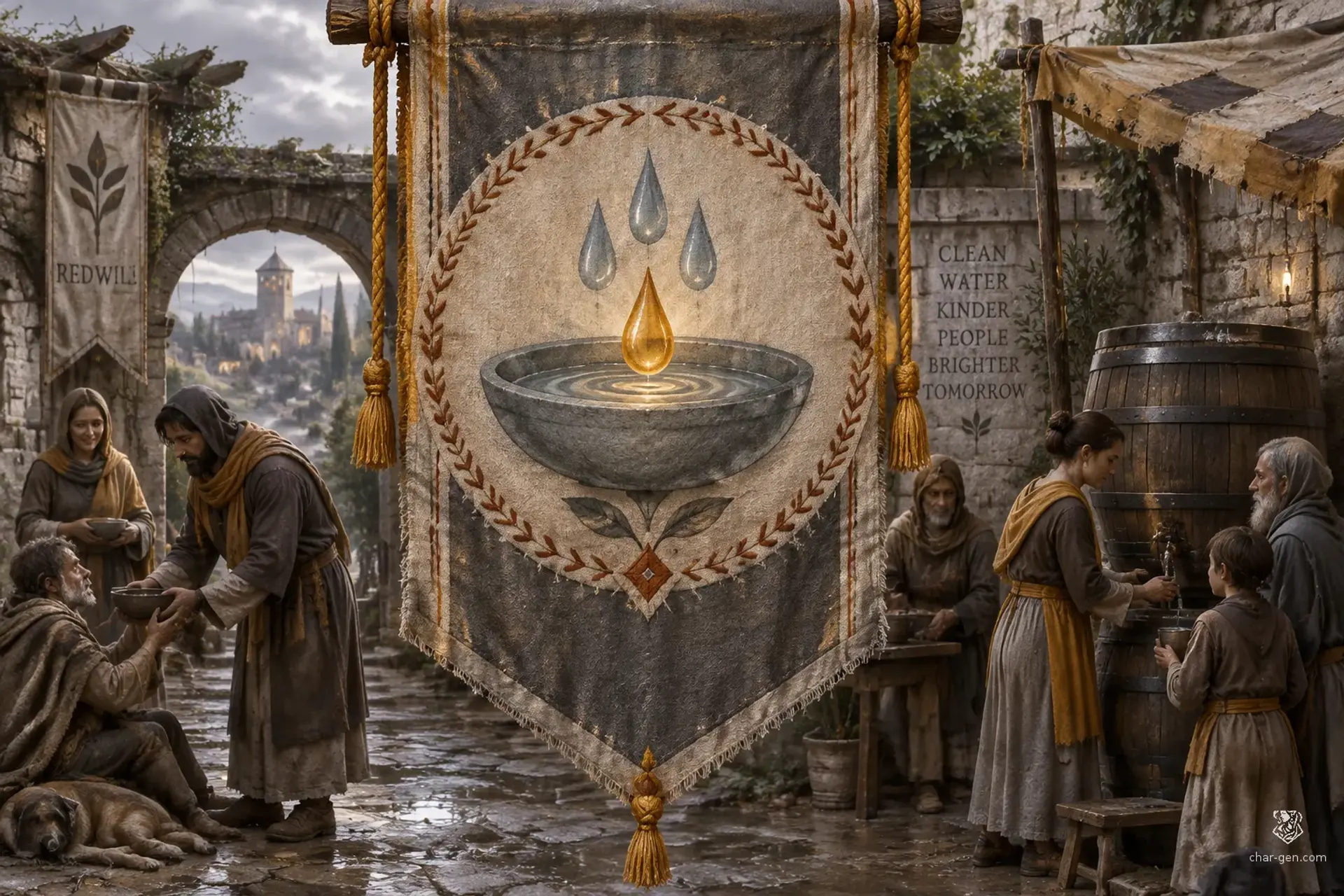
The Rain-Waiting Bowl
The order's accounts trace its beginnings to Changdong, where generations of monks maintained a cistern, taught breath-centered contemplation, and offered shelter to travelers. Its members were never numerous, and their influence came from practical service rather than political power. The attack by Rhaumek became the order's defining watershed: after the monastery fell, the survivors argued whether their duty was to return, rebuild elsewhere, or keep moving toward people in need. They chose the road. During the first years, they survived by treating caravan guards and refugees, and earned a wary welcome in settlements that feared harboring displaced strangers. A fever outbreak in Redwill established their local reputation when the monks stayed through the worst of it, treating residents without asking their faith or status. That winter also made their presence controversial: they used donations to feed outsiders before local creditors. Today they are a small, respected but unsettled community. They have preserved their teachings, but their travel has made every practical choice a debate about what, exactly, survived Changdong.
The Rain-Waiting Bowl
- Type
- Religious Order
- Size
- 40 members
- Reach
- Local
- Base
- Redwill
Overview
The order's accounts trace its beginnings to Changdong, where generations of monks maintained a cistern, taught breath-centered contemplation, and offered shelter to travelers. Its members were never numerous, and their influence came from practical service rather than political power. The attack by Rhaumek became the order's defining watershed: after the monastery fell, the survivors argued whether their duty was to return, rebuild elsewhere, or keep moving toward people in need. They chose the road. During the first years, they survived by treating caravan guards and refugees, and earned a wary welcome in settlements that feared harboring displaced strangers. A fever outbreak in Redwill established their local reputation when the monks stayed through the worst of it, treating residents without asking their faith or status. That winter also made their presence controversial: they used donations to feed outsiders before local creditors. Today they are a small, respected but unsettled community. They have preserved their teachings, but their travel has made every practical choice a debate about what, exactly, survived Changdong.
How it began
In Changdong, the monks of the Rain-Waiting Bowl maintained a hillside monastery beside a cistern that supplied several nearby hamlets. The order's old teaching held that a bowl is most sacred when it is passed to someone thirstier than its owner. When Rhaumek, the Cinder Crown, descended on Changdong, the monks opened the cistern stores and treated the injured rather than defend the monastery. The dragon's fire destroyed the halls, killed many residents and monks, and scattered the survivors. Abbess Suyin led the remaining twenty-three people down from the mountain carrying little but medicine, the order's travel bowls, and a rain-bell whose bronze had been made from the monastery's first well-chain. Suyin died on the road. The refugees kept walking, and their temporary waystations became a traveling order rather than a restored monastery.
How to know them
Rain-cloud gray, faded saffron, clay red
- A shallow bowl marked with three rain strokes
- A saffron cord tied inside the sleeve, hidden from casual view
- The missing rain-bell, remembered in a short call-and-response used at gatherings
Standing
What they say they want
What they are doing now
Where it leads
A chain of modest hospices and teaching houses that can offer food, care, and sanctuary without depending on one vulnerable monastery. The order has not agreed whether Changdong should become the first of these houses, a memorial, or a place they leave behind.
How others see them
In Redwill, many regard the monks as dependable, humble, and kinder than the local authorities. Others see them as meddling outsiders who take resources from residents and shelter people the law wants punished. Their quiet habits have led some to mistake them for harmless, though those who have traveled with them know they are hard to intimidate and difficult to provoke into needless violence.
People
5 ranks
Keeper of the Empty Bowl
Patient, observant, and quietly affectionate. She uses questions instead of commands, which can be calming or infuriating depending on the danger at hand.
- Keeper of the Empty Bowl1 member
The elected spiritual head speaks for the order, arbitrates disputes, and can direct emergency action. Major decisions still require council assent.
- Road Council5 members
Senior monks responsible for teaching, healing, stores, mediation, and the safety of the traveling community. Each has one vote; the Keeper breaks ties only in urgent matters.
- Way-Bearers8 members
Experienced members who lead small traveling parties, train novices, and negotiate temporary lodging or aid.
- Bowl-Keepers17 members
The full members who perform the order's daily work: tending the sick, maintaining supplies, teaching, and accompanying refugees.
- Listeners9 members
Novices and dependents learning the order's practices. They are not required to take permanent vows and may leave with an honest farewell.
Other key members
- Khezrik Way-Bearer and advocate for teaching defensive techniques
- Aulaya of Changdong Road Council healer
- Tovan Listener and aspiring road guard
How they are organised
- Show a willingness to serve people in need without requiring payment, status, or shared faith.
- Accept that the order's practices are disciplines, not supernatural guarantees or a claim to exclusive truth.
- Respect the community's safety and the right of members to leave without being hunted or shamed.
- No prior religious commitment is required. Members may hold different beliefs, provided they do not use the order's shelter to persecute others.
Relations
6 factionsThe settlement's healers trade food, shelter, and local knowledge for the monks' care during sickness and disaster. The arrangement strains when the order treats people whom the healers consider beyond saving.
Operations
What they do
How they do it
Services for hire
- Roadside careFree for those without means; otherwise a donation of food, supplies, or laborBasic treatment for wounds, fever, exhaustion, and exposure. They cannot promise magical healing.
- A dry cornerA modest meal, useful information, or no payment in an emergencyA place to sleep in the courtyard or shed when space allows. They do not promise secrecy from local authorities.
- Listening bowlA voluntary offeringA quiet conversation intended to help people clarify a dispute. The monks do not claim to judge law or determine guilt.
What they can do
What they have
Where they are weak
Territory
Headquarters
RedwillThe order has no permanent headquarters. Its current base is a cluster of rented rooms, a covered courtyard, and a borrowed shed in the settlement of Redwill. The courtyard's central rain barrel is treated as a communal shrine. When the monks travel, their records and medicines move with them in two locked chests.
Lands they hold
Outposts
- The North ShedA disused storehouse near Redwill's north roadA temporary medicine store and shelter for travelers. It is lent by a local family and could be reclaimed at any time.
- The Split SpringA roadside spring two days east of RedwillA meeting point where traveling members leave messages in a weatherproof box and help maintain the water source.
Secrets
Plot hooks
4 hooks- 1The Bowl He Sets DownLow, focused on negotiation, trust, and a personal choiceReward: A small favor from the order, local goodwill, and a recurring companion or contactA Listener asks the characters to escort him out of Redwill before he leaves to join a caravan guard company. Oyun requests that they bring him back for one last conversation, while Khezrik urges them to let him choose his own path.
- 2A Second WinterModerate, involving an environmental hazard, competing priorities, and possible investigationReward: Healing supplies, a safe place to stay, and improved standing with either the monks or the councilA fever has returned in one quarter of Redwill. The monks need a missing medicine chest recovered from a flooded storehouse, while the Market Council insists the building is unsafe and wants the monks to stop treating patients there.
- 3The Sound Under the MountainHigh, suited to an expedition with danger, moral choices, and uncertain evidenceReward: A major debt from the order, access to its route knowledge, and the chance to uncover its central secretA traveler claims to have heard the rain-bell beneath Changdong and says someone trapped below the ruined monastery is still alive. The order asks the characters to verify the story before its members risk a return. The claim may be true, mistaken, or bait laid by someone seeking the bell.
- 4Names in the Red LedgerCampaign-scale, with political pressure, investigation, and consequences for vulnerable residentsReward: The settlement's future trust, allies among the refugees, or evidence that can reshape local powerThe Red Ledger Office has learned that the monks aided fugitives and threatens to expel them unless they identify the people they helped. The council is divided: disclose names, flee, or ask the characters to expose the officer who has been selling captured refugees' identities.
Work they offer
What gets in the way
Rumours
Media
0 imagesNo images yet.
Turn The Rain-Waiting Bowl into a sheet
A high-res, share-ready sheet you can post or print.