
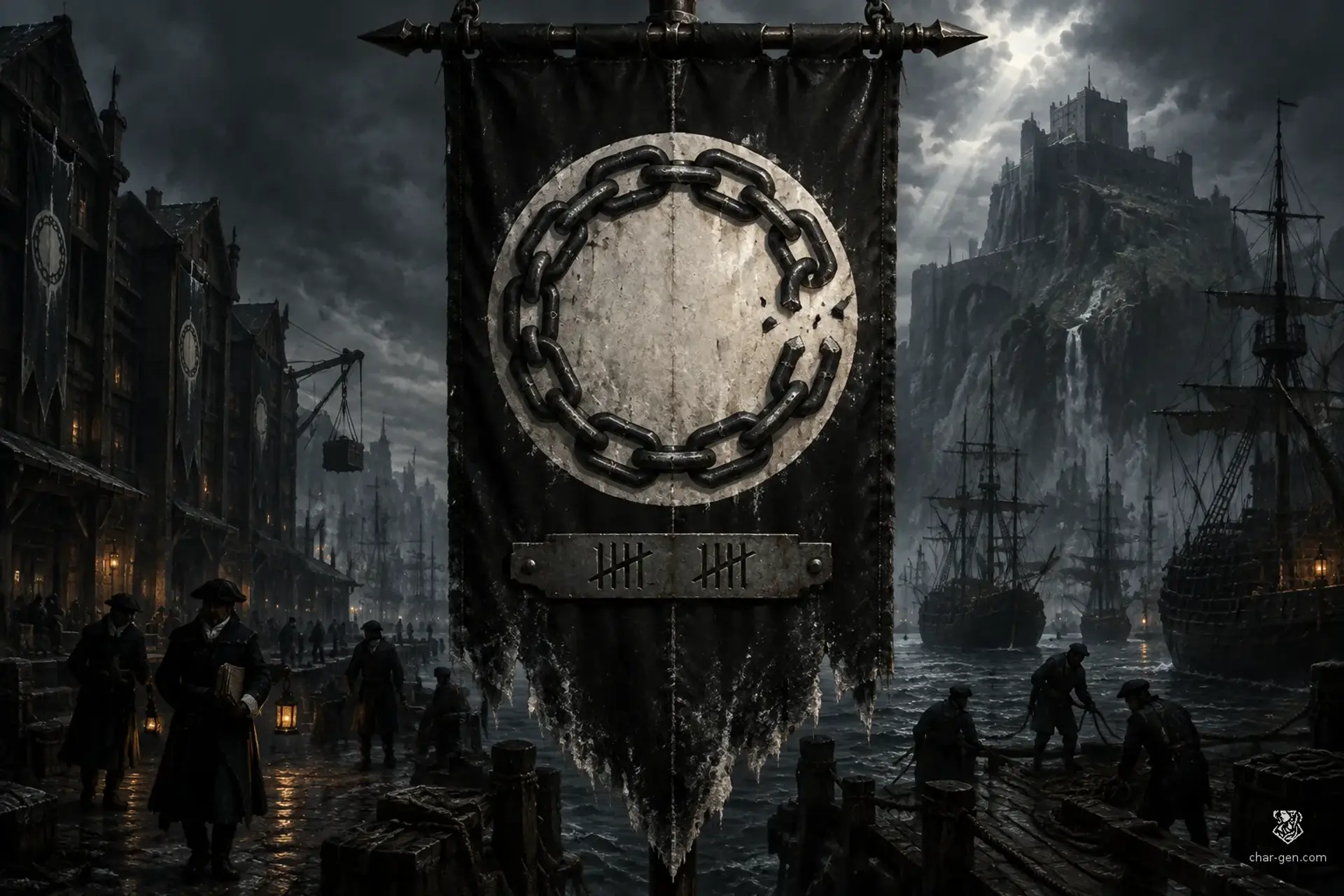
Salt & Chain Company
Salt & Chain's rise came from solving a real problem in the Grey Shores: long voyages could be profitable but depended on safe harbours, trustworthy intermediaries, durable stores, willing crews, and enforceable agreements. The Company linked financing, transport, storage, labour supply, and commercial intelligence. Its fleet eventually reached approximately 60 vessels and its personnel numbered about 1,800 at its peak, as recorded in the existing draft. Its holdings included Diver's Deep, the colonial galleon that became The Drift, and docks at Anvil Rock. Its watershed moment was the creation of a unified labour-and-shipping system. Rather than treating a labour contract as separate from a voyage, Salt & Chain began arranging the advance, obligation, transport, delivery, and resale or assignment of a person's labour as one continuous transaction. The innovation made the enterprise more profitable and made responsibility harder to trace. A broker could claim to have sold a contract, a captain to have carried lawful cargo, and a director to have approved only a route. For a time, the system appeared to work. Salt & Chain brought supplies to remote holdings, maintained docks, financed customers, and connected the Caldera to distant markets. Its practical competence won it patrons who disliked its methods but depended on its services. Its cooperation with the Ledger House was especially lucrative: the Ledger House wanted land and labour, while Salt & Chain supplied movement, credit, and access. The arrangement steadily strained. The Ledger House sought greater territorial control, while Salt & Chain wanted open commercial access and independent authority over its docks. The Silencers' Mission Society condemned the slave trade but accepted other forms of labour obligation, leaving a gap the Company could exploit and a point of real moral conflict. Meanwhile, workers and captives resisted, escaped, withheld knowledge, and organized. The Brethren emerged from people who knew the Company's routes and routines from within. The Company answered instability with more accounting, surveillance, armed enforcement, and contractual controls. These measures made the organization less adaptable and intensified resistance. Its fall was not a single clean defeat. Disruption, internal rivalry, contested claims, and the collapse of confidence in its authority broke its central structure. Salt & Chain is now defunct as an organization, but its infrastructure, surviving records, unpaid debts, and human consequences continue to shape the Caldera.
Salt & Chain Company
- Type
- Chartered maritime…
- Size
- Large at its height
- Reach
- Continental at its height
- Base
- Anvil Rock
Overview
Salt & Chain's rise came from solving a real problem in the Grey Shores: long voyages could be profitable but depended on safe harbours, trustworthy intermediaries, durable stores, willing crews, and enforceable agreements. The Company linked financing, transport, storage, labour supply, and commercial intelligence. Its fleet eventually reached approximately 60 vessels and its personnel numbered about 1,800 at its peak, as recorded in the existing draft. Its holdings included Diver's Deep, the colonial galleon that became The Drift, and docks at Anvil Rock. Its watershed moment was the creation of a unified labour-and-shipping system. Rather than treating a labour contract as separate from a voyage, Salt & Chain began arranging the advance, obligation, transport, delivery, and resale or assignment of a person's labour as one continuous transaction. The innovation made the enterprise more profitable and made responsibility harder to trace. A broker could claim to have sold a contract, a captain to have carried lawful cargo, and a director to have approved only a route. For a time, the system appeared to work. Salt & Chain brought supplies to remote holdings, maintained docks, financed customers, and connected the Caldera to distant markets. Its practical competence won it patrons who disliked its methods but depended on its services. Its cooperation with the Ledger House was especially lucrative: the Ledger House wanted land and labour, while Salt & Chain supplied movement, credit, and access. The arrangement steadily strained. The Ledger House sought greater territorial control, while Salt & Chain wanted open commercial access and independent authority over its docks. The Silencers' Mission Society condemned the slave trade but accepted other forms of labour obligation, leaving a gap the Company could exploit and a point of real moral conflict. Meanwhile, workers and captives resisted, escaped, withheld knowledge, and organized. The Brethren emerged from people who knew the Company's routes and routines from within. The Company answered instability with more accounting, surveillance, armed enforcement, and contractual controls. These measures made the organization less adaptable and intensified resistance. Its fall was not a single clean defeat. Disruption, internal rivalry, contested claims, and the collapse of confidence in its authority broke its central structure. Salt & Chain is now defunct as an organization, but its infrastructure, surviving records, unpaid debts, and human consequences continue to shape the Caldera.
How it began
Proposed expansion built on the established Scrimshaw foundation: Salt & Chain began when Grey Shores merchants repeatedly lost ships, cargo, and money to unsafe ports, spoiled provisions, deserters, and debts they could not enforce. Its founders concluded that trade failed because too many stages were controlled by different hands. They joined financing, transport, warehousing, labour supply, and commercial intelligence under one charter. At first this integration made distant voyages more reliable. The decisive moral failure came when the founders treated people as another uncertainty to be managed. They began financing labour, arranging its transport, and writing obligations that could follow a person across ports. The Company became efficient by making coercion contractual and making responsibility difficult to locate.
How to know them
Salt white, Tar black, Dull iron
- A chain looped around a salt-white disc, with one broken link.
- Paired tally marks stamped on cargo tags and warehouse doors.
- A strip of salt-stained canvas tied around the wrist by some former sailors as a sign of service, not an official surviving uniform.
Standing
What they say they want
What they are doing now
Where it leads
At its height, Salt & Chain sought to make the Caldera part of a continuous commercial machine in which goods, credit, labour, and information moved through Company-controlled routes. It believed control of movement would make it indispensable. Today there is no unified vision: survivors disagree over whether to restore a reformed shipping concern, break up the Company's holdings, or destroy the networks that enabled its abuses.
How others see them
At its height, the Salt & Chain Company was regarded by some merchants as dependable, skilled, and indispensable. It brought ships, supplies, work, and investment to places that other traders avoided. To many people it was also the face of forced labour, family separation, and colonial extraction. Its defenders praise its logistical achievements; its victims remember that the efficiency served those who owned the contracts.
People
5 ranks
Former senior director of the Counting Board
Patient, restrained, and politically perceptive. Bell rarely raises her voice. She believes that people who can keep food and medicine moving have a duty to do so, but she has spent years confusing that duty with a right to decide for others.
- The Counting Board9 members
Senior directors, major investors, and charter-holders. It approved routes, credit, major contracts, and distributions. Votes were weighted by investment, though a crisis could give a senior charter-holder temporary authority. Its members often knew the financial shape of an atrocity without knowing, or asking, who suffered it.
- Fleet Office34 members
Route planners, captains, navigators, pilots, and ship officers. It controlled schedules and maritime judgment. Captains had practical discretion at sea, which made them valuable and difficult to supervise.
- Harbour Works126 members
Dockmasters, shipwrights, engineers, riggers, warehouse supervisors, and stevedore foremen. It maintained the facilities and ships that made the Company possible. Skilled workers had quiet leverage because a damaged dock or poorly maintained vessel could halt an entire route.
- Contract Office52 members
Brokers, labour factors, clerks, debt collectors, claims assessors, and commercial agents. It classified people and goods, drafted obligations, and decided how losses appeared in the books. It was the Company's most administratively powerful department.
- Marine Guard80 members
Armed escorts, guards, and security detachments. It protected ships and Company property, enforced orders, and suppressed resistance. Its officers depended on Fleet Office transport and Contract Office authority, creating frequent disputes about who was responsible for an operation.
Other key members
- Kett Former Fleet Office captain who knows abandoned routes, hidden anchorages, and which Company charts were deliberately falsified.
- Nadi Gash Former Contract Office clerk who helped maintain the Company's labour and shipping records.
- Tobek Former Company agent now negotiating the transfer of Anvil Rock's facilities and outstanding claims.
- Yemi Doke Former Harbour Works engineer who now organizes workers maintaining Company-built infrastructure.
How they are organised
- Historically, membership depended on employment, a commercial partnership, a charter, investment, or a contract. There was no single initiation ritual.
- Officers generally needed a sponsor, a record of service, and a willingness to accept the Company's reporting and discipline.
- Workers were often hired through agents or tied to obligations that made departure difficult; the Company's terms were not equally voluntary for all.
- There is no current formal membership. Former employees, creditors, and claimants may still call themselves Company people, but doing so grants no reliable protection.
Relations
7 factionsA transactional partnership: the Ledger House supplies land, colonial customers, and export cargo; Salt & Chain provides ships, labour arrangements, credit, and access to distant markets. Each fears the other's control over the Caldera's economy.
Operations
What they do
How they do it
Services for hire
- Maritime transportPayment, commercial credit, or a contract granting future access to cargo or labourHistorically provided passage, shipping, and freight handling between Company-linked ports. Former captains may still offer these services independently.
- Dock and vessel repairCoin, repair materials, labour, or a share of future cargoDocks and workshops at Anvil Rock can still be used by skilled crews, though ownership and access are disputed.
- Warehousing and provisionsPayment or a negotiated claim over stored goodsCompany-built warehouses and provisioning stations once stored food, tools, and trade goods. Their present contents and ownership vary by location.
- Commercial records searchA favor, protection, money, or access to recordsFormer clerks can search old manifests, contracts, and route books. The information may be incomplete, costly, dangerous, or harmful to people named in the records.
What they can do
What they have
Where they are weak
Territory
Headquarters
Anvil RockThe Company had no single permanent capital. Its principal counting offices moved with its commercial centre, while its true headquarters were its linked facilities: warehouses, docks, records rooms, shipyards, and moorings. At its height, the Company's most valuable offices were near the docks at Anvil Rock. They held shipping manifests, contracts, route charts, and the keys to the warehouses. The place smelled of brine, tar, damp paper, and iron. There are no longer Company colors flying there, but old marks remain beneath newer paint.
Lands they hold
Outposts
- The Anvil Rock docksAnvil RockShip repair, loading, warehousing, and the transfer of goods and people. Their ownership and access remain disputed.
- Diver's DeepDiver's DeepA principal Company holding used to support its commercial and colonial operations.
- The Company's former provisioning stationsThe Grey ShoresSmall stores and service points once used to resupply vessels and maintain routes. Some have been abandoned, seized, or turned into independent settlements.
Secrets
Plot hooks
6 hooks- 1The Names Beneath the SaltLow to moderate; social investigation, infiltration, or negotiationReward: Information, local trust, and a possible claim to unpaid wagesA former dockworker hires the party to retrieve a sealed wage ledger from a warehouse at Anvil Rock before it is transferred to the Ledger House. The book could prove that several workers were never paid, but it also contains names of people who escaped and are still in hiding.
- 2Cargo That Never ArrivedModerate; investigation, travel, and a tense confrontation at seaReward: Rescue, evidence, and a personal allianceA family asks the party to locate a relative listed as cargo loss on a Company manifest. The record may be false, and competing former agents offer contradictory information. The trail leads to a surviving vessel whose crew insists it carried only provisions.
- 3The Price of Keeping the LightsModerate; negotiation, legal or historical research, or a risky seizureReward: Supplies, political influence, and gratitude from the settlementA settlement faces a shortage of medicine and food. The only warehouse with enough supplies is controlled by a former Company agent who will release them in exchange for recognition of an old debt. The claim may be legally valid under the old charter but morally indefensible.
- 4The Anchorage on the Old ChartModerate to high; exploration, maritime hazards, and faction diplomacyReward: A ship, valuable equipment, or an alliance with the BrethrenKett offers the party a chart to a hidden anchorage where a Company ship was abandoned. The vessel contains tools and provisions, but the route also crosses waters the Brethren use for a covert operation. The party must decide whether to warn them, bargain with them, or keep the discovery quiet.
- 5Who Owns the Moorings?High; political investigation and a public hearing or confrontationReward: Control of a major port, evidence for restitution, or a dangerous political favorThe Ledger House attempts to claim Anvil Rock's docks by purchasing a stack of Company contracts. Dockworkers ask the party to find proof that the original charter never granted ownership of the land. Oru Bell can provide evidence, but doing so would also reveal how the Company built its labour system.
- 6The Ledger of the UncountedHigh; campaign-scale investigation, negotiation, and protectionReward: A major change in regional power and possible justice for victimsA cache of manifests surfaces, complete enough to identify former directors, colonial clients, and people whose fates remain unknown. The Brethren want it released, Bell wants the names of survivors protected, and the Ledger House wants the cache destroyed. The party must find a way to reveal wrongdoing without exposing those still at risk.
Work they offer
What gets in the way
Rumours
Media
0 imagesNo images yet.
Turn Salt & Chain Company into a sheet
A high-res, share-ready sheet you can post or print.