
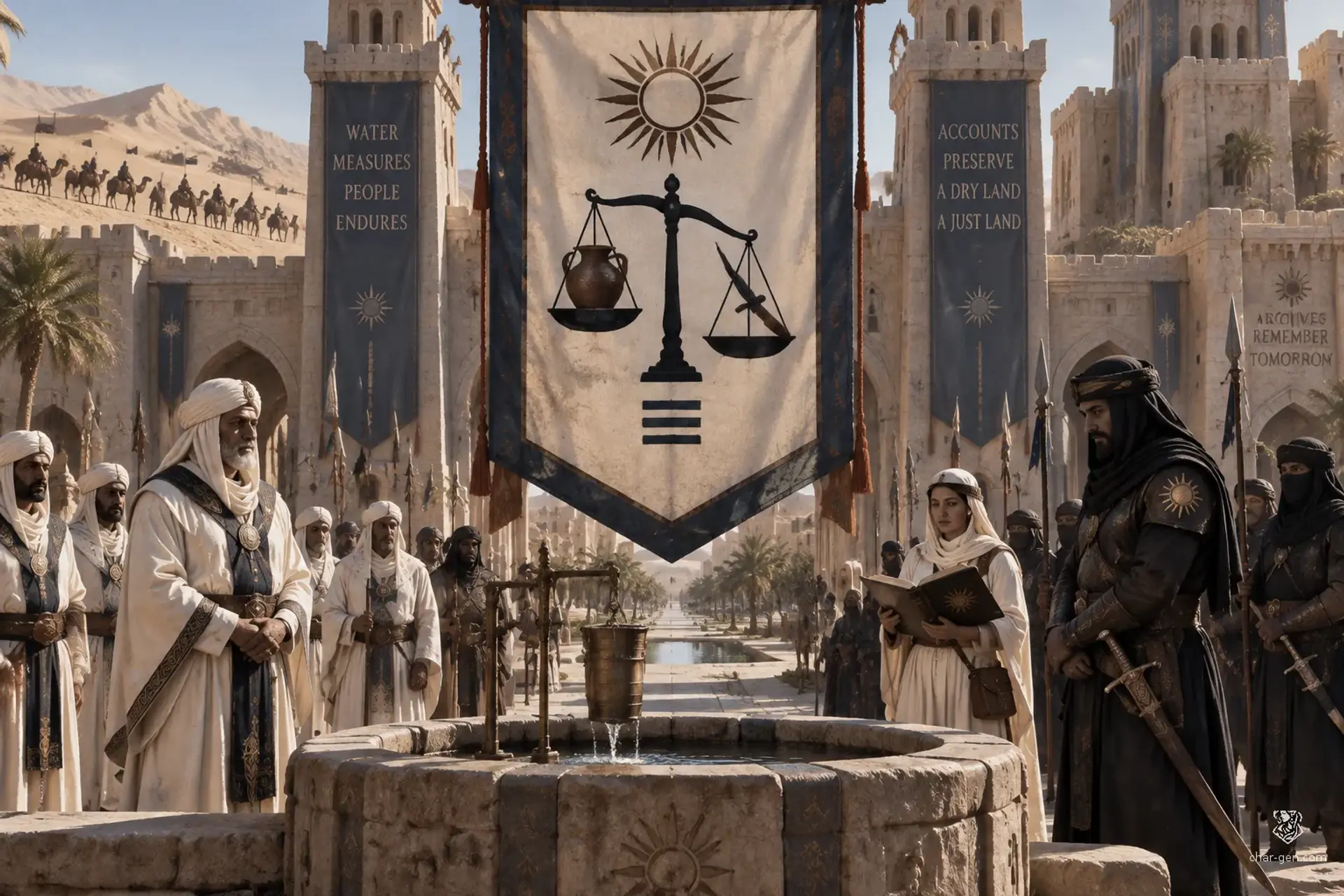
Sharakzar magistrates
The Sharakzar magistrates began as traveling arbiters and grew into a civil authority by making caravan law legible across scattered settlements. In the first decades, their judgments focused on water theft, debt, route injury, and disputes over responsibility for shared wells. They gained followers by keeping written copies of agreements and honoring rulings even when a caravan's patron was powerful. As trade expanded, the magistrates established fixed courts and armed escorts. That change brought security, but also turned a traveling court into an institution capable of imposing its will. Their greatest triumph was the execution of a wealthy heir after the Night of Three Measures, which demonstrated that status would not automatically shield a defendant. Their greatest setback followed a generation later, when an entire district refused to surrender accused healers. The resulting siege ended with the court's retreat and lasting distrust. Today, Sharakzar authority is strongest along the western caravan routes and weakest in remote settlements where local custom still governs.
Sharakzar magistrates
- Type
- Religious and civil…
- Size
- 803 members
- Reach
- Regional
- Base
- The western caravan district's largest oasis settlement
Overview
The Sharakzar magistrates began as traveling arbiters and grew into a civil authority by making caravan law legible across scattered settlements. In the first decades, their judgments focused on water theft, debt, route injury, and disputes over responsibility for shared wells. They gained followers by keeping written copies of agreements and honoring rulings even when a caravan's patron was powerful. As trade expanded, the magistrates established fixed courts and armed escorts. That change brought security, but also turned a traveling court into an institution capable of imposing its will. Their greatest triumph was the execution of a wealthy heir after the Night of Three Measures, which demonstrated that status would not automatically shield a defendant. Their greatest setback followed a generation later, when an entire district refused to surrender accused healers. The resulting siege ended with the court's retreat and lasting distrust. Today, Sharakzar authority is strongest along the western caravan routes and weakest in remote settlements where local custom still governs.
How it began
Sharakzar tradition says the magistracy began after the event remembered as the Night of Three Measures. Outsiders often call it a massacre, but the official account insists it was a rescue. During a season of failed wells, rival caravan captains met at a dry cistern to settle a dispute over the last water train. A sorcerer in one party's service allegedly caused the cistern stones to burst, killing several negotiators and flooding the chamber with dust. The surviving witnesses agreed to submit future disputes to one binding law and to forbid magic under penalty of death. The first magistrates were not conquerors but witnesses, tally-keepers, and judges who traveled with the caravans. Over time, their courts gained authority because traders needed predictable judgments and villages needed protection from armed escorts. The watershed moment came 63 years ago, when magistrates refused to pardon a wealthy caravan heir convicted of magical sabotage. His execution cost the institution its richest patron, but made its claim that law bound the powerful credible. It also taught the magistracy to rely on religious legitimacy and control of route records as much as force.
How to know them
sun-bleached ivory, deep indigo, rust red
- The black balance scale beneath a white sun
- A sealed water jar, used on official documents
- Three parallel marks, recalling the measures set out after the founding disaster
Standing
What they say they want
What they are doing now
Where it leads
A western desert in which a traveler can cross from well to well under one binding law, with water protected, disputes recorded, and no armed household above judgment. The official vision forbids magic altogether. Some members increasingly imagine a less absolute settlement, in which dangerous practices are regulated rather than hunted.
How others see them
Among merchants, the Sharakzar magistrates are known as reliable, strict, and difficult to bribe openly. Some villages value the protection their escorts provide; others remember raids, confiscations, and executions. Their public image is one of impartial order, but many see a civil authority using religious certainty to justify expanding its reach.
People
5 ranks
Presiding Judge of the High Bench
Patient, austere, and attentive to small signs of disrespect. He believes public certainty prevents violence, even when privately uncertain.
- The High Bench7 members
Sets legal doctrine, appoints senior judges, confirms executions, and decides when a district is considered subject to Sharakzar law. Major decisions require five votes; emergency decrees can be issued by three, but must later be reviewed.
- Route Magistrates34 members
Travel between caravan stations and settlements, hear civil disputes, inspect water measures, supervise trials, and command small escort details. Their written judgments can be appealed to the High Bench.
- Witness-Keepers112 members
Record testimony, maintain route and property rolls, translate local custom into court filings, and certify that sentences were carried out. Their records are a major source of institutional power.
- Road Wardens260 members
Guard courts, escort prisoners and couriers, protect wells, and enforce lawful sentences. They are not judges, although local commanders sometimes exert pressure on proceedings.
- Vow-Bearers390 members
Novices and lay adherents who maintain public water points, learn legal procedure, and serve as witnesses. Many never take full vows, but their labor and local knowledge sustain the institution.
Other key members
- Sethra Senior route magistrate and likely successor to the presiding judge
- Barek Dast Commander of the western road escort
- Chkhal Chief Witness-Keeper and keeper of sealed trial records
- Tamar Court advocate and negotiator with settlements
How they are organised
- Swear to record testimony faithfully, even when it harms a patron or ally.
- Refuse gifts connected to an active case and disclose any family or trade interest in a dispute.
- Accept that magic is prohibited under Sharakzar law, including when used by a fellow member.
- Complete a period of service at a public water point or on a caravan route.
Relations
7 factionsThe caravan houses rely on Sharakzar patrols to keep routes open and accept its court rulings when disputes threaten trade. Their support ends when magistrates interfere with profitable cargo.
Operations
What they do
How they do it
Services for hire
- Route ArbitrationA filing fee, waived for those who can demonstrate hardshipA recorded hearing for disputes over debt, trade, injury, water access, or property. A judgment may be appealed to a senior court.
- Road PassagePayment in coin, provisions, or a reciprocal serviceA guarded escort for couriers and travelers along recognized routes. Protection is not guaranteed outside the magistracy's jurisdiction.
- Witness CopyA sworn statement and a modest copying feeCertified copies of public judgments, route agreements, or water-rights records. Sealed and criminal records are excluded.
- Well VigilNo charge for urgent threats, but later testimony is expectedA public warning and limited protection for a well or caravan stop facing imminent attack. The magistrates may claim jurisdiction over any resulting dispute.
What they can do
What they have
Where they are weak
Territory
Headquarters
The western caravan district's largest oasis settlementA fortified court and archive built around a functioning well in the old western caravan district. Its public hall is open to petitioners, while the sealed archive beneath it contains trial records, route agreements, and confiscated magical objects. The complex has no grand palace: its authority is expressed through a shaded hearing court, a public water measure, and a raised platform where sentences are read.
Lands they hold
Outposts
- Three Measures StationA major crossing where two western caravan routes convergeThe name recalls the three public water measures said to have been set out after the Night of Three Measures. The station monitors cargo, water rights, and passage.
- Haddar's RestA remote chain of wells near the edge of settled territoryNamed for a forgotten surveyor whose work established the first reliable distances between wells. The outpost shelters couriers and records local disputes.
Secrets
Plot hooks
5 hooks- 1The Missing LinePersonal to regionalReward: A legal favor, access to court records, or protection from a pending accusationA novice Witness-Keeper asks the characters to find a missing page from an execution ledger before the High Bench seals the archive. The page could clear a condemned healer, but its disappearance may expose a respected magistrate's forgery.
- 2Water Without WitnessesLocalReward: Payment, route access, and influence with either the caravan houses or the magistratesA caravan has vanished between two protected wells. The magistrates blame magical raiders and demand an escort for a prisoner convoy. Evidence at the route suggests the caravan's own guards staged the attack to conceal stolen water rights.
- 3A Petition Before DawnPersonal and localReward: A lasting ally among settlement leaders or a formal warrant from the magistracyA settlement shelters a dying child accused of magic. The local court asks the party to carry a petition to the High Bench, while Road Wardens are already on their way to seize the child. Both sides claim that delay will lead to deaths.
- 4The First TestimonyRegionalReward: Access to forbidden historical records, a powerful patron, or leverage over the High BenchA sealed archive has been breached, and one confiscated object is missing. The Sharakzar magistrates ask for discreet help, but the object may be the only evidence that the founding account of the Night of Three Measures was altered.
- 5The Law of Three WellsCampaign-scaleReward: A treaty, control of a major route, or the chance to reshape regional lawThree districts plan to reject Sharakzar authority at once. The presiding judge wants the party to negotiate a new compact before the Road Wardens march. The caravan houses are secretly financing both sides to secure exclusive route rights after the dispute.
Work they offer
What gets in the way
Rumours
Media
0 imagesNo images yet.
Turn Sharakzar magistrates into a sheet
A high-res, share-ready sheet you can post or print.