
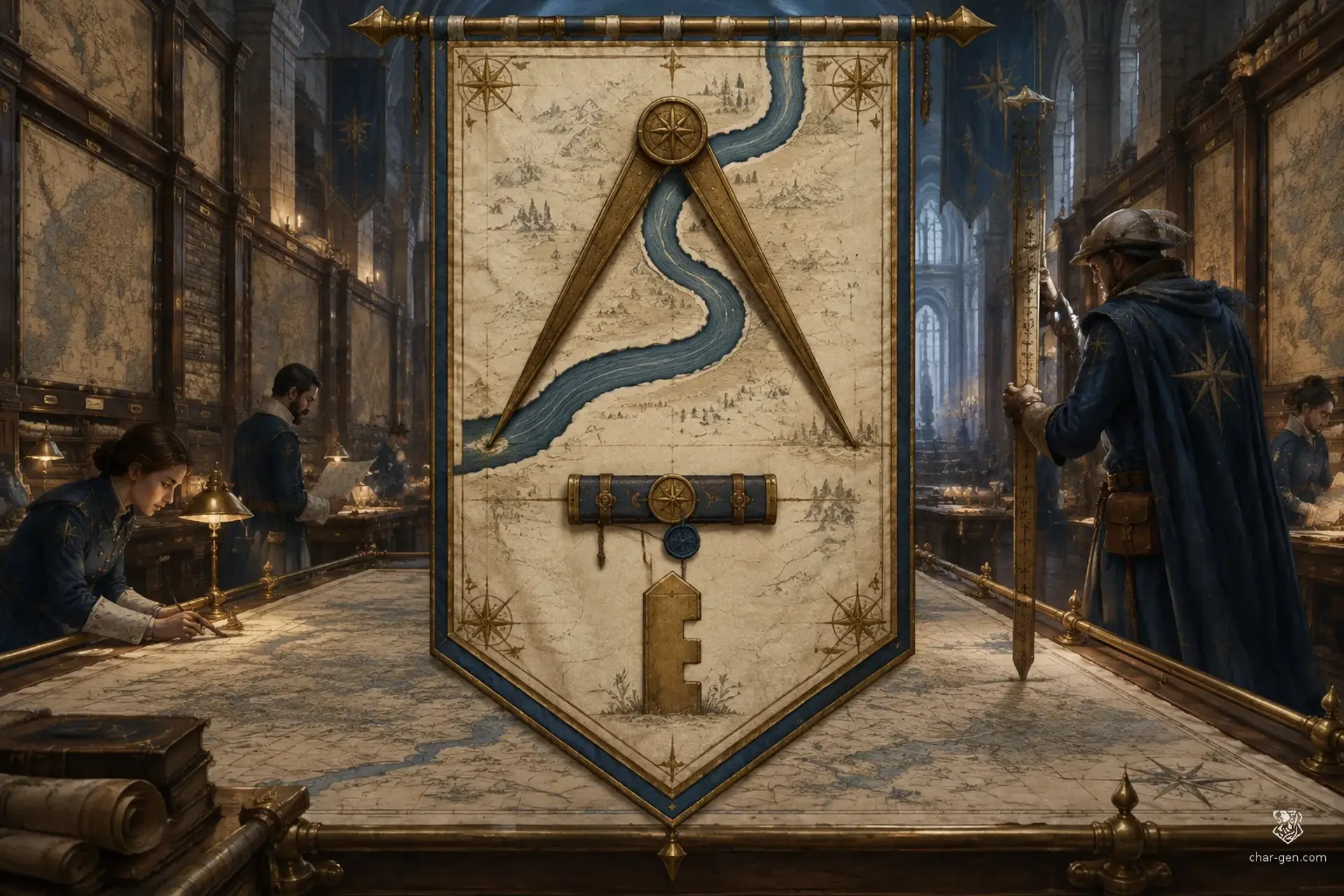
The Crown Survey Office
The Office grew from a small imperial surveying commission into the authority behind roads, tax districts, and provincial borders. Its triumph came in the Year of Two Floods, when coordinated route records allowed food caravans to reach several isolated towns despite washed-out bridges. The crown praised the Office as the empire's quiet instrument of unity. Its defining watershed was the Red Mile Decree, issued after a rebellion along the western road. The Office was ordered to redraw the boundary rolls so the crown could seize farms and clear a military corridor. Surveyors complied, but a junior copying clerk preserved the previous maps and smuggled them to displaced families. The scandal forced the crown to grant the Office custody of originals and made its seals indispensable in court. It also taught the Office that control of a map could outlast control of the land. As the empire weakened, provincial map houses began making their own copies and keeping local names alongside official ones. During the retreat from the outer provinces, central orders contradicted one another, and several map houses were abandoned. The Office survived by declaring itself a custodian of crown records rather than an arm of any particular ruler. Today its clerks serve the old imperial heartland, where its authority is still useful, feared, and increasingly contested.
The Crown Survey Office
- Type
- Government bureau
- Size
- Approximately 747 permanent clerks and…
- Reach
- High in the old imperial…
- Base
- The old imperial capital
Overview
The Office grew from a small imperial surveying commission into the authority behind roads, tax districts, and provincial borders. Its triumph came in the Year of Two Floods, when coordinated route records allowed food caravans to reach several isolated towns despite washed-out bridges. The crown praised the Office as the empire's quiet instrument of unity. Its defining watershed was the Red Mile Decree, issued after a rebellion along the western road. The Office was ordered to redraw the boundary rolls so the crown could seize farms and clear a military corridor. Surveyors complied, but a junior copying clerk preserved the previous maps and smuggled them to displaced families. The scandal forced the crown to grant the Office custody of originals and made its seals indispensable in court. It also taught the Office that control of a map could outlast control of the land. As the empire weakened, provincial map houses began making their own copies and keeping local names alongside official ones. During the retreat from the outer provinces, central orders contradicted one another, and several map houses were abandoned. The Office survived by declaring itself a custodian of crown records rather than an arm of any particular ruler. Today its clerks serve the old imperial heartland, where its authority is still useful, feared, and increasingly contested.
How it began
The Office began after the imperial armies returned from a disastrous eastern campaign with three incompatible maps of the same roads. Tax collectors, messengers, and soldiers each followed a different route, and a winter supply column vanished in the hills. Empress Avara ordered the surviving surveyors and royal clerks into one bureau, giving it authority to standardize mile counts, boundary rolls, and route books. Its first charter declared that a road properly recorded was a road the crown could reach. In practice, this meant that surveyors followed armies, measured conquered land, and converted local names into imperial entries.
How to know them
Ink blue, Old ivory, Dull brass
- A brass divider
- A blue route line
- A sealed ivory map case
- Three notches cut into a mile marker, marking distance, witness, and authority
Standing
What they say they want
What they are doing now
Where it leads
A heartland in which every road and boundary has a traceable record, and no ruler can casually erase a community by changing a map. The Office's leaders disagree about whether this requires a stronger crown, accountable local map houses, or a permanent neutral archive.
How others see them
To officials, the Office is indispensable, slow, and difficult to corrupt. To ordinary people, it can be a source of useful proof or a faceless institution whose ink makes a dispossession permanent. Its clerks are admired for their precision and distrusted for deciding which version of a place counts as official.
People
5 ranks
First Surveyor
Patient, controlled, and incisive. She asks for evidence when others want a promise, but her sense of institutional survival can make her cold.
- First Surveyor1 member
Directs the Office, certifies major surveys, and speaks for it before the crown. The First Surveyor cannot alter a sealed record alone.
- Seal Council7 members
Senior custodians of routes, boundaries, archives, standards, provincial houses, crown petitions, and internal discipline. Decisions require four seals.
- Provincial Masters43 members
Oversee map houses across the old imperial heartland, manage local survey teams, and reconcile field reports with central records.
- Chain Clerks186 members
Measure distances, copy maps, maintain mile registers, interview witnesses, and conduct routine surveys.
- Counters and Runners510 members
Maintain indexes, deliver sealed documents, staff public counters, and support field teams. Many are apprentices or temporary hires.
Other key members
- Sesh Keeper of the Restricted Index; a likely successor who could expose the Office's hidden archive.
- Ketta Chainmark Provincial Master of the southern roads; a rival to the central Seal Council.
- Gabor Quill Senior field surveyor and potential whistleblower.
- Nadi of the East Road Courier-master; controls the movement of sealed documents and knows which orders never arrived.
How they are organised
- Demonstrate basic skill in measurement, recordkeeping, or document handling.
- Swear not to falsify a survey for private gain, though members argue over what counts as falsification.
- Complete a supervised route walk and submit a legible field book.
- Accept that sealed originals belong to the Office, even when a member personally discovered them.
Relations
7 factionsThe palace chancery relies on the Office to establish which decrees apply where. The alliance is practical, not affectionate: each side keeps copies of the other's most damaging records.
Operations
What they do
How they do it
Services for hire
- Route ExtractA modest filing fee; waived at the discretion of a Provincial MasterChecks a traveler’s route against current reports and provides a certified copy of known crossings, tolls, and hazards.
- Boundary ReconciliationPetition fee, witness statements, and travel expenses for field surveyorsA formal comparison of competing boundary claims, including a report of available maps and witnesses. Certification does not guarantee the ruling will favor the petitioner.
- Archive SearchFee varies by age and status of the record; restricted originals require senior approvalSearches the archive for a historic route or boundary entry and provides a copy when permitted.
What they can do
What they have
Where they are weak
Territory
Headquarters
The old imperial capitalThe headquarters occupies a former toll archive in the old imperial capital. Its long, narrow rooms are built around locked map cabinets, a copying hall, and a public counter where petitioners submit boundary claims. Brass rails mark paths through the reading rooms so visitors cannot brush against open sheets. The upper floors hold the restricted route archive; a flood cellar below contains warped maps the Office officially lists as destroyed.
Lands they hold
Outposts
- Ferry Measure HouseA major river crossing in the old heartlandRecords bridge tolls, flood routes, and crossings. Its staff have been accused of changing the official river boundary after seasonal floods.
- Salt Mile OfficeA market town on the southern imperial roadMaintains road distances and caravan registers. It also provides a discreet meeting place for couriers carrying sensitive documents.
- Red Mile HouseThe former western military corridorKeeps the disputed surveys associated with the Red Mile Decree. Its current staff are instructed not to open the oldest cabinets.
Secrets
Plot hooks
4 hooks- 1The Orchard That Wasn't ThereLow to moderate; a local investigation with social pressure and a possible break-in.Reward: Payment, a favor from a provincial map house, or proof of a character's own disputed claim.A family hires the characters to find a missing field book that proves their orchard predates a crown boundary. The Office wants the book recovered too, but fears the family may be right.
- 2Two Seals on One StoneModerate; competing authorities, dangerous travel, and a choice about who receives the evidence.Reward: Access to restricted route records, legal standing, or the gratitude of displaced families.A road crew has uncovered a mile marker bearing two different official seals. The Office sends the characters to secure it before the succession court arrives, while local residents insist the marker records a secret mass displacement.
- 3The Road Outside the IndexModerate to high; wilderness travel, pursuit, and a consequential decision about disclosure.Reward: A route advantage, a political alliance, or leverage over a crown claimant.A courier carrying a map of an unregistered pass has vanished. The pass could shorten a military march, open a trade route, or let refugees evade a blockade. Several factions want the map for incompatible reasons.
- 4The Ledger Below the WaterlineHigh; investigation among powerful interests, with potential threats to the party and innocent landholders.Reward: A major political favor, a chance to reform the Office, or evidence capable of overturning land titles.The flood cellar's old ledger surfaces during repairs. Its entries connect respected officials to the Red Mile seizures. Toma asks the characters to verify the pages before the Seal Council can decide whether to suppress or publish them.
Work they offer
What gets in the way
Rumours
Media
0 imagesNo images yet.
Turn The Crown Survey Office into a sheet
A high-res, share-ready sheet you can post or print.