
The Third Bell
The Third Bell has little history, which is both its appeal and its weakness. Its founders were three caravan guards, two failed militia recruits, a hedge healer, and a mapmaker who had never left the region. They met after the rescue at the watch post and pooled their remaining coin to buy food, rope, and a secondhand map. Their first paid job was to escort a grain cart. They delivered it safely but lost their fee to a client who disputed the route they had taken. That failure produced the company’s first rule: every contract must name the work, the payment, and who bears the cost if circumstances change. Their second job, clearing a blocked culvert, paid little but earned them the goodwill of local carters. They became known as people who would take unglamorous work and stay until it was finished. Their watershed moment came during the warehouse rescue. The founders broke into the property using a forged work order, freed trapped laborers, and then stayed to help keep a fire from spreading to nearby homes. They gained the gratitude of the rescued workers and the attention of Dornel’s factor-house. Since then, arguments over whether their duty is to clients, the law, or people in immediate danger have shaped nearly every decision. Now the company is trying to grow without losing its reason for existing. Its charter is new, its purse is thin, and its reputation is still being written by whoever tells the story first.
The Third Bell
- Type
- New adventuring company
- Size
- Thirteen members and probationary…
- Reach
- Local and fragile
- Base
- A modest crossroads settlement on a busy trade road. The company has chosen it because travelers pass through daily, not because it is a safe or prestigious base.
Overview
The Third Bell has little history, which is both its appeal and its weakness. Its founders were three caravan guards, two failed militia recruits, a hedge healer, and a mapmaker who had never left the region. They met after the rescue at the watch post and pooled their remaining coin to buy food, rope, and a secondhand map. Their first paid job was to escort a grain cart. They delivered it safely but lost their fee to a client who disputed the route they had taken. That failure produced the company’s first rule: every contract must name the work, the payment, and who bears the cost if circumstances change. Their second job, clearing a blocked culvert, paid little but earned them the goodwill of local carters. They became known as people who would take unglamorous work and stay until it was finished. Their watershed moment came during the warehouse rescue. The founders broke into the property using a forged work order, freed trapped laborers, and then stayed to help keep a fire from spreading to nearby homes. They gained the gratitude of the rescued workers and the attention of Dornel’s factor-house. Since then, arguments over whether their duty is to clients, the law, or people in immediate danger have shaped nearly every decision. Now the company is trying to grow without losing its reason for existing. Its charter is new, its purse is thin, and its reputation is still being written by whoever tells the story first.
How it began
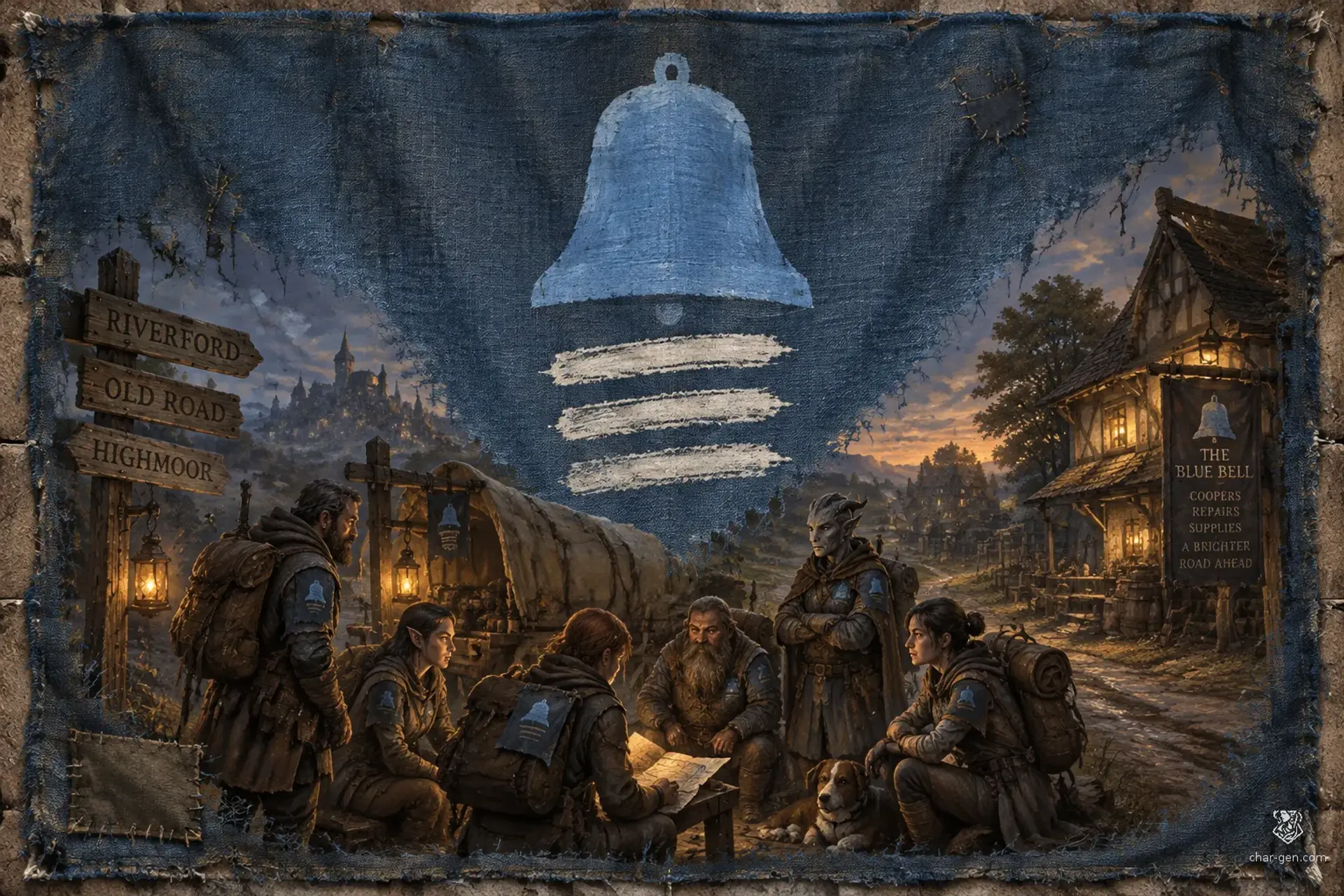
The name comes from a sound. On the night the company was formed, a loose bell in a closed roadside watch post rang three times in a windless storm. The founders later learned that the bell had been struck by a trapped traveler trying to attract help. The company’s first members heard it while arguing over whether a risky rescue was worth the cost. They went anyway, arriving too late to save the traveler but in time to free two other captives. They took the three rings as a warning: hesitation can be costly, but a call for help is not a contract to be weighed only in coin. They named themselves the Third Bell because the first two rings had been ignored by everyone else.
How to know them
- Dull blue, chosen because the first members dyed their mismatched cloaks with the same cheap vat.
- Chalk white, used for the three short marks they leave on a safe route.
- Three short chalk strokes
- A blue bell with no clapper
- A square of dull-blue cloth, usually worn on a pack rather than as a uniform
Standing
What they say they want
What they are doing now
Where it leads
Beskai imagines a small, trusted company able to take dangerous work without becoming dependent on a noble patron, merchant house, or local ruler. Orren imagines something less polished: a loose band that can always answer a call for help. Whether the Third Bell can become both remains an open question.
How others see them
A scrappy, earnest company that takes work larger groups consider beneath them. People admire that the members stayed after the warehouse rescue, though some doubt they know when to stop taking risks.
People
4 ranks
Bellkeeper
Measured, watchful, and stubbornly polite. She lets others mistake restraint for indecision, then acts once she has counted the likely costs.
- Bellkeeper1 member
Beskai holds the charter, negotiates contracts, and makes urgent field decisions. The title is elected every three months, but members can challenge the Bellkeeper’s decision at a full company meeting when time allows.
- Counters2 members
Orren and Tali track expenses, equipment, promises, and injuries. Either Counter may freeze a contract payment if the company cannot meet its agreed costs.
- Orren Vask Counter, scout, and likely challenger for leadership
- Tali Counter, quartermaster, and contract reader
- Roadhands3 members
The experienced field members lead watches, assess routes, and train applicants. They have practical authority on the road but no formal right to overrule the company meeting.
- The Unrung7 members
Applicants and probationary members who work alongside the company but cannot vote on major contracts. They must complete one supervised job and receive two member endorsements before full acceptance.
Other key members
- Sethra Roadhand and investigator
- Gwil Unrung applicant and aspiring guide
How they are organised
- Applicants must name someone they will not abandon without warning, so the company knows what obligations they bring with them.
- Applicants must complete a supervised contract and disclose relevant debts, warrants, or conflicts of interest.
- Full members must contribute a small agreed share of their earnings to food, repairs, and emergency care when they are able.
- Members may refuse a job, but must give a reason to the company if their refusal leaves another member exposed.
Relations
5 factionsA cautious arrangement: the shrine supplies basic healing and hears reports from travelers, while the company escorts its messengers. The shrine will end the arrangement if the adventurers bring trouble to its door.
Operations
What they do
How they do it
Services for hire
- Road escortNegotiated; usually a small fee plus meals and a clear agreement about delay or damage.A short escort for travelers or small cargo. The company is not large enough to guarantee safety against a serious armed force.
- Search and recoveryA modest advance for supplies, with the rest due when the search ends or a named milestone is reached.A search for missing people, lost property, or a route that has stopped reporting traffic.
- Site surveyUsually low, but members may refuse if the job appears to involve a trap or a client’s private feud.A first assessment of a dangerous site, including a written account of hazards and whether the company recommends further work.
What they can do
What they have
Where they are weak
Territory
Headquarters
A modest crossroads settlement on a busy trade road. The company has chosen it because travelers pass through daily, not because it is a safe or prestigious base.A rented loft above a cooper’s yard, reached by a steep outside stair. The room has six bedrolls, a table scarred by map knives, a locked chest for shared funds, and a board of jobs that is already crowded with crossed-out promises. The building’s lower floor smells of wet oak and vinegar. The loft is not defensible, and the neighbors can hear most arguments.
Lands they hold
Outposts
- The chalk marksThe market road and its nearby farmsNot a permanent outpost, but a set of agreed meeting points and route marks where members can leave short messages for one another.
Secrets
Plot hooks
5 hooks- 1A Place by the MapLow to moderate; a good opening job that can become a moral choice.Reward: Modest pay, a place among the Unrung, and a contact among local travelers.A character who is short on coin is offered a probationary place after the company’s guide is injured. The job seems simple: escort a medicine cart. The client has omitted that the road passes the site of the warehouse dispute, and the rescued workers recognize the cargo.
- 2Three Marks in the Wrong PlaceModerate; investigation, social pressure, and a choice about public trust.Reward: A useful local contact, evidence of a rival’s scheme, or leverage in the company’s internal vote.A shopkeeper claims the company’s three chalk marks led thieves to a hidden cache. The marks were copied by someone else, and the accused member insists they were nowhere near the route. The party can investigate the theft, defend the member, or discover who has learned to imitate the signal.
- 3The Ledger Under AshModerate to high; dangerous travel, competing claims, and consequences for witnesses.Reward: A substantial fee, evidence against the factor-house, or protection for the people named in the ledger.A client offers enough money to replace the company’s gear if the adventurers recover a locked ledger from a burned way station. The ledger may prove the factor-house financed the warehouse confinement, but another faction wants it destroyed before the names inside are exposed.
- 4Who Rang First?Campaign scale; faction politics, personal loyalties, and a potentially manufactured scandal.Reward: A leadership alliance, a repaired company reputation, or access to the wider network behind the forgery.The Bellkeeper is accused of accepting a bribe to abandon a contract. The accusation comes from a missing applicant and is backed by a forged receipt. The company divides over whether to defend Beskai, suspend her, or let the constables investigate. The real author may be trying to force a leadership change before a larger crisis.
- 5Three CallsHigh in consequences rather than combat; timing and hard choices drive the scenario.Reward: Lasting community support, a new rival, and a defining change to the company’s charter.The company receives three separate pleas for help on the same night: a stranded family on the road, a missing courier, and a fire in a laborers’ quarter. Their members can reach only one in time. The party’s choice will define what the Third Bell means to its supporters and may determine whether the Unrung remain.
Work they offer
What gets in the way
Rumours
Media
0 imagesNo images yet.
Turn The Third Bell into a sheet
A high-res, share-ready sheet you can post or print.