
Elder-Clan Moot
The Elder-Clan Moot began as a promise between clans whose survival depended on shared routes. Over time, its oath customs grew into a confederation: a clan could keep its own laws and hunting grounds, but it could not knowingly endanger a passage another clan needed for migration or warning. The Moot's influence grew as it mapped root bridges and stone spans through repeated journeys, preserving route knowledge in chants, stories, and ritual recitation rather than in a single map that could become obsolete. Its defining watershed came when an unknown threat drove prey animals and several clans onto the same narrow passage. According to the preserved account, the clans abandoned a long-standing boundary dispute, formed a single defensive line, and held the span long enough for the vulnerable to cross. The Moot refuses to agree on the threat's exact nature, but every clan remembers the oath renewed there: a route may be contested, never casually broken. Later generations established deep-trackers and spirit-callers as recognized duties, allowing the alliance to respond beyond the reach of any one clan. The Moot gained authority by warning settlements of dangerous shifts and by driving raiders from vital trails. That authority also brought resentment. Its keepers began restricting access to hunting grounds and oral histories, arguing that careless disclosure could invite exploitation. In recent years, leyline disturbances and unstable gravity have made old knowledge less reliable. The Moot is now forced to choose between adapting its traditions and enforcing them more strictly, while both choices threaten the trust that holds its clans together.
Elder-Clan Moot
- Type
- Saurian alliance
- Size
- Large
- Reach
- High within the deep…
- Base
- A council ground on the Wedge Span, a meeting place named for the stone that splits the old trail there.
Overview
The Elder-Clan Moot began as a promise between clans whose survival depended on shared routes. Over time, its oath customs grew into a confederation: a clan could keep its own laws and hunting grounds, but it could not knowingly endanger a passage another clan needed for migration or warning. The Moot's influence grew as it mapped root bridges and stone spans through repeated journeys, preserving route knowledge in chants, stories, and ritual recitation rather than in a single map that could become obsolete. Its defining watershed came when an unknown threat drove prey animals and several clans onto the same narrow passage. According to the preserved account, the clans abandoned a long-standing boundary dispute, formed a single defensive line, and held the span long enough for the vulnerable to cross. The Moot refuses to agree on the threat's exact nature, but every clan remembers the oath renewed there: a route may be contested, never casually broken. Later generations established deep-trackers and spirit-callers as recognized duties, allowing the alliance to respond beyond the reach of any one clan. The Moot gained authority by warning settlements of dangerous shifts and by driving raiders from vital trails. That authority also brought resentment. Its keepers began restricting access to hunting grounds and oral histories, arguing that careless disclosure could invite exploitation. In recent years, leyline disturbances and unstable gravity have made old knowledge less reliable. The Moot is now forced to choose between adapting its traditions and enforcing them more strictly, while both choices threaten the trust that holds its clans together.
How it began
The Moot's oldest account tells of a season when the deep routes failed one by one. Root bridges split, familiar caverns shifted, and hunters returning from the lower passages brought stories of a presence that followed their scent. Several clans, previously rivals over hunting grounds, met at a broad stone span where a wedge-shaped rock divided the trail. They swore a blood oath to keep the passages open for migration, to warn one another of threats, and to set limits on the taking of prey. The first agreement did not make them one people. It made each clan answerable when its choices endangered the others.
How to know them
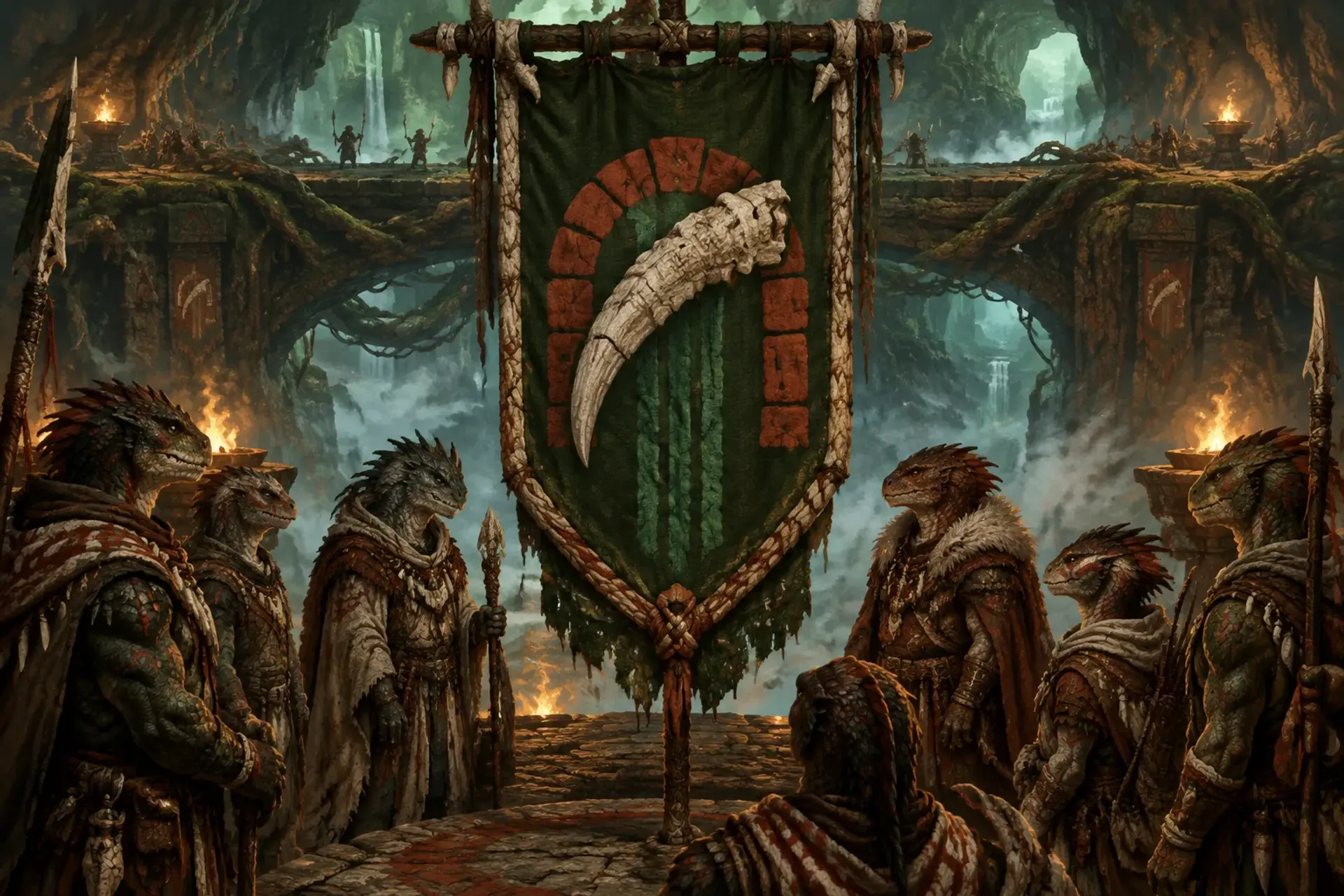
Deep green, Clay red, Pale bone
- The bone claw crossing a red stone arch.
- Three parallel green marks, representing the root-ways held in common.
- A knotted strip of hide worn by oath witnesses during major gatherings.
Standing
What they say they want
What they are doing now
Where it leads
A confederation strong enough to protect the root-ways without becoming a power that owns them. The Moot hopes to preserve clan sovereignty, keep dangerous knowledge alive, and pass on a living understanding of the Nexus rather than a frozen set of rules. Whether its current leaders can reconcile those aims remains unsettled.
How others see them
To the clans, the Moot is a hard but necessary guardian of shared paths and inherited obligations. To many outsiders, it is an imposing confederation that can appear territorial, secretive, and quick to punish trespass. Those who travel with its trackers often discover that its rules are precise rather than arbitrary, though the Moot rarely explains every reason before demanding obedience.
People
5 ranks
High War-Chieftain
Blunt, steady under pressure, and protective of those who have sworn the oath. He values clear commitments and can mistake caution for disloyalty when lives are at stake.
- The Twin Voices2 members
High War-Chieftain Korash Ridge-Breaker directs defense and action against immediate threats. First Speaker Mor'gath the Wise interprets oath, history, and custom. Neither can permanently bind every clan alone; major decisions require the Moot's assent.
- Mor'gath the Wise First Speaker; Female Saurian, Level 16 Circle of the Land Druid
- Elder Seats18 members
Clan elders speak for their lineages, arbitrate disputes, preserve local histories, and decide whether a matter threatens the confederation as a whole.
- Path-Keepers120 members
Experienced scouts and route wardens maintain passage knowledge, guide authorized travelers, mark hazards, and carry warnings between clans.
- Spirit-Callers360 members
Ritual specialists maintain oath observances, tend ancestral remembrance, and help interpret signs from the land. Their authority is respected but contested when their readings conflict.
- Clan-Bound1 member
The remaining members are warriors, hunters, craftspeople, elders in training, and their kin. Duties vary by clan and circumstance; the count includes the whole active confederation, not merely fighters.
Other key members
- Tavik Path-Keeper and likely successor among the younger trackers
- Oruyem Elder-history keeper
- Zulei of the Reed Stand Spirit-caller and mediator between clans
How they are organised
- Be accepted by a member clan or formally adopted into one.
- Swear to respect the blood oath, including obligations to warn other clans when a route is threatened.
- Learn the boundaries and customs relevant to one's assigned territory.
- Accept that protected passages and hunting grounds may not be entered without permission.
- For roles involving oral histories, demonstrate care in preserving testimony and willingness to hear conflicting clan accounts.
Relations
9 factionsThe Root-Sovereigns exchange warnings about unstable passages and negotiate which routes may be crossed. The alliance is practical and sometimes strained: the Moot expects visitors to obey hunting boundaries, while Root-Sovereigns resist any claim that old custom grants the clans authority over every deep route.
Operations
What they do
How they do it
Services for hire
- Passage guidanceA spoken promise to honor the route rules, often accompanied by a useful offering or a reciprocal service.A trained tracker can guide approved travelers through a known section of the deep routes and identify obvious signs of recent disturbance.
- Clan warningA favor to a clan, an agreed share of recovered supplies, or a service of comparable value.The Moot can carry a warning between clans or to a nearby settlement, provided the message does not expose protected oral histories.
- Ancestral counselPermission from the relevant clan and a clear account of the proposed work.A spirit-caller or elder may help interpret a local ritual tradition or determine whether a disturbance resembles a known account. The Moot does not claim every sign has a single certain meaning.
What they can do
What they have
Where they are weak
Territory
Headquarters
A council ground on the Wedge Span, a meeting place named for the stone that splits the old trail there.The Moot has no permanent seat. Its principal gatherings take place on a broad, naturally level stone span above a root-choked cavern. Clan standards hang from the bridge's rough sides, smoke from cooking fires carries the sharp smell of resin and meat, and a ring of worn stones marks where speakers stand. When the Moot adjourns, the fires are scattered and the bridge returns to its ordinary work as a crossing.
Lands they hold
Outposts
- The Split RootA broad root bridge overlooking a mist-filled cavern on a primary migration route.A rotating watch station where path-keepers track movement and carry messages between nearby clans.
- Red Tooth SpanAn ancient stone span above a narrow passage used by prey animals and clan hunters.A seasonal hunting camp and warning post. Its name comes from a tooth-shaped red stone that protrudes from the bridge's edge.
- The Reed StandA sheltered hollow beneath a tangle of old roots near a traditional deep-hunting passage.A quiet place for spirit-callers to tend ritual observances and receive clan messengers.
Secrets
Plot hooks
4 hooks- 1The Summons at the CrossingPersonal; suitable for a single character or a short party missionReward: Restored standing, access to a route guide, or a debt owed by one clanA character who once crossed a restricted route receives a formal summons from a Path-Keeper. The Moot offers a choice: help recover a lost patrol and explain the trespass before the Elder Seats, or face a clan hearing without the evidence that might clear them.
- 2Tracks on the StoneLocal; exploration, negotiation, and a dangerous confrontationReward: Information about unstable routes, a trusted local contact, or permission to cross a protected passageA hunting party disappears near Red Tooth Span. The tracks suggest something moved against gravity, yet the elders' accounts disagree about which passage it entered. The party must travel with a Moot tracker, resolve a dispute over jurisdiction, and find out whether the vanished hunters are alive.
- 3The Instrument in the RootsRegional; investigation and faction diplomacy under time pressureReward: A working lead on the Nexus disturbance, support from one faction, or safe access to the affected areaA group of arcanists claims that a device they installed can identify the source of a leyline disturbance. The Moot orders it removed, while nearby residents fear that dismantling it will worsen the instability. The characters must inspect the device, establish what it is doing, and prevent the dispute from turning violent.
- 4The Voice Beyond the RouteCampaign-scale; requires trust-building, investigation, and consequential choicesReward: The Moot's alliance, a major revelation about the deep Nexus, or a lasting change in the clans' lawsA newly discovered oral account describes the forbidden passage and a threat that may be returning. The history-keepers will not disclose the complete version, and Korash is assembling a force to seal the route by destroying its entrance. The party can uncover the missing testimony, persuade the leaders to cooperate, or decide that the danger demands immediate action.
Work they offer
What gets in the way
Rumours
Media
0 imagesNo images yet.
Turn Elder-Clan Moot into a sheet
A high-res, share-ready sheet you can post or print.