
The Third Roadwardens
The roads of the Ninth Sheet were surveyed before the Wardens existed. Their original markers were meant to make travel possible between settlements whose written records were incomplete, inconsistent, or held by distant authorities. Over time, routes shifted, settlements moved, and the markers remained. The Road Keepers once maintained bridges and roadside shelters, while the Third Survey Office checked distances and marker faces. Neither group could command enough labor to do both jobs. During a period of failed harvests, arguments over who was responsible for a missing wayhouse became a fight over whether a whole settlement should be supplied at all. The resulting Surveyor's Truce merged the two organizations into The Third Roadwardens. Their defining moment came during the famine years. A patrol discovered that an original marker directed travelers toward a settlement that had lost its stores and could no longer support arrivals. The Wardens' predecessor had to choose between honoring the marker and sending desperate people into danger. They removed it. The settlement survived the winter, but the act was treated as an assault on the authority of the survey. The Wardens were founded soon afterward with a charter allowing them to report hazards, but not to alter original markers without a council's approval. For a generation they gained trust by maintaining practical routes, escorting supply trains, and keeping the roads open through local crises. Their best-known triumph was a coordinated chain of patrols that carried warning of a washed-out crossing faster than any official messenger network. Their greatest setback followed when a senior patrol leader sold copies of route records to private toll collectors. The scandal led to strict custody rules for maps and a lasting suspicion of anyone who asks to copy them. Today, The Third Roadwardens are small, respected, and stretched thin. They protect the main surveyed roads and the settlements that rely on the original markers, but they cannot keep every path safe. Their old success has made them an authority in practice, even as their charter insists they are only custodians.
The Third Roadwardens
- Type
- Road guild and civic patrol
- Size
- Small regional organization
- Reach
- Regional
- Base
- A junction settlement where the main surveyed roads meet
Overview
The roads of the Ninth Sheet were surveyed before the Wardens existed. Their original markers were meant to make travel possible between settlements whose written records were incomplete, inconsistent, or held by distant authorities. Over time, routes shifted, settlements moved, and the markers remained. The Road Keepers once maintained bridges and roadside shelters, while the Third Survey Office checked distances and marker faces. Neither group could command enough labor to do both jobs. During a period of failed harvests, arguments over who was responsible for a missing wayhouse became a fight over whether a whole settlement should be supplied at all. The resulting Surveyor's Truce merged the two organizations into The Third Roadwardens. Their defining moment came during the famine years. A patrol discovered that an original marker directed travelers toward a settlement that had lost its stores and could no longer support arrivals. The Wardens' predecessor had to choose between honoring the marker and sending desperate people into danger. They removed it. The settlement survived the winter, but the act was treated as an assault on the authority of the survey. The Wardens were founded soon afterward with a charter allowing them to report hazards, but not to alter original markers without a council's approval. For a generation they gained trust by maintaining practical routes, escorting supply trains, and keeping the roads open through local crises. Their best-known triumph was a coordinated chain of patrols that carried warning of a washed-out crossing faster than any official messenger network. Their greatest setback followed when a senior patrol leader sold copies of route records to private toll collectors. The scandal led to strict custody rules for maps and a lasting suspicion of anyone who asks to copy them. Today, The Third Roadwardens are small, respected, and stretched thin. They protect the main surveyed roads and the settlements that rely on the original markers, but they cannot keep every path safe. Their old success has made them an authority in practice, even as their charter insists they are only custodians.
How it began
The name The Third Roadwardens comes from the unwanted merger of two failed organizations, the Road Keepers and the Third Survey Office. When flood, fever, and hunger scattered the first two attempts to maintain the roads, their remaining members were ordered to combine under a single charter. They kept the number in the name as a warning against pretending this was a clean beginning. The Wardens say their founding was not a heroic oath but a practical bargain: someone had to walk the roads, check the markers, and tell settlements when a route had become a lie.
How to know them
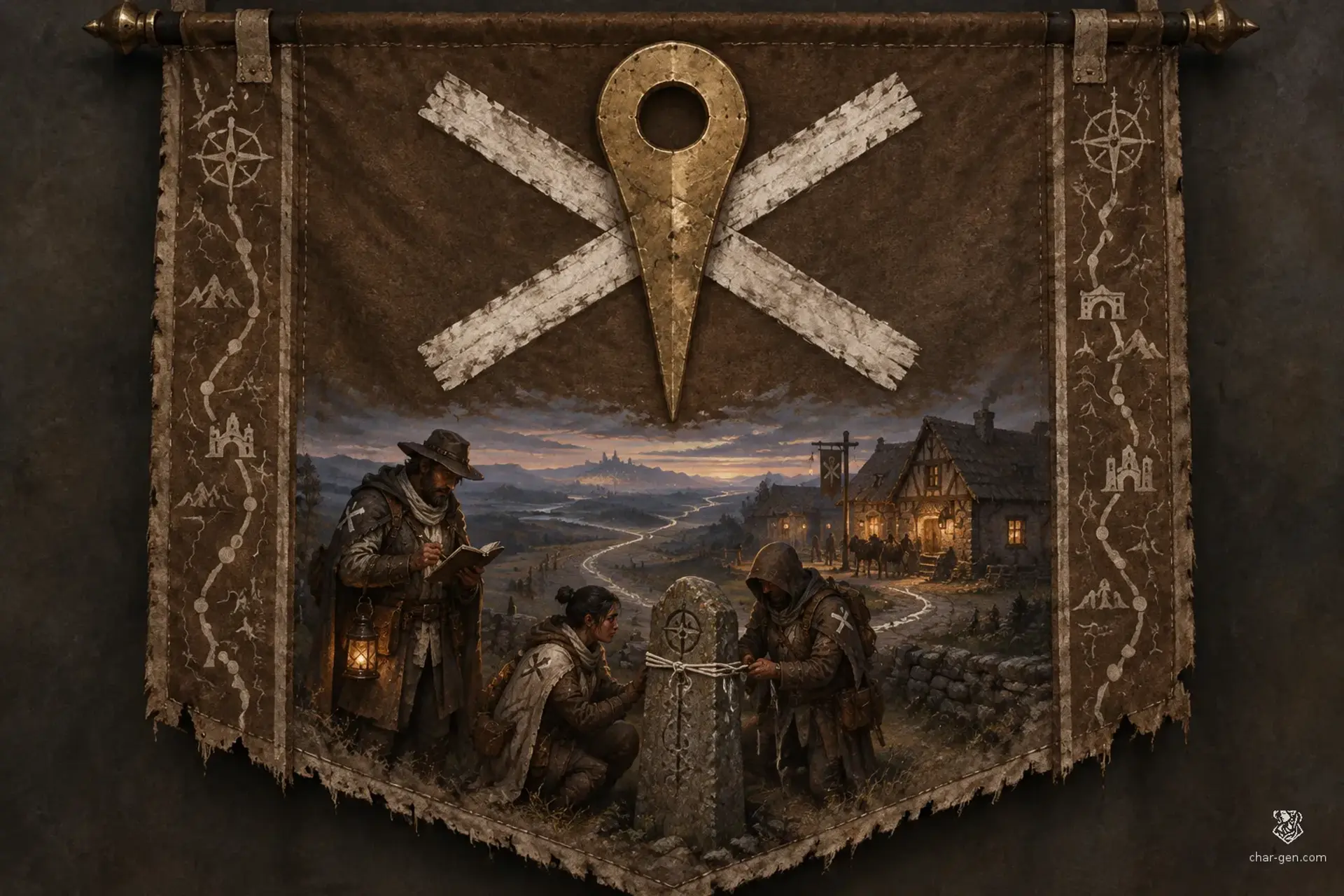
Chalk white, Road-dust brown, Dull brass
- A brass road pin worn at the collar or on a travel strap
- Two crossed white bars painted on wayhouse doors
- A short length of pale cord tied to a marker when a route has been temporarily closed
Standing
What they say they want
What they are doing now
Where it leads
A road system people can trust because its markers are checked, its dangers are reported honestly, and no settlement is abandoned merely because it lies beyond a convenient route. The Wardens disagree on whether this vision requires preserving the original survey or giving communities a formal say in revising it.
How others see them
Generally respected as practical, stubborn protectors who know the roads better than anyone else. Some travelers see them as the only reason a journey is possible; isolated communities see them as gatekeepers who decide which places deserve to remain connected.
People
5 ranks
First Warden
Patient, plainspoken, and difficult to hurry. Oru prefers a small, verifiable promise to a grand declaration and takes the blame for decisions made under their watch.
- First Warden1 member
Sets patrol priorities, negotiates with settlement councils, and may order an emergency closure. The title is elected by the senior route officers, not inherited.
- Route Stewards5 members
Each oversees a portion of the surveyed roads, assigns patrols, reviews marker reports, and resolves disputes between local crews.
- Marker Readers18 members
Inspect original markers, compare them with rubbings and records, and train patrols to notice tampering. They hold unusual influence because the older signs are not always self-explanatory.
- Road Companions42 members
Travel in pairs or trios, escort vulnerable travelers, report hazards, and keep settlements informed about closures and safe passage.
- Wayhouse Hands27 members
Maintain stores, care for animals, repair equipment, copy records, and host travelers. Many are former patrol members or dependents of the road communities.
Other key members
- Vaskel Surn Senior Marker Reader and likely successor
- Iver Route Steward for the southern roads
- Kosk Road Companion and patrol organizer
How they are organised
- Complete a probationary journey along a surveyed road with an experienced patrol.
- Learn the basics of marker inspection, hazard reporting, and safe escort practice.
- Swear not to knowingly falsify a route report or sell a copy of the patrol records.
- Accept that the organization cannot promise protection beyond the roads it can actually patrol.
Relations
7 factionsA loose association of settlement councils that depends on the main surveyed roads to move food and news. Its members supply shelter and local guides, but resent the Wardens' authority to close a route.
Operations
What they do
How they do it
Services for hire
- Marker inspectionUsually a modest fee, a promised favor, or supplies for the next patrolA Warden checks a marker, records its condition, and reports whether the route is currently considered reliable.
- Road escortNegotiated with the travelers and the settlement receiving themA patrol accompanies a small group along a surveyed stretch, sharing warnings and helping them avoid known hazards.
- Road noticeA small donation or contribution of food, repair materials, or local informationTravelers receive current route warnings, closure notices, and reports of missing bridges or unsafe shelters.
What they can do
What they have
Where they are weak
Territory
Headquarters
A junction settlement where the main surveyed roads meetTheir headquarters is a squat, repaired wayhouse built around an old survey table. Its walls hold rubbing copies of marker faces, patrol ledgers, and a public board listing closures. One room is kept locked for damaged originals. The Wardens claim it is a conservation store; a few senior members know it also contains records that contradict the official maps.
Lands they hold
Outposts
- Junction wayhouseAt a main-road crossing where several settlements exchange goodsCoordinates patrol assignments, stores supplies, and posts the latest route warnings.
- The dry-road shelterAt a long stretch between settled areasOffers water, basic repairs, and a place for travelers to leave messages for the next patrol.
- The marker shedBeside a road with several disputed markersKeeps tools and rubbing copies for inspection crews. Its public records are incomplete by deliberate policy.
Secrets
Plot hooks
5 hooks- 1The Sign That LiedLow to moderateReward: A personal favor, safe passage, and access to a patrol's local knowledgeA new recruit asks the characters to witness a patrol oath, then confesses that their family has been accused of altering a marker. The evidence is convincing, but the family claims the original sign has pointed toward a washed-out crossing for years.
- 2A Closed RoadModerateReward: Payment, local standing, or a lasting alliance with one sideA settlement's food caravan has not arrived. The Wardens say the road is closed because a marker has been tampered with. The settlement council claims the closure is fabricated to force them into a new supply compact. The party must inspect the route, identify the real danger, and decide whose account to make public.
- 3The Paper in the SaddlebagModerate to highReward: Evidence, political leverage, and the trust of Kosk or the leadershipKosk has a copy of a suppressed closure order and wants help delivering it to a council delegate. The document could expose a cover-up, but it also contains patrol names that would endanger people still working the route.
- 4The Unlisted LineHighReward: A discovery with regional importance, a route through dangerous territory, or influence over the new road's futureA chain of copied markers appears to describe a road absent from every known map. The Wardens want a discreet survey. A settlement council wants the route opened immediately, while private toll collectors are already charging for access.
- 5The Marker Beneath the FloorHigh, campaign-scaleReward: A major change to road policy, a powerful ally, or a public reckoning with the Wardens' historyAn original marker has been removed, and the people who did it insist they are preventing travelers from reaching a settlement that cannot support them. The Wardens' own founding story suggests the accusation may be true. The party must find the settlement, verify its condition, and decide whether to expose the old precedent.
Work they offer
What gets in the way
Rumours
Media
0 imagesNo images yet.
Turn The Third Roadwardens into a sheet
A high-res, share-ready sheet you can post or print.