
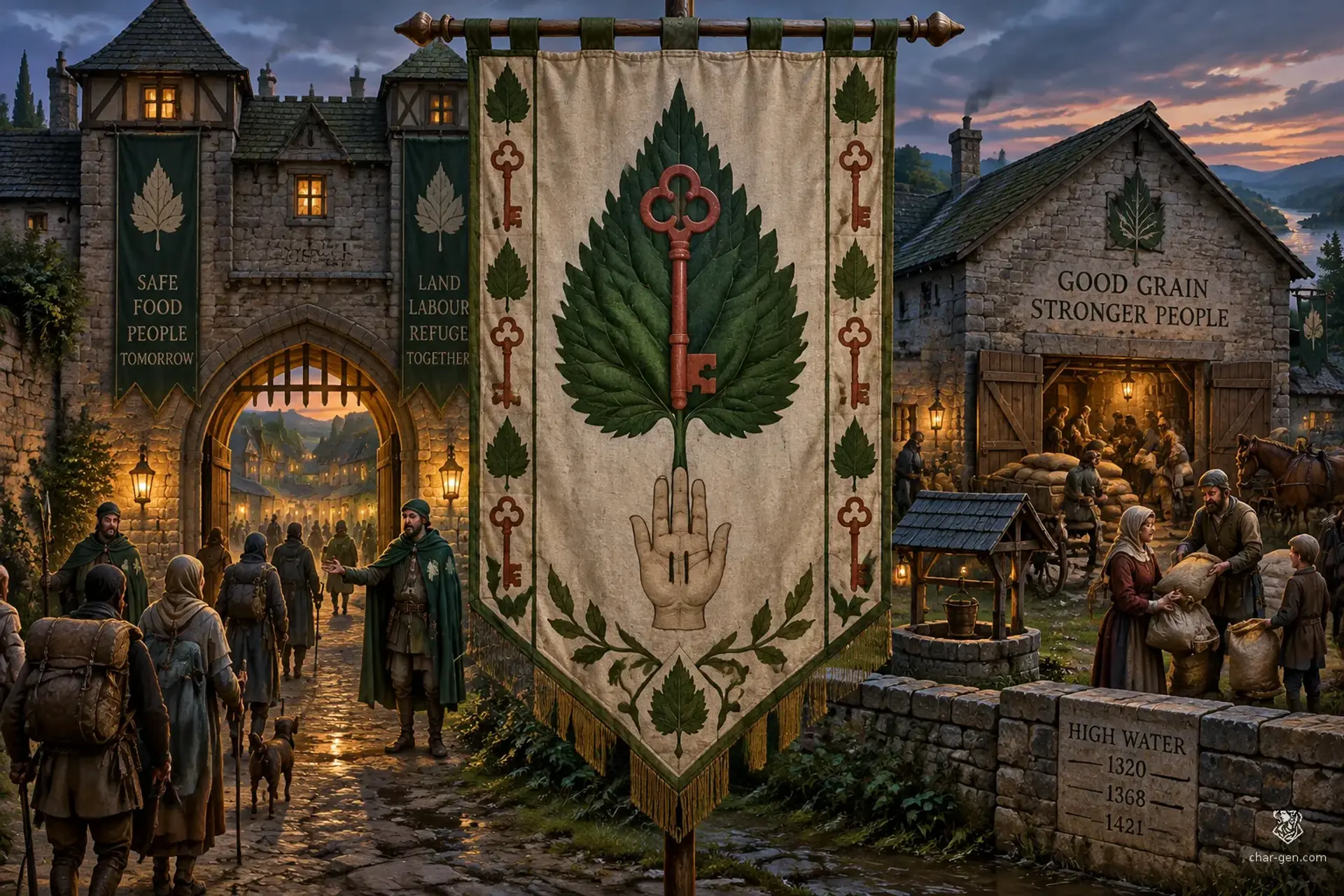
House Nettle
House Nettle began as a modest border family, made influential by its grain stores and the refuge established by Lady Targit. Over the next century, its heirs traded military service for rights to maintain roads and granaries. They became unusually useful to successive monarchs: Nettle could move food quickly, settle local disputes without sending royal troops, and produce reliable accounts in years when other nobles hid their harvests. Its first great triumph came during the Three Thaw Famine, when spring floods destroyed the lowland crop. The family opened its stores and organized boats to carry grain into isolated villages. The house's ledgers record the relief as a loan; village songs call it a gift. This disagreement still shapes how people understand Nettle's generosity. The watershed moment was the Salt Years, a seven-year conflict over food taxes and the crown's attempt to requisition private stores. House Nettle falsified its grain books, sheltered organizers of a tax refusal, and used its road wardens to keep royal collectors away from several villages. The monarch eventually granted the family a permanent role in emergency provisioning, but also required it to swear never to use food as political pressure. Nettle publicly accepted the restriction. A concealed clause in the settlement gave the family considerable discretion over what counted as an emergency. In the following generations, the house grew from a border estate into a national presence. It established waystations, negotiated tenant protections, and married into older noble lines. Its growing wealth brought new contradictions: it fought predatory levies while charging its own rents, and offered refuge while expecting labor and loyalty in return. A later head of house attempted to replace hereditary estate managers with elected local stewards. The reform collapsed after several estates withheld dues, and the family restored much of the old structure. Today, House Nettle is large enough to influence national food policy but divided over what its influence is for. Some members want a more accountable house that yields authority to tenant councils. Others believe only strong hereditary leadership can protect people when the crown fails. The missing original charter threatens both camps, because it may prove that the house's first right to collect dues was never freely granted.
House Nettle
- Type
- Noble House
- Size
- 1,267 members
- Reach
- National
- Base
- Kestrelwick, a market settlement named for the kestrels that nest in its granary eaves
Overview
House Nettle began as a modest border family, made influential by its grain stores and the refuge established by Lady Targit. Over the next century, its heirs traded military service for rights to maintain roads and granaries. They became unusually useful to successive monarchs: Nettle could move food quickly, settle local disputes without sending royal troops, and produce reliable accounts in years when other nobles hid their harvests. Its first great triumph came during the Three Thaw Famine, when spring floods destroyed the lowland crop. The family opened its stores and organized boats to carry grain into isolated villages. The house's ledgers record the relief as a loan; village songs call it a gift. This disagreement still shapes how people understand Nettle's generosity. The watershed moment was the Salt Years, a seven-year conflict over food taxes and the crown's attempt to requisition private stores. House Nettle falsified its grain books, sheltered organizers of a tax refusal, and used its road wardens to keep royal collectors away from several villages. The monarch eventually granted the family a permanent role in emergency provisioning, but also required it to swear never to use food as political pressure. Nettle publicly accepted the restriction. A concealed clause in the settlement gave the family considerable discretion over what counted as an emergency. In the following generations, the house grew from a border estate into a national presence. It established waystations, negotiated tenant protections, and married into older noble lines. Its growing wealth brought new contradictions: it fought predatory levies while charging its own rents, and offered refuge while expecting labor and loyalty in return. A later head of house attempted to replace hereditary estate managers with elected local stewards. The reform collapsed after several estates withheld dues, and the family restored much of the old structure. Today, House Nettle is large enough to influence national food policy but divided over what its influence is for. Some members want a more accountable house that yields authority to tenant councils. Others believe only strong hereditary leadership can protect people when the crown fails. The missing original charter threatens both camps, because it may prove that the house's first right to collect dues was never freely granted.
How it began
House Nettle traces its beginning to a lean winter in which Lady Targit, then a minor landholder, opened the stores of her fortified manor to families fleeing a burned border district. The manor's yard was choked with nettles, and local people supposedly joked that even the weeds were better fed than the refugees. Targit ordered the nettles cut back, but left a strip beside the gate so arrivals could find the refuge in snow. The family adopted the plant as its sign. The story is repeated at every household oath, though the original records show that Targit also demanded military service from able-bodied refugees. Her descendants emphasize the shelter. Her critics remember the price.
How to know them
Nettle green, Undyed linen, Rust red
- A green nettle leaf, for endurance and the stubborn life that persists in poor soil
- A rust-red key, for the promise of shelter
- An open palm marked with three short lines, used by Open Door escorts to identify safe meeting points
Standing
What they say they want
What they are doing now
Where it leads
House Nettle wants a kingdom where no village can be starved into obedience and no family must flee a violent lord without a place to go. Its private vision is less modest: a durable network of local councils, safe roads, and public granaries with Nettle as their trusted coordinator. The unresolved question is whether the house imagines itself as a steward of that network or its permanent master.
How others see them
Most common people regard House Nettle as stern but dependable. Its agents keep records, pay for grain when they can, and are known to open doors in a crisis. Other nobles consider it meddlesome and self-righteous, especially when it protects tenants who challenge local authority. At court, the family is praised as a stabilizing force and criticized as a private power that has learned to dress ambition as charity.
People
7 ranks
Lady of the Open Key
Controlled, patient, and difficult to surprise. She can be genuinely generous, but treats trust as a resource that must be spent carefully. She is more comfortable arranging a practical remedy than offering an apology.
- The Hearth Council9 members
The head of house, three adult family members, two senior stewards, two tenant delegates, and the household chaplain decide policy. The leader may act alone in an immediate emergency, but must justify the decision at the next sitting. Council votes are not legally binding on the family head, yet defying a united council can cause estates to stop remitting revenue.
- The Branches38 members
Members of the extended family manage estates, negotiate marriages, serve at court, and maintain local obligations. They can recommend candidates for the Hearth Council but cannot appoint the next head without the family's succession rite.
- The Stewards146 members
Accountants, reeves, healers, legal clerks, granary keepers, and estate managers administer the house's lands. Their records give them quiet power. A steward who controls the ledgers can make a family policy work or fail without openly disobeying it.
- The Gate and Road230 members
Household guards, messengers, caravan escorts, and watch captains protect the estates, granaries, and refuge routes. They are trained to escort before they are trained to fight, but many are veterans of border conflicts.
- The Bound Households620 members
Tenant families, craft workers, cooks, stable hands, and other estate residents make up the largest body associated with the house. They are not all members in a legal sense. Each estate chooses one delegate to carry petitions to the local steward.
- The Open Door74 members
A small, mostly itinerant group maintains refuge houses, escorts displaced people, and verifies claims of danger. It answers formally to the Hearth Council but has developed its own traditions and sometimes shelters people the council would rather turn away.
- The Oathbound180 members
Knights, sworn retainers, and their attendants owe personal service to the head of house. Their obligation is understood to include defending tenants, though some argue that the oath only protects the family and its lands.
Other key members
- Kest Vard Tenant delegate on the Hearth Council and advocate for binding local votes
- Nesk Senior steward and keeper of the sealed ledgers
- Ulla of Reedmere Roadwarden of the Open Door
- Pekka Nettle Younger family heir and court representative
- Gundrek Captain of the Oathbound
How they are organised
- Family members must swear the household oath and accept the Hearth Council's duty to hear tenant petitions.
- Stewards must keep honest accounts, including records of food given away or lost. Deliberate falsification is grounds for dismissal, though the Salt Years remain a contested exception.
- The Open Door accepts people of any origin who can keep a confidence, follow safety instructions, and treat other refugees without abuse.
- Retainers must swear to defend the house's dependents as well as its lands. The meaning of dependents is disputed.
- Tenants are not required to pledge personal loyalty to the family, despite some local stewards implying otherwise.
Relations
8 factionsThe royal household relies on House Nettle's grain reserves and trusted local stewards during famine. The alliance is practical, not devotional: the house will refuse a royal order it believes would starve its tenants.
Operations
What they do
How they do it
Services for hire
- Open Door shelterA modest fee, waived for people in immediate dangerA bed, hot food, and a discreet assessment of whether the visitor needs a new route, a witness, or a hearing.
- Reserve grainMarket price during ordinary seasons; reduced or deferred after a failed harvestGrain released from a household store, with local stewards recording recipients and quantities. In a crisis, the house may require a village to nominate a trusted keeper.
- Ledger hearingUsually an agreed share of recovered funds or a reciprocal serviceA clerk reviews rent, debt, or levy documents and identifies disputed charges. The house cannot guarantee a favorable ruling, especially when a royal court has jurisdiction.
- Road passagePayment for supplies, or a sworn favor for those under Open Door protectionA guarded escort between estate towns, refuge houses, and major market roads. Escorts prioritize safety and discretion over speed.
What they can do
What they have
Where they are weak
Territory
Headquarters
Kestrelwick, a market settlement named for the kestrels that nest in its granary eavesThe ancestral seat is a broad, low-walled manor built around a public granary, a well, and a paved refuge yard. It is more defensible than its plain exterior suggests: stores lie below the central court, and the old gatehouse can be sealed independently from the family wing. The oldest wall stones are marked with shallow cuts that function as flood gauges. The east range houses tenant petitioners and visitors who cannot safely sleep in the town. The house calls this hospitality; several neighboring nobles call it a private court.
Lands they hold
Outposts
- The Bracken GateA dry rise beside the southern trade roadA guarded waystation that offers food, beds, and fresh mounts to messengers and families traveling under Open Door protection.
- The Reed StoresThe old ferry crossing on the eastern floodplainA small granary and boat shed used to move provisions when roads are submerged. Its accounts are kept separately from the main estate books.
- The Bent Key HouseA market town near the royal highwayA townhouse where petitioners can consult a clerk, deliver sealed complaints, or ask for an escort to the manor.
Secrets
Plot hooks
6 hooks- 1The Vanished TallyLow to moderateReward: Payment, access to the house's records, and a favor from the affected villageA tenant family has been ordered to leave its home before winter, despite holding a written agreement that should protect it. A junior steward asks the characters to find the missing estate ledger before the eviction becomes violent.
- 2A Door Left OpenModerateReward: Safe-conduct, information, and a chance to secure a lasting allyA frightened traveler carries a sealed message naming a royal official who sold famine grain during the Salt Years. House Nettle offers safe passage, but a member of the Open Door insists the traveler is being used to conceal a more recent crime.
- 3Empty BinsModerateReward: Coin, supplies, and influence with a regional steward or tenant councilA granary's stores are lower than the ledgers claim, and local families will soon go hungry. The characters must determine whether the grain was stolen, secretly distributed, or claimed by a neighboring authority before accusations spark a riot.
- 4The First KeyHighReward: A major political favor, the charter's evidence, or leverage over a national factionThe original Nettle charter is rumored to be hidden in a sealed manor cellar. Targit quietly hires the party to find it, while Pekka asks them to bring any copy they discover to the royal court instead.
- 5The Salt OathCampaign scaleReward: National reputation, political allies, and the power to influence food policyDuring a national shortage, the crown orders House Nettle to surrender its reserves. The Hearth Council splits over compliance. The characters may be asked to escort grain, investigate whether the emergency is genuine, or keep rival retainers from fighting in the streets.
- 6Names Scratched AwayModerate to highReward: Trust of the Open Door, access to its routes, and evidence against a powerful household memberSomeone is removing names from the Open Door's refuge rolls. One missing person is a witness to abuse by a noble branch; another may be a spy. The party must find them before the house's internal dispute turns into a public scandal.
Work they offer
What gets in the way
Rumours
Media
0 imagesNo images yet.
Turn House Nettle into a sheet
A high-res, share-ready sheet you can post or print.