
The Waymarks
In the years after the flood, the Waymarks worked as a loose band of guides and problem-solvers. Their first major triumph came when they escorted a winter grain train through a pass held by bandits, then returned to rescue the bandits' own sick children rather than leave them to die. The story made them popular among ordinary people and unpopular with several powerful merchants. As requests spread across neighboring settlements, informal promises became difficult to manage. Teams began accepting work beyond their abilities, and clients learned to describe dangerous jobs as simple errands. The guild adopted its grading system after the Bell Quarry disaster, in which a team of six entered a supposedly abandoned quarry and triggered a chain of cave-ins. Two members died and several miners were trapped. The guild's inquiry found that the client had withheld evidence of underground activity, but also that the team had lacked anyone with experience assessing unstable tunnels. The resulting system required assessors to grade the danger, uncertainty, and likely consequences of each quest, not just its apparent difficulty. The system became the guild's defining practice. Its grades helped newer adventurers find suitable work, made clients disclose more, and gave experienced teams a way to reject a task without appearing cowardly. Over time, the guild established outposts at settlements along the regional roads. Its watershed moment came at Sable Ford, when a local tax collector seized a refugee camp's supplies and threatened to imprison anyone who resisted. Guild members broke the camp's prisoners out, carried food across the ford, and destroyed the collector's list of families. The guild was praised by the people it saved and condemned by officials who called it a private army. Since then, the Waymarks have tried to remain independent and helpful without becoming a political power. That balance is now under pressure: some settlements rely on them as a public service, while others resent their growing authority.
The Waymarks
- Type
- Regional adventurers' guild
- Size
- 160 members
- Reach
- Regional
- Base
- Darrow's Crossing
Overview
In the years after the flood, the Waymarks worked as a loose band of guides and problem-solvers. Their first major triumph came when they escorted a winter grain train through a pass held by bandits, then returned to rescue the bandits' own sick children rather than leave them to die. The story made them popular among ordinary people and unpopular with several powerful merchants. As requests spread across neighboring settlements, informal promises became difficult to manage. Teams began accepting work beyond their abilities, and clients learned to describe dangerous jobs as simple errands. The guild adopted its grading system after the Bell Quarry disaster, in which a team of six entered a supposedly abandoned quarry and triggered a chain of cave-ins. Two members died and several miners were trapped. The guild's inquiry found that the client had withheld evidence of underground activity, but also that the team had lacked anyone with experience assessing unstable tunnels. The resulting system required assessors to grade the danger, uncertainty, and likely consequences of each quest, not just its apparent difficulty. The system became the guild's defining practice. Its grades helped newer adventurers find suitable work, made clients disclose more, and gave experienced teams a way to reject a task without appearing cowardly. Over time, the guild established outposts at settlements along the regional roads. Its watershed moment came at Sable Ford, when a local tax collector seized a refugee camp's supplies and threatened to imprison anyone who resisted. Guild members broke the camp's prisoners out, carried food across the ford, and destroyed the collector's list of families. The guild was praised by the people it saved and condemned by officials who called it a private army. Since then, the Waymarks have tried to remain independent and helpful without becoming a political power. That balance is now under pressure: some settlements rely on them as a public service, while others resent their growing authority.
How it began
The guild began when a spring flood swept away three bridges and trapped the hamlets along the Lorn road. A caravan guard named Hadrik Vale gathered ferrymen, hunters, and a discharged soldier to carry messages, guide stranded travelers, and bring back anyone lost in the floodplain. They marked safe paths with cuts in pale roadside posts. The locals called the helpers the Waymarks, after the markers they left behind. When the flood receded, the group kept taking dangerous work, because the road was still full of bandits, beasts, and people who needed help.
How to know them
Deep blue, Cream, Rust red
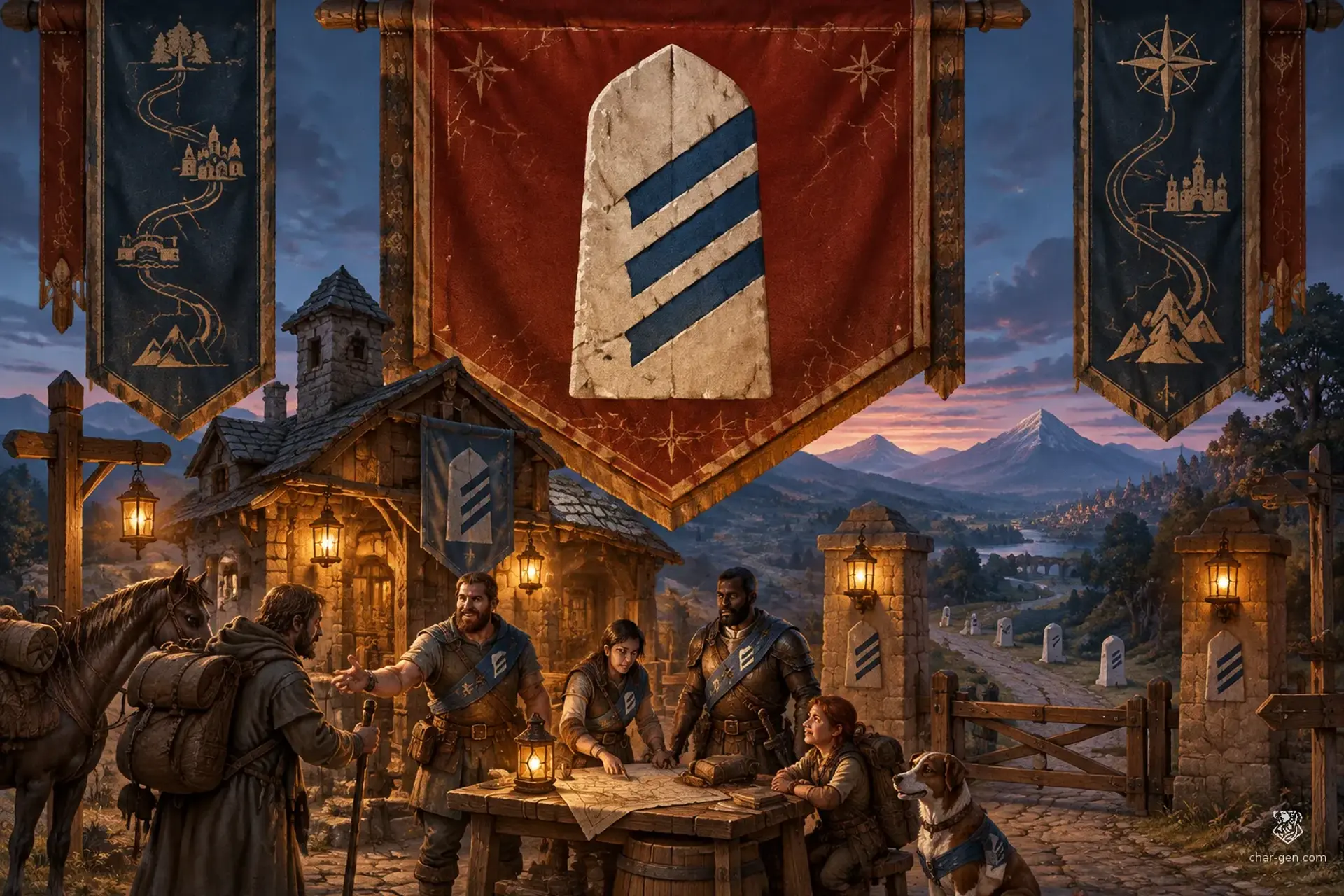
- Three diagonal cuts on a pale waymarker
- A blue thread tied around a traveler's wrist to show guild membership
- A small rust-red lantern hung outside an outpost when rescue teams are needed
Standing
What they say they want
What they are doing now
Where it leads
A network of capable local teams, connected by shared standards and trusted information, so no settlement has to face a crisis alone. The guild wants to be a dependable public good without becoming an army, a government, or a tool of wealthy clients.
How others see them
Among travelers and ordinary residents, the Waymarks are known as practical helpers who show up when the road turns dangerous. Merchants value their reports but complain about their fees and caution. Officials often respect their competence while worrying that their independence makes them difficult to control.
People
7 ranks
First Waymark
Practical, compassionate, and stubborn about promises. She dislikes grand speeches and has little patience for people who treat adventurers as disposable.
- First Waymark1 member
The elected head of the guild, responsible for setting priorities, representing the guild to local authorities, and deciding whether to suspend a dangerous quest. The First Waymark cannot change a quest grade alone.
- Road Council6 members
Senior members who oversee finances, recruitment, training, safety, settlements, and records. Major policy requires four of six votes, and a grade dispute requires an assessor's written evidence.
- Assessors12 members
Experienced adventurers who inspect requests, interview clients, estimate hazards, assign quest grades, and review completed work. They can issue an urgent provisional grade, subject to later review.
- Masters31 members
Veteran members trusted to lead high-risk work, mentor other teams, and take command during emergencies. A master can refuse a quest without losing standing.
- Journeymen49 members
Established members qualified to lead ordinary assignments and serve as mentors to newcomers. They may take quests alone or form teams.
- Greenhands43 members
Probationary members who take supervised work, learn guild procedure, and demonstrate that they can protect fellow team members as well as complete objectives.
- Roadkeepers18 members
Quartermasters, clerks, healers, stable hands, and messengers who keep the guild functioning. They are full members, though they do not need an adventurer's field grade.
Other key members
- Oluwase Chief Assessor
- Sissel Varn Master and likely successor
- Tomi of Wrenbank Outpost keeper and possible internal dissenter
How they are organised
- Applicants must provide a reference from a member, a local community leader, or two people willing to vouch for their character.
- Applicants must complete an interview about how they handle risk, teamwork, and a client who cannot pay.
- Field applicants must complete supervised work as Greenhands before seeking a higher grade.
- All members agree to report serious hazards accurately and to avoid abandoning a teammate solely to protect a reward.
- The guild does not require a particular ancestry, faith, homeland, or adventuring profession.
Relations
8 factionsThe company hires their guides for dangerous routes, while the guild helps recover missing caravans. The partnership is strained because the guides sometimes conceal which roads they consider sacred.
Operations
What they do
How they do it
Services for hire
- Route and Risk AssessmentFree for urgent rescue requests when the applicant cannot pay; otherwise a modest fee based on ability and risk.The guild reviews a route, request, and available reports, then provides a written hazard estimate. This is useful guidance, not a guarantee of safety.
- Quest PostingNegotiated in advance; hardship cases may be funded from the guild's relief fund.The guild assembles a suitable team for escort, recovery, investigation, or protection work and records the agreed scope of the job.
- Roadhouse SupportFree for members; small fees for nonmembers when supplies allow.Outposts offer a bed, basic field supplies, maps, and current warnings. They are not secure fortresses and may be crowded during emergencies.
- Records SearchFree for members; barter accepted from travelers in need.A clerk checks the guild archive for known hazards, routes, previous reports, and unresolved questions about a location.
What they can do
What they have
Where they are weak
Territory
Headquarters
Darrow's CrossingThe headquarters occupies a former tollhouse beside a busy regional crossroads. Its ground floor holds a public quest board, a map room, a plain dining hall, and a bench where travelers can request aid. Upstairs are bunk rooms, a small infirmary, a records vault, and an enclosed training yard. The old toll gates remain in place, though the guild uses them to hang lanterns during night watches.
Lands they hold
Outposts
- Harth DeskThe old weigh station outside the market town of HarthReceives local requests, posts road and monster reports, and coordinates escorts for travelers.
- Ford RoomA rented loft beside the ferries at Sable FordSupports river crossings, missing-person searches, and urgent aid for settlements on either bank.
- Pass ShedA former charcoal shed near the northern passTracks weather, landslides, and dangerous creatures along the mountain route.
Secrets
Plot hooks
5 hooks- 1The Quiet ErrandPersonal to regionalReward: Guild standing, payment, and evidence about the altered quest noticesA Greenhand asks the characters to help find her missing mentor, who vanished after taking a modestly graded herb-gathering quest. The route is dangerous, and the original client insists the mentor never reached the site.
- 2A Grade Too LowLocalReward: Coin, local trust, and access to the well's hidden routeA village posts a low-grade request to clear an old well. The assessor finds signs that something intelligent is using the tunnels, but the village council refuses to pay for a higher-grade expedition. The characters must decide whether to investigate, negotiate, or walk away.
- 3Names Left BlankRegionalReward: Safe passage, a serious ally, and a choice about the guild's legal standingA master asks the party to escort a refugee family to safety without recording their names. At the same time, an official demands the guild's travel records and threatens to close the local outpost.
- 4The Second LedgerCampaign-scaleReward: Leverage over local officials and the chance to reshape the guild's futureA sealed copy of the Sable Ford records appears on the quest board with no client listed. The Council orders it removed. Bryn asks the characters to find out who posted it before the magistrate learns it exists.
- 5The Price of a MapPersonal to regionalReward: High payment, access to secret intelligence, or continued guild trustA rival broker offers the characters a lucrative contract based on confidential guild reports. The job is legitimate, but taking it may reveal the identity of a source who has been warning the guild about ambushes.
Work they offer
What gets in the way
Rumours
Media
0 imagesNo images yet.
Turn The Waymarks into a sheet
A high-res, share-ready sheet you can post or print.