
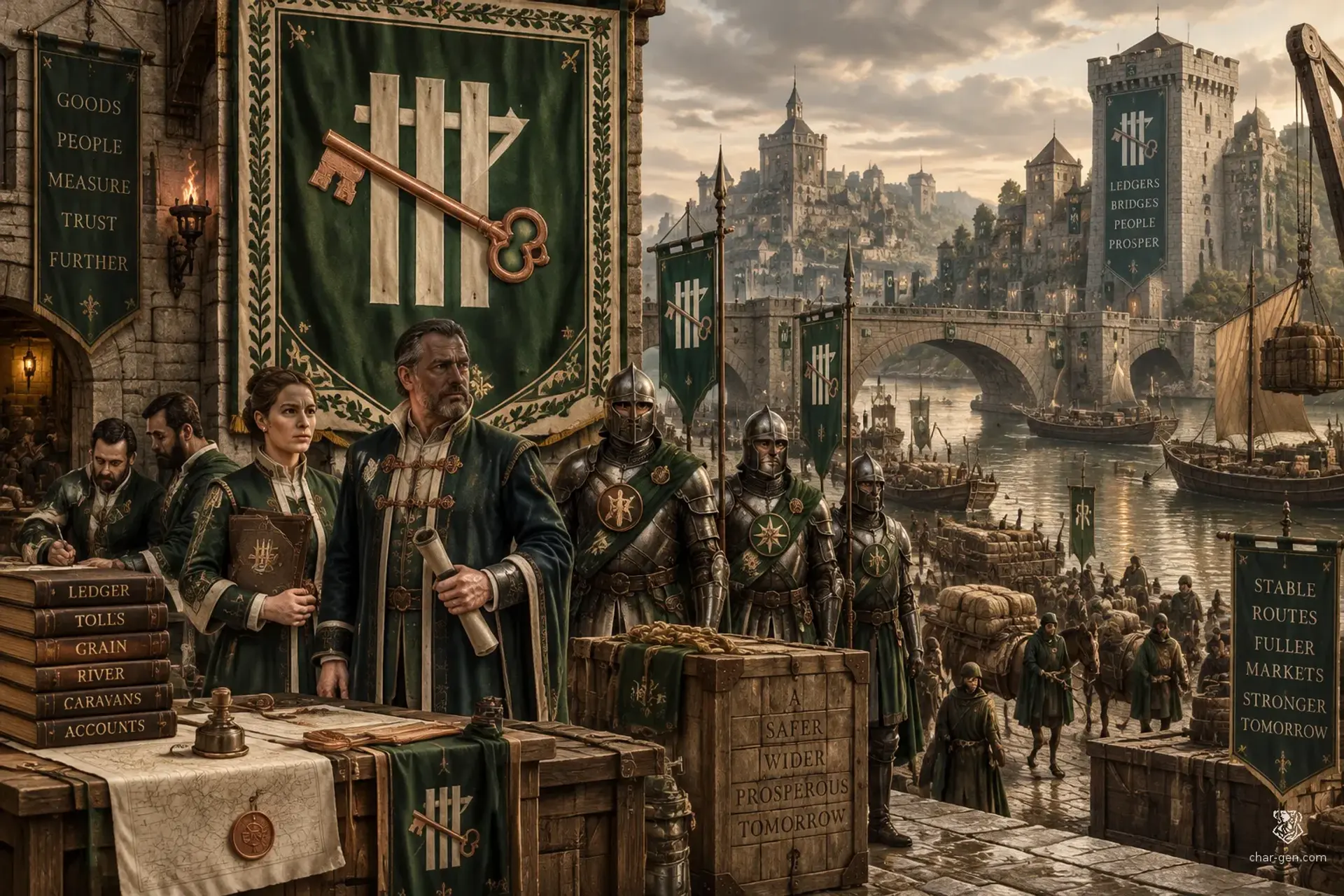
Eastern Trade Consortia
The original road compact grew into a federation of counting houses by offering reliable weights, common contracts, and guarded caravans. Its first great triumph was the opening of a mountain pass after a succession of local toll wars. The Consortia paid to repair the road, then secured a long lease on its gates. Over generations, its loans funded rulers' wars and its clerks became indispensable to customs offices. The watershed moment came 61 years ago during the Ash-Reed Settlement. After a border famine, the Consortia negotiated a truce between rival states by releasing grain from its warehouses, but only after both rulers signed sweeping rights to inspect cargo, standardize tolls, and station chartered knights at key crossings. The settlement ended the fighting and saved thousands, while turning emergency concessions into permanent law. A later failed expedition into the western marshes cost the Consortia several depots and exposed how dependent its power was on local cooperation. Today it is immense, wealthy, and increasingly brittle: rulers resent its privileges, independent traders evade its rules, and its knightly ranks disagree over whether their duty is to defend commerce or enforce the Board's will.
Eastern Trade Consortia
- Type
- Continental trade…
- Size
- 1,500 members
- Reach
- Continental
- Base
- The city of Reedford, named for the stubborn reed beds beside its ford.
Overview
The original road compact grew into a federation of counting houses by offering reliable weights, common contracts, and guarded caravans. Its first great triumph was the opening of a mountain pass after a succession of local toll wars. The Consortia paid to repair the road, then secured a long lease on its gates. Over generations, its loans funded rulers' wars and its clerks became indispensable to customs offices. The watershed moment came 61 years ago during the Ash-Reed Settlement. After a border famine, the Consortia negotiated a truce between rival states by releasing grain from its warehouses, but only after both rulers signed sweeping rights to inspect cargo, standardize tolls, and station chartered knights at key crossings. The settlement ended the fighting and saved thousands, while turning emergency concessions into permanent law. A later failed expedition into the western marshes cost the Consortia several depots and exposed how dependent its power was on local cooperation. Today it is immense, wealthy, and increasingly brittle: rulers resent its privileges, independent traders evade its rules, and its knightly ranks disagree over whether their duty is to defend commerce or enforce the Board's will.
How it began
The Consortia's accepted founding account begins with a winter when the eastern roads iced over and three rival caravans were trapped at a narrow ford marked by a stand of reed that locals could never clear. Their captains agreed to pool guards, stores, and pack animals until the thaw. A clerk recorded each contribution on a single tally board, and the captains swore to honor the shares even after the danger passed. That first compact became a route-sharing association, then a lender, then a power that could decide which caravans were allowed to travel at all. The story is taught as a lesson in cooperation. Private records suggest the captains also agreed to drive out independent carriers once the roads reopened.
How to know them
Deep green, Old ivory, Dull copper
- The tally board, signifying recorded obligation
- The copper key, signifying access to chartered routes
- A green cord worn by factors who are authorized to negotiate contracts
Standing
What they say they want
What they are doing now
Where it leads
A continent where every major good, route, and exchange passes through a dependable common system administered by the Consortia. Its ideal future is peaceful and predictable, but it leaves little room for communities to refuse the terms of that peace.
How others see them
Among merchants, the Consortia is praised for reliable weights, dependable escorts, and contracts that are honored across borders. Common laborers see it as a distant power that can turn a missed payment into a life sentence. Rulers regard it as useful, wealthy, and increasingly difficult to dismiss. Its public face is orderly commerce; its shadow is the realization that whoever controls the routes can decide who eats.
People
5 ranks
First Factor
Calm, attentive, and almost impossible to provoke. She remembers small kindnesses and old debts with equal care. Her sense of order is sincere, but she regards consent as a luxury when the survival of the system is at stake.
- The High Board13 members
Sets continental policy, approves war and major lending, and appoints senior factors. Votes are weighted by chartered capital, although the presiding chair can delay a vote on grounds of risk.
- Route Factors96 members
Manage national and regional trade offices, negotiate local privileges, audit depots, and report to the High Board. Their offices compete fiercely for profitable routes.
- Counting Houses430 members
Clerks, brokers, assessors, contract witnesses, and warehouse stewards who run the everyday commercial network.
- Caravan and Port Hands780 members
Drivers, pilots, guards, teamsters, porters, cooks, and skilled laborers. Many are free workers; some are bound to long service by debt contracts.
- Chartered Knights185 members
Elite mounted and foot officers who protect convoys, enforce charter judgments, and guard senior factors. Their five ranks are Copper, Steel, Gold, Platinum, and Onyx.
Other key members
- Borin Marshal of the Chartered Knights
- Kezdren of the Split Rock Route Factor for the northern crossings and a leading advocate of expansion
- Muna Copper Knight captain and organizer of a quiet reform circle
- Vargel Reed Onyx Knight commander
How they are organised
- Accept the Consortia's standard contract and submit to its internal arbitration.
- Disclose existing debts, business partners, and routes that could create a conflict of interest.
- Provide a deposit, a recognized guarantor, or a defined period of service.
- Swear not to falsify weights, seals, or accounts within Consortia business.
- For the Chartered Knights, complete a separate oath and training period. Rank is earned through service, judgment, and command, not simply purchased.
Relations
8 factionsThe three river principalities rely on the Consortia's convoy protection and credit. Their rulers welcome predictable tolls, but resent the Consortia's growing say in succession disputes.
Operations
What they do
How they do it
Services for hire
- Convoy EscortA negotiated fee, often reduced for members or guaranteed by a recognized patronProvides armed escort for goods and travelers along chartered routes. Protection outside those routes is costly and may require a special warrant.
- Chartered CreditInterest, collateral, and a signed repayment scheduleOffers loans for trade, harvest recovery, and political emergencies. Default can result in seized goods, route privileges, or contracted labor.
- Bonded StorageA storage fee and inspection chargeStores goods in guarded warehouses and records their condition and ownership. In a dispute, the Consortia's record is treated as strong evidence in its own courts.
- Ledger ArbitrationA filing fee and acceptance of the Board's arbitration rulesAssigns contract witnesses and mediators to resolve disputes between merchants. Awards are enforceable in territories recognizing the Consortia charter.
What they can do
What they have
Where they are weak
Territory
Headquarters
The city of Reedford, named for the stubborn reed beds beside its ford.A fortified complex of counting halls, warehouses, barracks, and courts built around an old river ford. Its public hall is open to petitioners, but the upper counting rooms require a sponsor and a verified ledger seal. The walls display no royal banners, only the Consortia's tally-board emblem.
Lands they hold
Outposts
- Bend HouseAt the tidal bend where the eastern road meets the seaClears cargo, collects port duties, and provides a base for convoy ships.
- Ford HouseBeside the broad stone crossing of the northern roadControls passage permits and maintains a fortified bridge and caravan yard.
- Reed YardAt a persistent stand of reed beside a freshwater landingStores grain and timber and serves as a transfer point between barges and wagons.
Secrets
Plot hooks
6 hooks- 1The Unpaid BalancePersonal; social investigation, document recovery, or negotiationReward: Debt relief, a trusted contact, or evidence of internal corruptionA character's family discovers that an old loan was paid in full, but the local counting house still claims the debt. The original ledger has vanished, and a Copper Knight offers help in exchange for keeping the matter quiet.
- 2Sealed GrainLocal; investigation and tense mediation, with combat possibleReward: Supplies, local allegiance, or leverage over a Route FactorA village's grain carts are stopped under a disputed inspection order. The local factor insists the seizure is lawful, while hungry residents prepare to break into the warehouse. The party must uncover who issued the order before violence begins.
- 3The Road OutRegional; travel, moral choices, and a confrontation with chartered lawReward: A Knightly contact, safe passage, or proof of abusive contractsMuna asks the party to escort several workers who have escaped debt contracts to a safe town. The Consortia sends a formally polite retrieval party led by a Steel Knight who genuinely believes the contracts protect the workers from worse fates.
- 4Markers in the PassRegional; exploration, diplomacy, and possible military conflictReward: A share of a route contract, clan allies, or evidence against an expansionist factionKezdren offers the party a lucrative job to secure a mountain crossing before a rival state can claim it. The route passes through clan land, and the Consortia's survey markers have already been cut down. The party must choose whether to enforce the survey, bargain with the clans, or expose Kezdren's hidden orders.
- 5The Second LedgerCampaign-scale; heists, faction negotiation, and hard choices about disclosureReward: A chance to reform or destabilize the Consortia, plus major political allies or enemiesA sealed archive has surfaced containing the original instructions from the Ash-Reed famine. Avara wants it recovered before it is copied; Vargel wants it delivered to the Onyx Knights; a reform-minded clerk wants the truth published. The archive's location is known only through fragments spread across several counting houses.
- 6The Price of PassageCampaign-scale; naval or military strategy, diplomacy, and competing mandatesReward: Peace between rival powers, control of a trade route, or a decisive change in the Consortia's military policyThe Free Quays and the Consortia are both preparing to blockade a vital sea lane. The Board hires the party to protect commerce, while a local ruler privately asks them to prevent either side from controlling the strait. Borin believes a negotiated truce is possible, but the Onyx commander has already mobilized.
Work they offer
What gets in the way
Rumours
Media
0 imagesNo images yet.
Turn Eastern Trade Consortia into a sheet
A high-res, share-ready sheet you can post or print.