
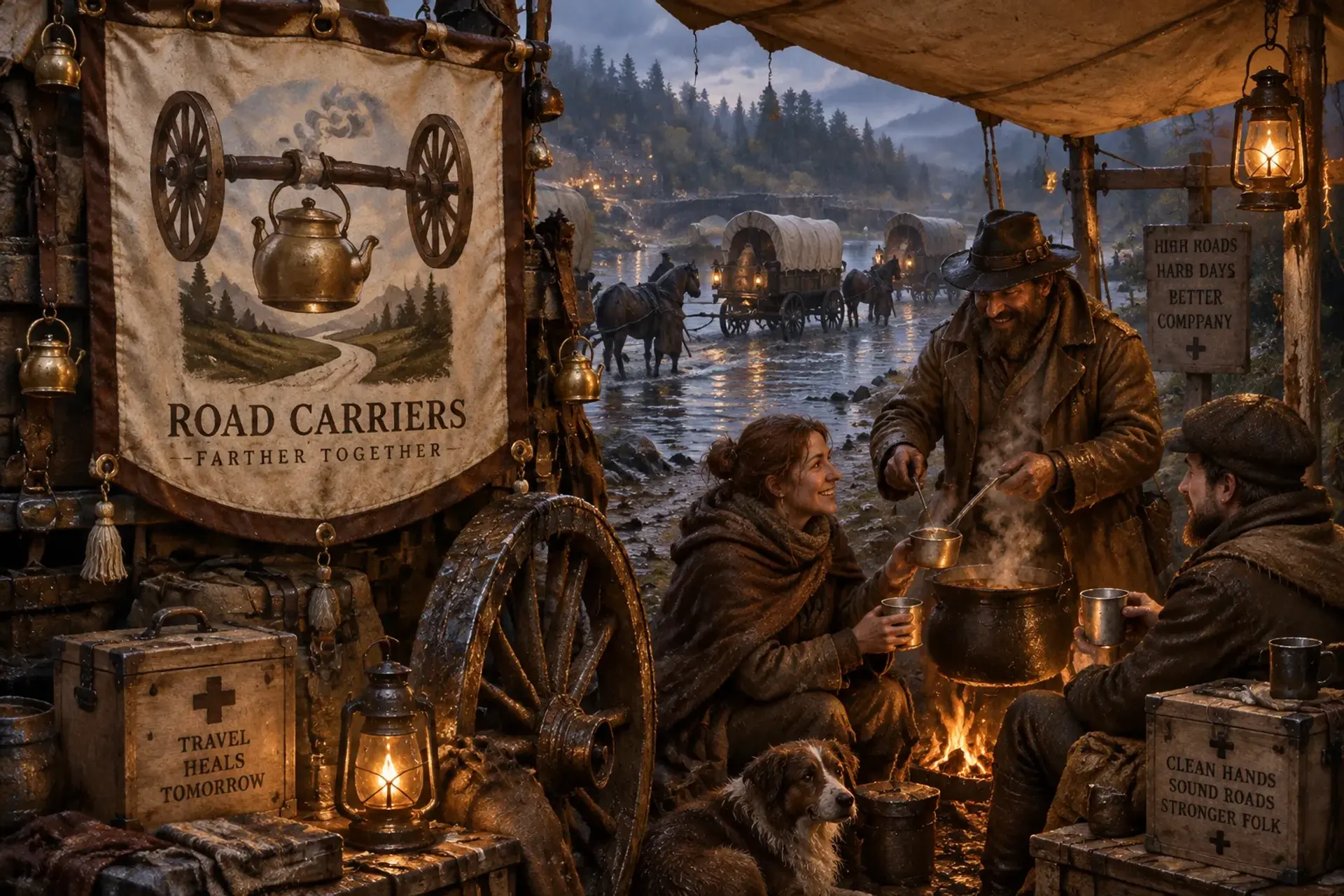
The Kettle Road Carriers
The company’s first great success was keeping the north road supplied through the Ashen Fever winter, when its crews moved food and medicine through flooded crossings and brought isolated families to safer ground. Its first serious setback came a decade later, when an unrecorded passenger transfer carried a contagious transformation into a market town. The carriers lost wagons, members, and public trust. The Lantern Wardens imposed strict escort and manifest rules afterward, and the company accepted them to preserve access to the roads. The watershed moment came at the Silt Ford Standstill, when a Warden commander ordered a wagon train to leave behind a group of quarantined travelers during a rising flood. The lead driver refused, turned the wagons into a floating causeway, and carried the travelers across under Warden escort. The Wardens later denied that any rule had been broken; the carriers recorded the rescue in their private route book. Since then, the company has maintained a double identity: a dependable supplier whose ledgers meet official scrutiny, and a discreet network that sometimes moves people when formal systems will not. Today it is large enough to bargain with authorities but still depends on each driver’s judgment at the roadside.
The Kettle Road Carriers
- Type
- Road-carrier mutual-aid…
- Size
- 114 members
- Reach
- Regional influence over…
- Base
- Rill Ford, a settlement named for the shallow runnel that crosses its stony approach road.
Overview
The company’s first great success was keeping the north road supplied through the Ashen Fever winter, when its crews moved food and medicine through flooded crossings and brought isolated families to safer ground. Its first serious setback came a decade later, when an unrecorded passenger transfer carried a contagious transformation into a market town. The carriers lost wagons, members, and public trust. The Lantern Wardens imposed strict escort and manifest rules afterward, and the company accepted them to preserve access to the roads. The watershed moment came at the Silt Ford Standstill, when a Warden commander ordered a wagon train to leave behind a group of quarantined travelers during a rising flood. The lead driver refused, turned the wagons into a floating causeway, and carried the travelers across under Warden escort. The Wardens later denied that any rule had been broken; the carriers recorded the rescue in their private route book. Since then, the company has maintained a double identity: a dependable supplier whose ledgers meet official scrutiny, and a discreet network that sometimes moves people when formal systems will not. Today it is large enough to bargain with authorities but still depends on each driver’s judgment at the roadside.
How it began
The Kettle Road Carriers began during the Ashen Fever winter, when ordinary freight companies stopped taking the flooded north road. A handful of mule drivers and wagon cooks pooled their last lamp oil and medicine, then made repeated trips between stranded settlements. Their first leader, a driver remembered only as the Kettle Widow, heated a dented cooking kettle over wagon coals to sterilize bandages and melt snow for the sick. After the road’s watch posts failed, her crews began carrying people out of sealed villages as well as supplies into them. The company took its name from the kettle hung beneath the lead wagon, a practical signal that there was still hot water and a place to sit. In its early years it was little more than a shared fund and a route roster. When the Lantern Wardens formed as a mobile lawkeeping and transformation-containment force, they needed escorted supply wagons. The carriers needed armed protection. The bargain that followed made them indispensable, and also gave them access to the people the Wardens had confined.
How to know them
Tar brown, Dull brass, Wagon-cloth cream
- A small brass kettle token hung from a driver’s belt or harness.
- A steaming kettle painted beneath the lead wagon’s axle.
- A strip of cream wagon cloth tied to a safe roadside post to signal that water, heat, or a message can be found nearby.
Standing
What they say they want
What they are doing now
Where it leads
A network of roads where a stranded traveler can find food, heat, and a fair hearing, and where no single authority can make an entire region unreachable by closing one gate.
How others see them
To isolated settlements, they are the people who arrive with oil, medicine, and a hot cup when other traders turn back. Officials consider them useful but frustratingly independent. The Lantern Wardens regard them as dependable partners whose discretion must be watched. Wealthier merchants often call them unprofessional because they sometimes prioritize a passenger or emergency delivery over a profitable contract.
People
5 ranks
Road Speaker
Patient, dryly humorous, and practical. She gives opponents room to speak, then asks who will bear the cost if they are wrong.
- Road Speaker1 member
Elected from the route captains for a two-year term. Represents the company to the Wardens and settlements, settles disputes, and can authorize emergency departures. Major policy still requires a vote of the route captains.
- Route Captains7 members
Each oversees a route, assigns wagons and drivers, negotiates escort arrangements, and reports losses. They form the company’s decision council and can overrule the Road Speaker with five votes.
- Kettle Keepers19 members
Senior cooks, medics, mechanics, and dispatchers who maintain supplies, keep route knowledge, and decide which urgent requests receive scarce cargo. Their practical expertise gives them influence beyond their formal rank.
- Road Hands64 members
Drivers, guards, teamsters, repairers, and regular couriers. They may carry company tokens, vote on local route matters, and refuse an unsafe assignment without losing their membership.
- Layover Kin28 members
Seasonal drivers, cooks, stable workers, and trusted local contacts. They are not full members, but can earn membership through service and a vote by their route crew.
Other key members
- Tarek at Rill Ford Route Captain of the northern crossings; Hana’s most influential critic.
- Kaisa Senior Kettle Keeper responsible for medicine and manifests; a likely successor to Hana.
- Goro Road Hand and clandestine passenger broker; a potential whistleblower or successor.
How they are organised
- Complete a season of service with a route crew, including at least one difficult crossing.
- Contribute a practical skill such as driving, cooking, repair, medicine, guarding, or route knowledge.
- Swear to protect cargo and passengers from theft, abandonment, and needless cruelty, while acknowledging that a crew may refuse an unsafe load.
- Receive approval from the crew and one Kettle Keeper; a full council vote is required for anyone seeking access to restricted route records.
Relations
8 factionsThe Lantern Wardens depend on the carriers to move medicine, lamp oil, food, and quarantined people through crossings too dangerous for ordinary traffic. The carriers depend on Warden escorts when roads are threatened by violence or transformation outbreaks. Neither side trusts the other completely, but both know the routes would become deadlier without this arrangement.
Operations
What they do
How they do it
Services for hire
- Road PassageNegotiated in coin, goods, or labor; urgent trips cost more.Transport for cargo and passengers along established routes, with safer scheduling when a Lantern Warden escort is available.
- Kettle ShareMedicine, fuel, or future work of comparable value.A small emergency allotment of basic medicine, lamp oil, dry food, and bandaging for travelers or isolated households.
- Quiet TransferA service owed to a route crew or a carefully verified favor.A discreet message, passenger handoff, or emergency ride for someone unable or unwilling to use official channels. Availability depends on risk and the judgment of the crew.
What they can do
What they have
Where they are weak
Territory
Headquarters
Rill Ford, a settlement named for the shallow runnel that crosses its stony approach road.A sprawling wagon yard built around a long, low stable and a covered cooking shed. The kettle emblem hangs from the entrance beam. The place is deliberately plain: visitors see harness racks, ledgers, wheels, and a public soup pot, while the private passenger rooms are concealed behind repair bays. Most authority is exercised around a scarred table where drivers can arrive, argue, and leave without ceremony.
Lands they hold
Outposts
- Rill Ford YardAt the north approach to Rill Ford, beside the shallow runnel and a line of hitching posts.Headquarters, repairs, dispatch, public meals, and private passenger transfers.
- Grey Heron StandA narrow gravel rise above a stretch of flood-prone road.Stores dry food and oil, watches the road, and shelters drivers waiting for water to fall.
- Kestrel Bend ShedAt a stony bend where the route leaves the open plain for a wooded cut.Holds spare wheels, harness, and a small medicine cache; also serves as a handoff point for messages.
Secrets
Plot hooks
5 hooks- 1The List Beneath the KettlePersonal to localReward: A trusted introduction, discreet transport, or access to a carrier safe stopA newly hired driver asks the characters to deliver a sealed kettle wrapped in oilcloth. The package contains a list of quarantined people due to be moved that night, but the driver insists the list is not hers and cannot say who gave it to her.
- 2Missing at the CrossingLocal investigation with faction consequencesReward: Payment, recovered medicine, and influence with either the Wardens or the carriersA medicine wagon has vanished between two Warden checkpoints. The Wardens demand the carriers’ route book, while Tarek asks the characters to find the wagon before an official search uncovers a hidden passenger. Evidence may point to the Black Sedge Brokers, a frightened Warden, or an inside job.
- 3One Seat LeftHigh-stakes moral choiceReward: Safe passage, a lasting ally, or evidence that changes quarantine policyThe Wardens declare a village closed after reports of transformation. Hana asks the characters to carry lamp oil and medicine to the cordon, while Goro asks them to smuggle out a child whose family says the symptoms are being misread. The child may be harmless, dangerous, or both.
- 4The Burned PagesRegional intrigueReward: Leverage over the company, protection for named people, or a dangerous truth about past outbreaksKaisa discovers that someone has altered the private route book. The missing pages identify former passengers, several of whom now hold respected positions in distant communities. The characters must discover who took them and decide whether to restore, destroy, or expose the records.
- 5Dark RoadsCampaign-scale investigation and negotiationReward: A reopened route, major faction standing, or control over a vital supply chainA series of crossings fail just as the region faces a shortage of lamp oil. The carriers suspect the Black Sedge Brokers; the Wardens suspect sabotage by the company. The party can trace the theft, negotiate a new supply route, or uncover a deliberate effort to force both factions into conflict.
Work they offer
What gets in the way
Rumours
Media
0 imagesNo images yet.
Turn The Kettle Road Carriers into a sheet
A high-res, share-ready sheet you can post or print.